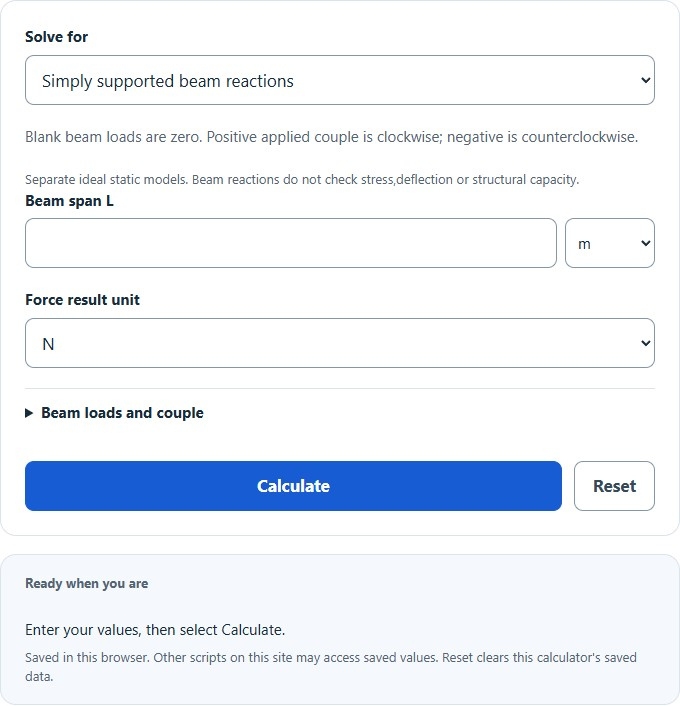
Choose simply supported beam reactions or incline normal force. Beam mode includes a point load, full-span uniform load and signed couple; incline mode includes weight components, friction limits and perpendicular push/pull effects.
- All Physics Calculators
- Average Force Calculator
- Resultant Force Calculator
- Reaction Distance Calculator
Reaction Force Formula
Beam mode: for downward point load P at distance a from the left support, full-span uniform load w and clockwise-positive couple M, RB = P(a/L) + wL/2 + M/L and RA = P + wL − RB. A negative reaction requires hold-down restraint; this is equilibrium only, not a strength or deflection check.
The following formula is used to calculate a reaction force acting on an object on an incline.
- Where F is the force
- m is the mass
- g is the acceleration due to gravity (9.81 m/s^2)
- x is the angle between the ground and the incline surface
To calculate a reaction force, multiply the mass by the acceleration due to gravity, then multiply by the cosine of the angle of incline.
Reaction Force Definition
Newton’s third-law partners are equal and opposite forces acting on different bodies. A support’s normal force and an object’s weight act on the same body, so they are not a third-law pair. The normal’s partner is the object’s contact force on the support.
Example Problem
How to calculate a reaction force of an inclined plane?
- First, determine the mass of the object.
Measure the mass of an object using an accurate scale, or calculate it through volume and density. For this example, the mass is found to be 50 kg.
- Next, determine the angle of the inclined plane.
It's important to note that in this example problem the reaction force is the normal force acting on the object and not the friction force (assumed frictionless). The angle is found to be 50 degrees.
- Finally, calculate the reaction force.
Calculate the reaction force using the formula F = m*g*cos(x) = 50*9.81*cos(50) = 315.287 N.
FAQ
What is an example of a reaction force?
While there is technically an infinite number of reaction forces, the most common reaction force considered is the normal force. A normal force is the perpendicular contact force exerted by a supporting surface. It depends on contact, other perpendicular loads and acceleration; it is not always equal to weight. With an added force Faway perpendicular away from a stationary incline, N = mg cos(x) − Faway while contact persists. A negative requirement means contact loss on a nonadhesive surface. A static coefficient gives only a maximum friction μsN, whereas μkN models sliding-friction magnitude.
What is an action-reaction force?
An action-reaction force is the combination of two equal but opposite forces acting on two different objects. That is, one object exerts a force on another, such as a person pushing a wall, and the wall reacts by exerting the same force on the person.