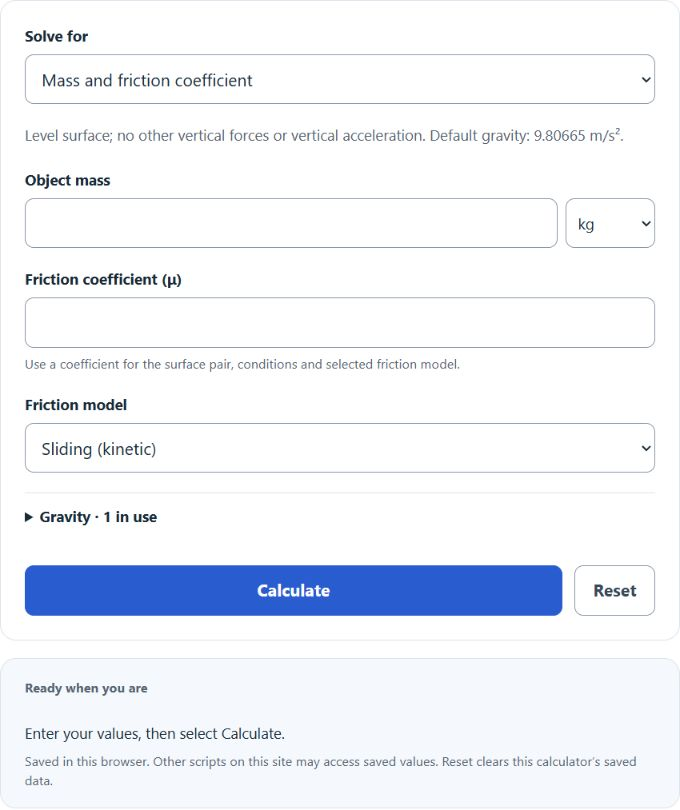
Calculate contact force from mass and friction, normal force and friction, or two blocks pushed on a frictionless surface with unit conversions.
- All Physics Calculators
- Coefficient of Friction Calculator
- Horizontal Vertical Force Calculator
- Inclined Plane Force Calculator
- Tractive Force Calculator
- Applied Force Calculator
- Resultant Force Calculator
- Net Force Calculator
Contact Force Formula
The calculator uses three formulas, one for each mode.
Mass + friction mode. The surface contact force is the resultant of the normal force and the friction force.
Normal + friction mode. If you already know both component forces, combine them as perpendicular vectors.
Two blocks mode. For two blocks pushed together on a frictionless horizontal surface, the contact force between them equals the mass of the non-pushed block times the system acceleration.
- F_c = contact force (N)
- m = object mass (kg)
- g = gravitational acceleration (9.80665 m/s² by default)
- μ = coefficient of friction (dimensionless)
- N = normal force (N)
- f = friction force (N)
- F_applied = push force on the block pair (N)
- m_A, m_B = masses of block A and block B (kg)
- m_other = mass of the block that is not directly pushed
The first mode assumes a level surface with no other vertical forces or vertical acceleration, so N = mg. Choose sliding friction (f = μkN) or impending slip (maximum static friction = μsN). Actual static friction can be smaller, including zero. The second mode skips that step when you already have force values from a free-body diagram. The third mode handles the classic textbook problem where two blocks travel together and you want the internal pushing force at their interface.
Reference Values
The force conversions below are rounded. Friction coefficients depend on the surface pair, conditions and friction model; use measured or applicable reference values.
Static friction satisfies 0 ≤ f ≤ μsN; μsN is its maximum. Sliding friction is modeled as f = μkN. A single coefficient cannot represent all material conditions.
| From | To | Multiply by |
|---|---|---|
| N | lbf | 0.2248 |
| N | kgf | 0.1020 |
| kN | N | 1000 |
| lbf | N | 4.4482 |
Worked Example and FAQ
Example. A 12 kg crate slides on a level floor with an assumed kinetic coefficient μ = 0.30 and no other vertical forces. The normal force is N = 12 × 9.80665 = 117.68 N. The friction force is f = 0.30 × 117.68 = 35.30 N. The contact force is √(117.68² + 35.30²) = 122.86 N, tilted about 16.7° from the vertical normal direction.
Is contact force the same as normal force? No. The normal force is only the perpendicular component. The contact force is the full reaction at the surface, which includes friction acting along the surface.
What if there is no friction? Then f = 0 and the contact force equals the normal force.
Why does the two-block answer not depend on which block is heavier in the same way? The contact force always equals the mass being pushed through the interface times the shared acceleration. Pushing the lighter block transmits a larger contact force than pushing the heavier block with the same applied force.
Can contact force exceed the applied force? Not in the two-block case on a frictionless surface. The contact force is always a fraction of the applied force, equal to m_other / (m_A + m_B).