Calculate cone slant height, height, or base diameter from any two values using the Pythagorean theorem in inches, feet, cm, or m and solve the missing measurement.
- All Math and Numbers Calculators
- Percent Slope Calculator
- Slope Calculator
- Angle of Elevation Calculator
- Ramp Slope Calculator
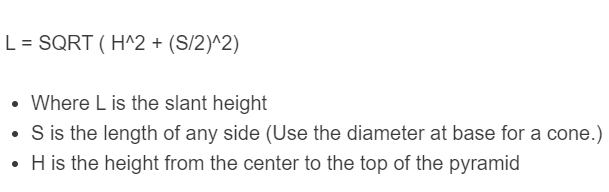
Slant Height Formula
The slant height is the distance measured along the face of a right square pyramid or along the curved side of a right circular cone from the apex to the base edge. This calculator uses the vertical height and the base width to find that surface distance.
- L = slant height
- H = perpendicular height from the center of the base to the apex
- S = base side length for a square pyramid, or base diameter for a cone
The formula comes directly from the Pythagorean theorem because the vertical height and half of the base width form a right triangle with the slant height as the hypotenuse. Inputs may use different supported units; the result uses the selected result unit.
Rearranged Forms
If you already know the slant height, the same relationship can be rearranged to solve for the missing height or base width.
How to Use the Calculator
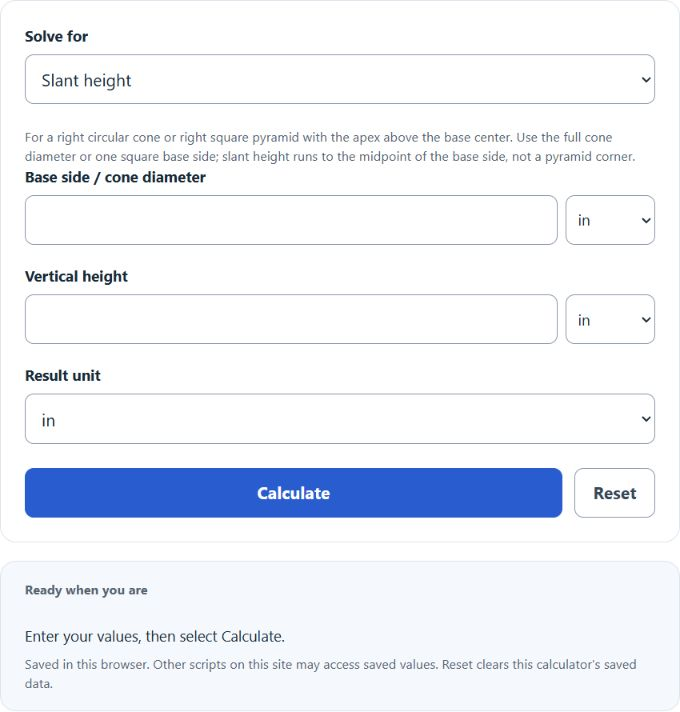
- Enter the side length if you are working with a right square pyramid, or the diameter if you are working with a cone.
- Enter the vertical height measured from the center of the base to the apex.
- Click calculate to find the slant height.
- If you know any two of the three values, the calculator can solve for the third.
What Each Measurement Means
| Quantity | Description | How to Measure It |
|---|---|---|
| Slant Height | Surface distance from apex to base edge | Measure along the face of the pyramid or along the cone’s side |
| Height | Vertical, perpendicular distance from base center to apex | Measure straight up through the center, not along the side |
| Side Length / Diameter | Base width used in the right-triangle setup | Use one base side for a square pyramid or the full diameter for a cone |
Example Calculations
Square pyramid: if the base side length is 10 ft and the vertical height is 12 ft, then the slant height is:
The slant height is 13 ft.
Cone: if the diameter is 8 m and the height is 15 m, then the slant height is:
This gives a slant height of approximately 15.52 m.
Why Slant Height Matters
Slant height is used in surface area calculations because the lateral faces of these solids depend on the true distance along the side, not just the vertical height.
Right circular cone lateral area
Right circular cone total surface area
Right square pyramid lateral area
Right square pyramid total surface area
In these formulas, r is the cone radius and a is the square base side length.
Common Mistakes
- Using radius instead of diameter for cones: this calculator uses the cone’s diameter as the base width input.
- Confusing slant height with vertical height: vertical height goes straight up; slant height follows the surface.
- Confusing slant height with a pyramid edge: the edge from the apex to a corner is not the same as the slant height, which runs to the midpoint of a side.
- Mixing units: select the correct unit beside each input; the calculator converts them before calculating.
- Using the formula for a non-right shape: this relationship applies to right cones and right square pyramids where the apex is centered above the base.
Frequently Asked Questions
Is slant height the same as height?
No. Height is the perpendicular distance from the base center to the apex, while slant height is the distance along the side surface.
Does the calculator work for cones and pyramids?
Yes. For a cone, enter the base diameter. For a right square pyramid, enter one base side length.
What unit will the answer be in?
Choose inches, feet, centimeters or meters in the Result unit selector. Input units are converted automatically.
Can I solve for height instead of slant height?
Yes. If you know the slant height and base width, the calculator can rearrange the relationship and solve for the vertical height.