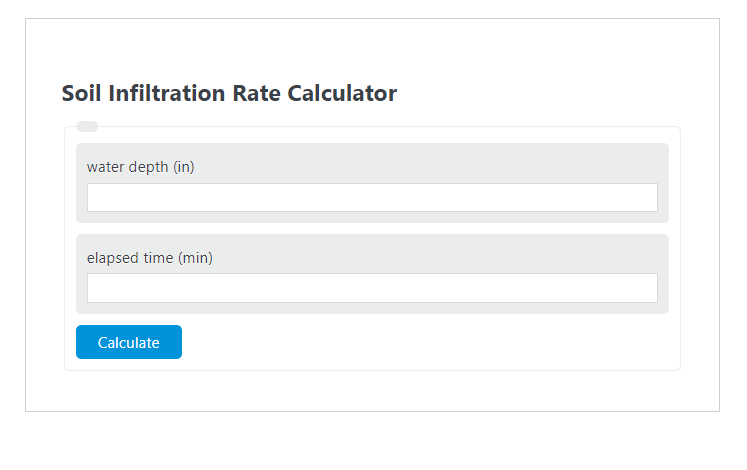
Calculate soil infiltration rate, infiltrated depth, or elapsed time with mm, cm, and inch units, plus drain-time, rainfall comparison, rate categories, and steps.
- All Construction Calculators
- All Rate Calculators
- Soil Calculator
- Soil Stockpile Volume Calculator
- Void Ratio Calculator
- Saturated Unit Weight Of Soil Calculator
Soil Infiltration Rate Formula
The soil infiltration rate describes how quickly water enters the soil over a measured period of time. This value is useful in irrigation planning, drainage evaluation, stormwater design, runoff estimation, and field testing of soil performance.
- SIR = soil infiltration rate
- WD = water depth infiltrated during the test interval
- T = elapsed time
If you know any two values, you can rearrange the equation to solve for the third:
How to Use the Calculator
- Enter the water depth that infiltrated into the soil during the test.
- Enter the elapsed time for that measurement.
- Select the proper units for each field.
- The calculator returns the soil infiltration rate in depth per unit time.
- If solving for water depth or time instead, enter the other two values and let the calculator compute the missing variable.
The result is always a rate, so the units will be a depth unit divided by a time unit, such as inches per minute, feet per hour, centimeters per second, or meters per hour.
What the Result Means
A higher infiltration rate means the soil accepts water more quickly. A lower infiltration rate means water enters the soil more slowly, which can increase surface ponding and runoff if water is applied faster than the soil can absorb it.
| Observed Rate | General Interpretation |
|---|---|
| Low | Water enters slowly; runoff, crusting, or compaction may be more important concerns. |
| Moderate | Water enters at a balanced pace; often suitable for many irrigation and drainage conditions. |
| High | Water enters quickly; surface runoff is reduced, but water may move downward rapidly. |
Examples
If 5 inches of water infiltrate over 30 minutes, the infiltration rate is:
If the infiltration rate is 0.25 in/min for 12 minutes, the infiltrated water depth is:
If 4 inches of water infiltrate and the measured infiltration rate is 0.2 in/min, the time required is:
How Soil Infiltration Is Measured in Practice
In field testing, infiltration rate is often estimated from the drop in water level over a timed interval. The key value is the amount of water that actually entered the soil during the test window, not simply the initial amount of water placed on the surface.
- Measure the water depth lost to infiltration during a known time interval.
- Keep units consistent when entering values.
- Repeat tests at multiple locations if the site is variable.
- Note that early-time infiltration is often faster than later-time infiltration.
Factors That Affect Soil Infiltration Rate
| Factor | Typical Effect on Infiltration |
|---|---|
| Soil texture | Coarser soils usually infiltrate faster than finer soils. |
| Compaction | Compacted soil reduces pore space and typically lowers infiltration. |
| Soil structure | Stable aggregates and connected pores usually improve water entry. |
| Organic matter | Higher organic matter often supports better aggregation and pore continuity. |
| Initial moisture | Dry soil may absorb water faster at first; wet soil may infiltrate more slowly. |
| Vegetation and roots | Roots and biological activity can create channels that increase infiltration. |
| Surface sealing or crusting | A sealed surface can sharply reduce the rate of water entry. |
| Macropores and cracks | Large channels can cause very rapid localized infiltration. |
Common Mistakes
- Using the total water applied instead of the depth that infiltrated during the measured interval.
- Mixing units without converting them properly.
- Comparing results from tests run under very different moisture conditions.
- Assuming one short test represents long-term soil behavior everywhere on the site.
Why This Calculation Matters
Knowing the soil infiltration rate helps determine how quickly water can move from the surface into the ground. That makes it valuable for selecting irrigation application rates, estimating runoff potential, assessing drainage performance, and comparing different soils or site conditions with a simple and consistent metric.
Additional Notes
A high infiltration rate is not automatically better in every situation, and a low rate is not always a failure condition. The best rate depends on the goal of the site, such as supporting plant growth, limiting runoff, storing water near roots, or moving water downward for drainage. Use the calculator as a quick way to quantify the rate, then interpret the result in the context of the soil, land use, and test conditions.