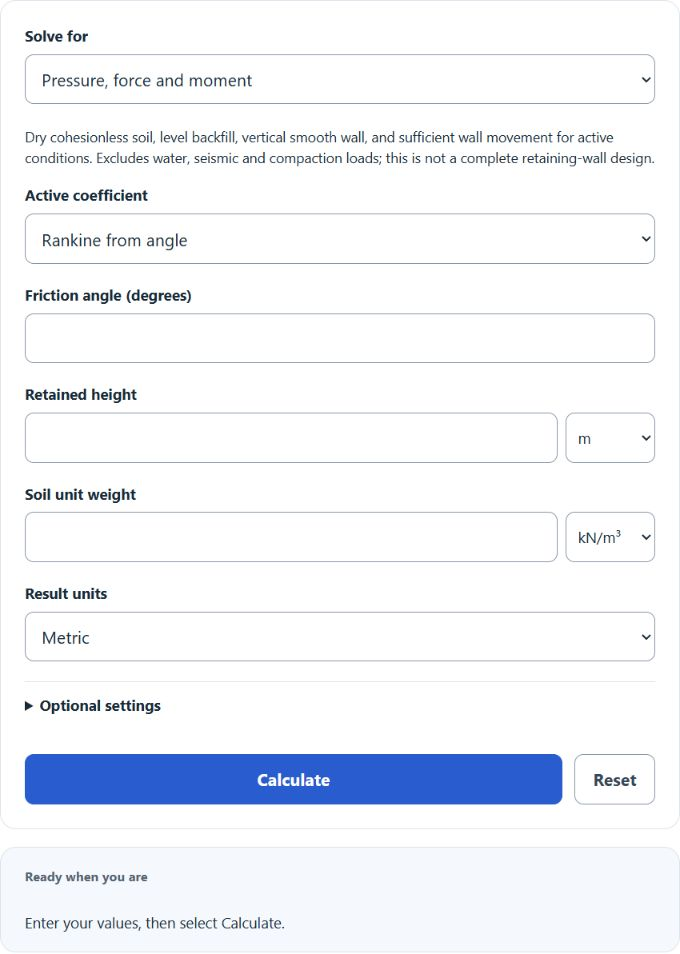
Calculate Rankine active pressure, soil and surcharge forces, overturning moment, and resultant location, or reverse-solve retaining height in metric or imperial units.
- All Construction Calculators
- Soil Calculator
- Active Earth Pressure Calculator
- Earth Pressure Coefficient Calculator
- Passive Pressure Coefficient Calculator
- Angle of Internal Friction Calculator
- SPT to Bearing Capacity Calculator
- Overburden Pressure Calculator
Active Soil Pressure Formula
The active soil pressure calculation uses the active earth pressure coefficient, soil unit weight, and wall height or depth. If you enter the friction angle instead of Ka, the calculator first estimates Ka using the Rankine formula for level backfill and a vertical wall with no wall friction.
- Ka = active earth pressure coefficient
- phi = soil internal friction angle, in degrees
- gamma = soil unit weight, in kN/m³ or lb/ft³
- H = depth or retaining wall height, in m or ft
- q = uniform surface surcharge, in kPa or psf; blank means zero
- pa = soil pressure at depth H; add Kaq for combined base pressure
- Pa = total active force per unit length of wall, in kN/m or lb/ft
- y = line of action of the resultant force above the base
If you choose the Ka input mode, the entered coefficient is used directly. If you choose the friction angle φ input mode, Ka is calculated first, then used in the pressure and force equations. The pressure result is the lateral pressure at the bottom of the entered depth. The soil-force component is the triangular pressure diagram and acts at H/3. Uniform surcharge adds KaqH at H/2. The combined resultant height is the sum of the component base moments divided by total force. Reverse solving gives the height for the target force; it does not determine safe wall height.
Illustrative Soil Input Ranges and Active Coefficients
These ranges are illustrative assumptions, not recommended design values or verified site properties. Moisture, grading and compaction affect soil parameters; use site-specific geotechnical data for design.
| Soil type | Illustrative unit weight, γ | Illustrative friction angle, φ | Approx. Ka |
|---|---|---|---|
| Loose sand | 15 to 17 kN/m³, 95 to 110 lb/ft³ | 28° to 30° | 0.33 to 0.36 |
| Medium dense sand | 17 to 19 kN/m³, 105 to 120 lb/ft³ | 32° to 35° | 0.27 to 0.31 |
| Dense sand or gravel | 19 to 22 kN/m³, 120 to 140 lb/ft³ | 36° to 40° | 0.22 to 0.26 |
| Silty sand | 17 to 20 kN/m³, 105 to 125 lb/ft³ | 28° to 34° | 0.28 to 0.36 |
Result Interpretation
| Result | Meaning | Common use |
|---|---|---|
| Ka | Multiplier that converts vertical overburden pressure into active lateral pressure | Checking assumed soil pressure conditions |
| Active pressure at depth H | Maximum lateral pressure at the bottom of the wall or entered depth | Pressure diagram and local wall checks |
| Total active force over H | Resultant lateral force per unit length of wall | Sliding, overturning, and bearing checks |
| Line of action | Moment-weighted location of the soil-plus-surcharge resultant | Moment calculations about the wall base |
Example Problems
Example 1: Metric calculation using Ka
Suppose Ka = 0.3333, γ = 18 kN/m³, H = 3 m, and q = 0.
Active pressure at depth H:
Total active force:
Line of action:
Example 2: Imperial calculation using friction angle
Suppose φ = 30°, γ = 120 lbf/ft³, H = 10 ft, and q = 0.
First calculate Ka:
Active pressure at depth H:
Total active force:
Line of action:
FAQ
What assumptions are used for Ka from the friction angle?
When you enter φ, the calculator uses the Rankine active earth pressure equation. This assumes a simple active pressure case, usually treated as a vertical wall with level backfill, cohesionless soil, and no wall friction. Uniform surface surcharge is included when entered. Sloping backfill, wall friction, groundwater, compaction loads, seismic loads and cohesive soil behavior require separate models.
Why is the total active force one-half of KaγH²?
For dry cohesionless soil with no surcharge, lateral pressure increases linearly with depth. It is zero at the surface and reaches KaγH at the base. The pressure diagram is triangular, so the resultant force equals the area of that triangle: one-half times the base pressure times the wall height.
Where does the active force act on the wall?
For the triangular pressure distribution used here, the resultant active force acts at H/3 above the base of the wall. This location is used when calculating overturning moment. If the pressure diagram is not triangular, such as when surcharge or water pressure is included, the line of action may be different.