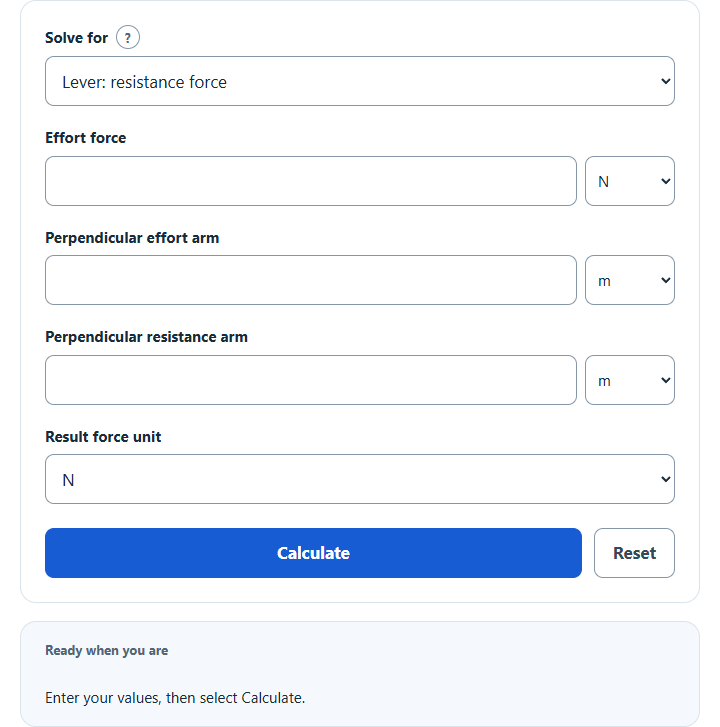
Calculate resistance force on a lever from effort force and arm lengths, or resistive force from friction, fluid drag or rolling resistance.
- All Physics Calculators
- All Force Calculators
- Lever Force Calculator
- Effort Force Calculator
- AMA (Actual Mechanical Advantage) Calculator
- Average Resistive Force Calculator
Resistance Force Formula
The following equation gives the resistance force for an ideal lever in static equilibrium. D1 and D2 are perpendicular moment arms; end-to-pivot lengths apply only when the forces act perpendicular to the lever.
- Where Fr is the resistance force (N)
- EF is the effort force (N)
- D1 is the perpendicular effort moment arm from the fulcrum
- D2 is the perpendicular resistance moment arm from the fulcrum
Select the lever value to solve, enter the known forces and positive perpendicular arms, then select Calculate. Friction, drag and rolling modes use separate magnitude models: F=μN (maximum for static friction), D=½ρv²CdA and F=CrrN. For mass-based normal force, N=mg cos θ assumes no other normal forces. Drag coefficients must match their reference area and flow conditions; rolling Crr is dimensionless. Enter measured coefficients rather than relying on unscoped material presets.
What is a Resistance Force?
Definition:
A resistance force, in the case of the formula above, is the force pushing on the end of a lever with given effort force, such that the moment about the fulcrum/pivot points is equal.
How to Calculate Resistance Force?
Example Problem:
The following example outlines the steps and information needed to calculate the Resistance Force.
First, determine the effort force. For this problem, the effort force is measured to be 50 N.
Next, determine the distance from the effort force to the pivot point. In this case, the perpendicular effort arm is 3 ft.
Next, determine the distance from the pivot point to the resistance. For this problem, the perpendicular resistance arm is 1 ft.
Finally, calculate the resistance force using the formula above:
Fr = EF*D1 / D2
Fr = 50*3/ 1
Fr = 150 N
How do you calculate average resistive force?
For an object of constant mass slowing in a straight line, the distance-averaged magnitude of the net force opposing its motion is Favg,d = m(vi2 − vf2) / (2d). Use mass m in kilograms, initial and final speeds vi and vf in m/s, and travel distance d in meters to obtain newtons. The distance must be positive and vi ≥ vf ≥ 0; for a complete stop, vf = 0.
If the positive slowing time Δt > 0 is known instead, the time-averaged opposing net-force magnitude is Favg,t = m(vi − vf) / Δt, with Δt in seconds. Distance and time averages can differ when the force varies. These are net-force results: they equal a particular friction or drag force only when the remaining forces or their work cancel or have been accounted for separately.