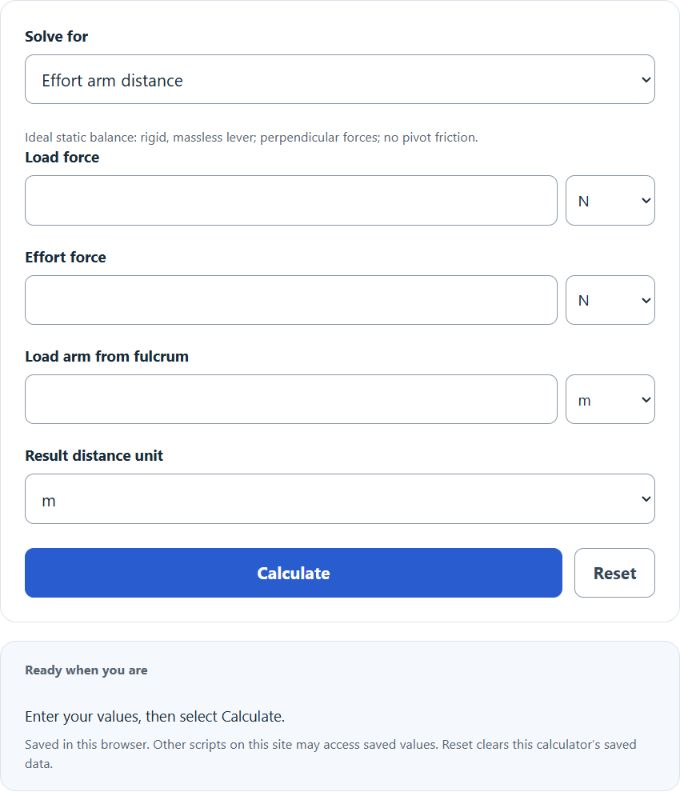
Calculate lever arm distances, fulcrum position, or effort force from load force, lever class, and mechanical advantage for any lever.
- All Physics Calculators
- All Distance Calculators
- Lever Force Calculator
- Radial Distance Calculator
- Effort Force Calculator
Lever Distance Formula
A lever in static balance follows the law of the lever. The torque from the effort equals the torque from the load.
Rearranged for each unknown the calculator solves:
- F_e = effort force applied by you
- F_l = load force or resistance
- d_e = effort arm, distance from fulcrum to the point where effort is applied
- d_l = load arm, distance from fulcrum to the load
- MA = mechanical advantage (dimensionless ratio)
Assumptions: the lever is rigid and massless, forces act perpendicular to the lever, and the system is in static equilibrium. Friction at the pivot is ignored. All inputs must be positive.
The calculator has three modes that use the same formula:
- Find distance: you know both forces and one arm. It returns the other arm using d = (F_known * d_known) / F_other.
- Fulcrum: you know the total lever length L and either the two forces or the target MA. For Class I, d_l = L / (MA + 1) and d_e = L - d_l. For Class II, d_e = L and d_l = L / MA. For Class III, d_l = L and d_e = MA * L.
- Effort force: you know the load and both arms. It returns F_e = (F_l * d_l) / d_e.
Reference Tables
Use these to sanity check inputs and interpret results.
| Lever class | Arrangement | Typical MA | Examples |
|---|---|---|---|
| Class I | Fulcrum between load and effort | Any value | Crowbar, seesaw, scissors |
| Class II | Load between fulcrum and effort | Always > 1 | Wheelbarrow, nutcracker, bottle opener |
| Class III | Effort between fulcrum and load | Always < 1 | Tweezers, fishing rod, human forearm |
| MA value | Effort arm vs load arm | What it means |
|---|---|---|
| 0.5 | Effort arm is half the load arm | Effort needed is twice the load. Trades force for speed. |
| 1 | Equal arms | Effort equals load. No force gain. |
| 2 | Effort arm twice the load arm | Effort is half the load. |
| 5 | Effort arm 5× load arm | Effort is one fifth of the load. |
| 10 | Effort arm 10× load arm | Strong force multiplier. Effort moves 10× the distance the load does. |
Worked Example and FAQ
Example. You want to lift a 600 N load with 150 N of effort. The load sits 0.2 m from the fulcrum. How long must the effort arm be?
Apply d_e = (F_l * d_l) / F_e = (600 * 0.2) / 150 = 0.8 m. The effort arm needs to be 0.8 m, giving an MA of 0.8 / 0.2 = 4.
Why does my Class II result reject the mechanical advantage? In a Class II lever the effort acts at the far end, so the effort arm equals the total length. The load arm must be shorter than the lever. Class II requires MA greater than 1, with the load strictly between the fulcrum and effort. Class III requires MA less than 1, with the effort strictly between the fulcrum and load. Invalid or coincident-point arrangements are rejected. Select the class matching the actual arrangement.
Do the units have to match? No. Each input has its own unit selector. The calculator converts everything to meters and newtons internally, then converts the result to the unit you pick.
What if the forces are not perpendicular to the lever? The formula assumes perpendicular forces. If your force is at an angle θ to the lever, multiply that force by sin(θ) before entering it, or use the perpendicular component directly.
Can MA be less than 1? Yes. Class III levers always have MA below 1. You apply more force than the load, but the load moves farther and faster than your hand does. That trade-off is useful for tools like tweezers and tongs.
How is mechanical advantage related to distance traveled? Energy in equals energy out for an ideal lever. If MA is 4, the effort moves 4 times as far as the load. Force gain costs travel distance in equal proportion.