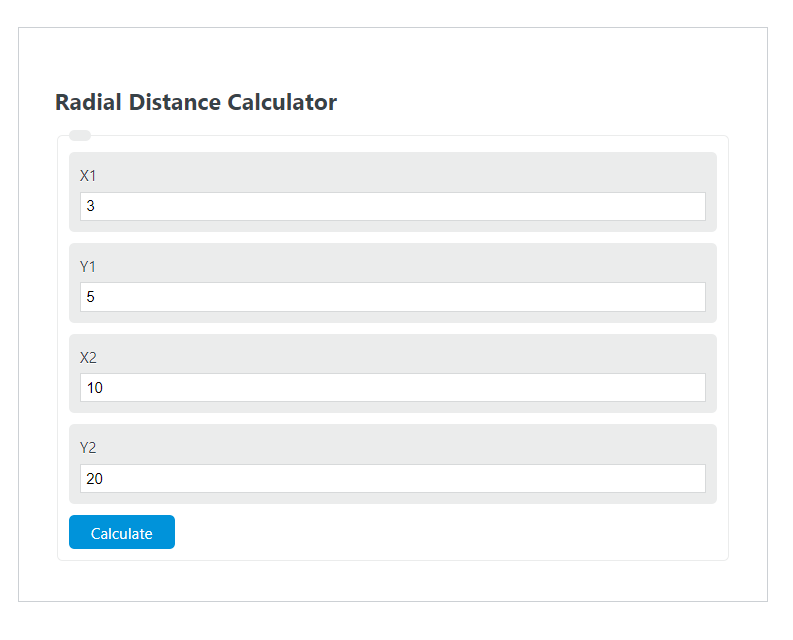
Calculate radial distance r from x, y, and z coordinates or any center point, with polar, spherical, and cylindrical angles plus unit conversion.
- All Math and Numbers Calculators
- Distance from Point to Plane Calculator
- Distance Between Points Calculator
- Euclidean Distance Calculator
- Polar Coordinates Calculator
- Midpoint Calculator
Radial Distance Formula
The calculator uses one of three formulas depending on the mode you select.
From origin (2D):
Between two points (2D):
3D radius from origin:
- r — radial distance from the origin in 2D
- d — straight-line distance between two points
- ρ — radial distance from the origin in 3D
- x, y, z — Cartesian coordinates
- x1, y1, x2, y2 — coordinates of the two points
All inputs must use the same unit. The result comes out in that same unit. Radial distance is always non-negative. If a point sits at the origin, the direction angle is undefined.
Reference Tables
Quick checks for common coordinates and the matching radial distance.
| Point (x, y) | r = √(x² + y²) | Angle θ |
|---|---|---|
| (3, 4) | 5 | 53.13° |
| (1, 1) | 1.4142 | 45° |
| (5, 12) | 13 | 67.38° |
| (8, 15) | 17 | 61.93° |
| (-6, 8) | 10 | 126.87° |
| (0, 7) | 7 | 90° |
Unit conversion factors for translating a calculated radial distance.
| From | To meters | To feet |
|---|---|---|
| 1 mm | 0.001 | 0.00328 |
| 1 cm | 0.01 | 0.0328 |
| 1 in | 0.0254 | 0.0833 |
| 1 ft | 0.3048 | 1 |
| 1 yd | 0.9144 | 3 |
| 1 mi | 1609.344 | 5280 |
Example and FAQ
Example: Find the radial distance from the origin to the point (9, 12).
r = √(9² + 12²) = √(81 + 144) = √225 = 15. The angle is θ = atan2(12, 9) ≈ 53.13°, so the polar coordinates are (15, 53.13°).
Is radial distance the same as the magnitude of a vector? Yes. For a position vector starting at the origin, the radial distance equals the vector magnitude.
Can radial distance be negative? No. It is a length, so it is always zero or positive. A negative sign in polar form flips the direction, not the distance.
What is the difference between azimuth and elevation in 3D? Azimuth is the angle in the XY plane measured from the positive X-axis. Elevation is the angle of the point above or below the XY plane.
Does the unit affect the answer? Only the label. As long as all coordinates share the same unit, the numerical result is consistent and comes out in that unit.