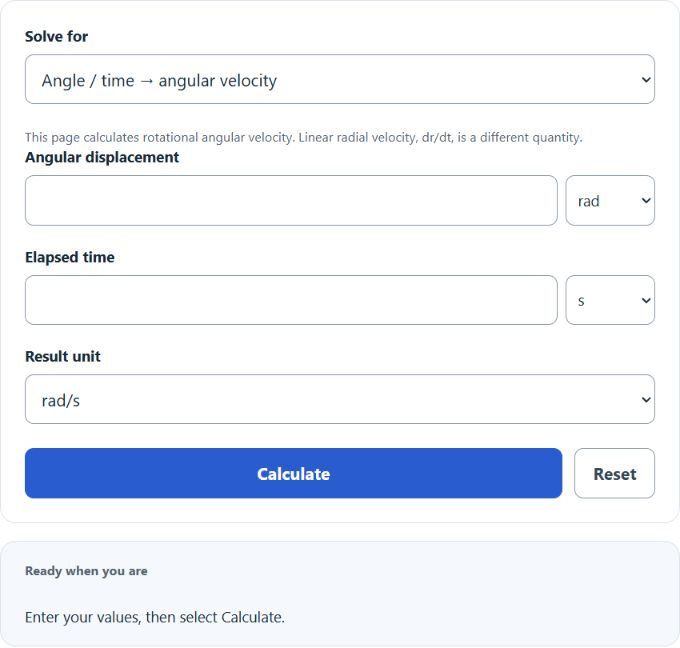
This page retains its rotational angular-velocity calculator: choose the quantity to solve from angle and time, tangential velocity and radius, or frequency and period. Linear radial velocity (dr/dt) is a different calculation.
- All Velocity Calculators
- Tangential Velocity Calculator
- Angular Frequency Calculator
- Angular Velocity To Linear Velocity Calculator
- RPM to Angular Velocity Calculator
- All Physics Calculators
- Radial Distance Calculator
Angular Velocity Formula
The following equation gives average angular velocity over a positive elapsed time.
- Where ω is the angular velocity (rad/s)
- Δθ is the change in angular position (radians)
- Δt is the change in time (s)
Divide signed angular displacement by positive elapsed time. Tangential velocity uses vₜ = rω at a fixed positive radius. For steady rotation, frequency is |ω|/(2π) and period is 2π/|ω|; zero angular velocity has no finite period.
What is Angular Velocity?
Definition:
Angular velocity (ω) is the rate of change of angular position with respect to time, typically measured in radians per second (rad/s). (This is different from linear radial velocity, which is the time rate of change of radial distance, dr/dt, measured in m/s.)
How to Calculate Angular Velocity?
Example Problem:
The following example outlines the steps and information needed to calculate angular velocity.
First, determine the change in angular position. In this example, the change in angular position is found to be 50 radians.
Next, determine the change in time. In this case, the change in time is measured to be 5 seconds.
Finally, calculate the angular velocity using the formula above:
ω = Δθ / Δt
ω = 50 / 5
ω = 10 rad/s