Calculate lever force, torque, mechanical advantage, and arm distances for class I, II, and III levers using force, length, and angle inputs.
Pivot Force Formula
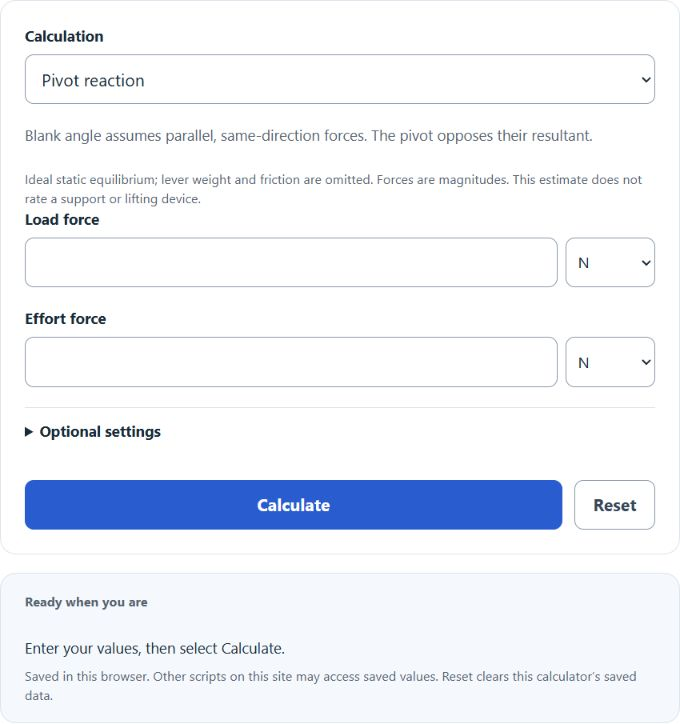
For a lever in static equilibrium with parallel load and effort forces acting in the same direction, the pivot reaction magnitude is:
- Where PF is the pivot force (N)
- LF is the lever force (N)
- EF is the effort force (N)
For same-direction parallel forces, add the load and effort magnitudes. In general, the pivot reaction is the negative vector sum of all applied forces; opposite collinear forces give the absolute difference. Lever weight is omitted here.
What is a Pivot Force?
Definition:
A pivot force is the total force acting at the pivot point of a lever at equilibrium due to the effort and lever forces.
How to Calculate Pivot Force?
Example Problem:
The following example outlines the steps and information needed to calculate Pivot Force.
First, determine the load force. In this example it is 10 N, and the load and effort act in the same direction.
Next, determine the effort force. For this problem, the effort force is found to be 13 N.
Finally, calculate the Pivot Force using the formula above:
PF = LF + EF
PF = 13 + 10
PF = 23 N
FAQ
What is the significance of calculating pivot force in mechanical systems?
Pivot force calculation is crucial in mechanical systems as it helps in designing levers and mechanical systems that are efficient and balanced. By understanding the total force acting at the pivot point, engineers can ensure that the system operates smoothly without undue stress on any part, leading to a longer lifespan and better performance.
Can the pivot force formula be applied to any type of lever?
The vector force balance applies to every lever class. PF = LF + EF applies only when load and effort point in the same direction. For opposite collinear forces use PF = |LF − EF|; angled forces require a vector sum. Static equilibrium also requires balanced moments.
How does the pivot force affect the mechanical advantage of a lever?
Mechanical advantage is the load-force magnitude divided by the effort-force magnitude. For an ideal lever with parallel perpendicular forces, it also equals effort-arm distance divided by load-arm distance. The pivot reaction follows force balance; changing it alone does not determine mechanical advantage.