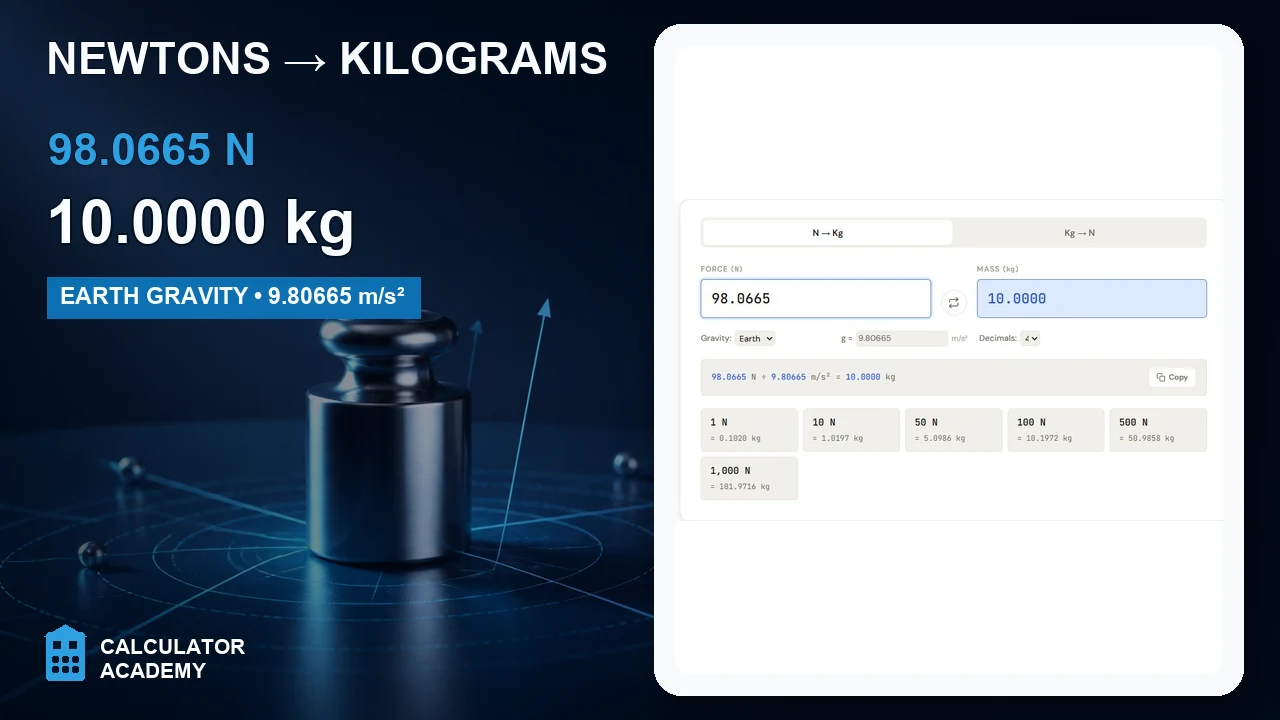
Convert force in newtons (N) to mass in kilograms (kg) instantly. Supports custom gravity for any planet or celestial body.
Enter one value per line. Paste a column of numbers from a spreadsheet or CSV.
| Newtons (N) | Kilograms (kg) |
|---|
Newtons to Kilograms Reference Table
Earth gravity (9.80665 m/s²)| Newtons (N) | Kilograms (kg) | Pounds (lb) | Description |
|---|
How Much Mass Does 100 N Correspond To?
Same force, different gravity| Body | Gravity (m/s²) | Mass (kg) | vs Earth |
|---|
Watch the full Newtons-to-kilograms video explanation
How to Convert Newtons to Kilograms
Newtons and kilograms measure different things: newtons (N) measure force, while kilograms (kg) measure mass. The conversion between them depends on gravitational acceleration. On Earth’s surface, the standard value of gravitational acceleration (g) is 9.80665 m/s².
kg = N ÷ g Where g = 9.80665 m/s² on Earth (standard gravity)
This means dividing any force value in newtons by 9.80665 gives you the equivalent mass in kilograms on Earth. On other planets or celestial bodies, the value of g changes — and so does the resulting mass.
Step-by-Step Example
Convert 500 N to kilograms on Earth:
Understanding Weight vs. Mass
In everyday language, “weight” and “mass” are used interchangeably, but they are different physical quantities. Mass is the amount of matter in an object and stays the same regardless of location. Weight is the force gravity exerts on that mass — it changes depending on where you are.
A 10 kg object always has a mass of 10 kg whether it’s on Earth, the Moon, or floating in space. But its weight (in newtons) changes: about 98.07 N on Earth, 16.25 N on the Moon, and 0 N in free-fall.
When people say they “weigh 70 kg,” they technically mean their mass is 70 kg and their weight is about 686.5 N. This calculator bridges that gap: given a weight force in newtons, it tells you the corresponding mass in kilograms.
When Do You Need This Conversion?
This conversion comes up in physics homework, engineering calculations, material testing, aerospace applications, and everyday situations like reading a spring scale (which measures force in newtons) and wanting the result in kilograms. It’s also used in load and structural calculations where forces need to be expressed as equivalent masses, and vice versa.
The Reverse: Kilograms to Newtons
To go from mass to force, multiply by g instead of dividing:
N = kg × g