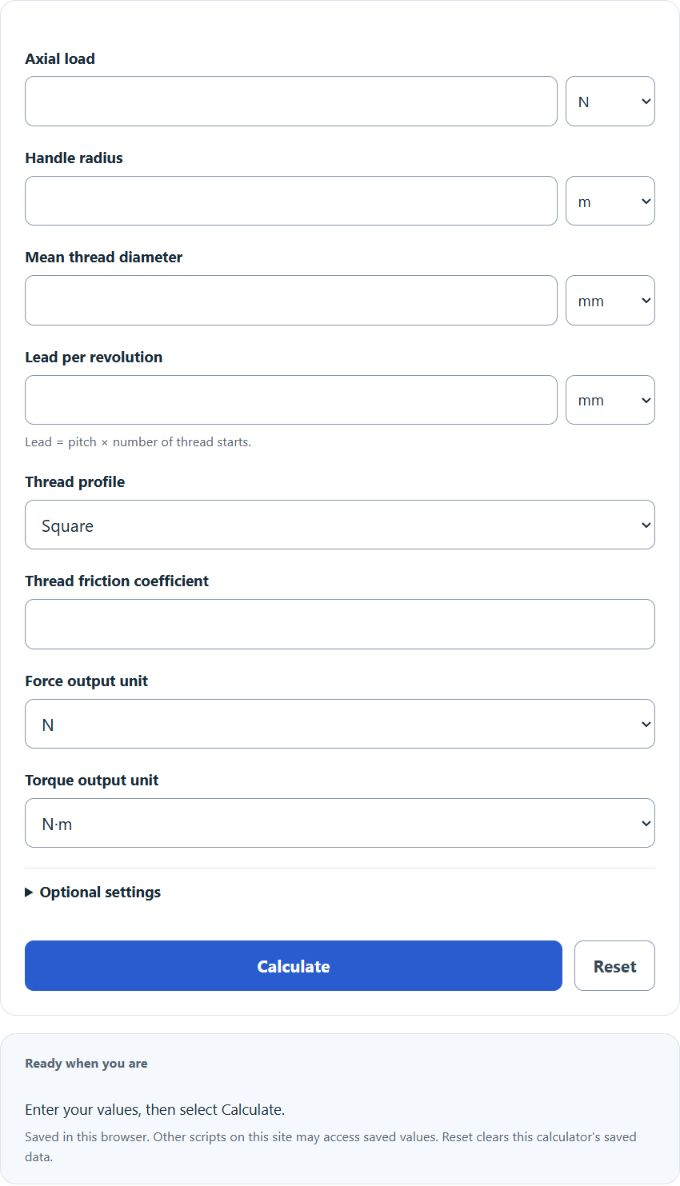
Calculate screw jack torque and handle force to raise or lower a load from screw dimensions, lead, friction, collar data, and handle length.
- All Force Calculators
- All Construction Calculators
- Thread Engagement Length Calculator
- Helix Angle Calculator
- Lead Angle Calculator
- Ball Screw Force Calculator
- Bolt Pull-Out Force Calculator
- Lead Screw Efficiency Calculator
Screw Jack Force Formula
The following equation gives the ideal tangential handle force for a frictionless screw jack. The calculator also includes thread and optional collar friction, so its required raising force can be higher. It estimates steady motion, not safe load capacity or guaranteed self-locking.
- Where Fsj is the handle effort force (lb-f)
- L is the axial load on the screw jack (lb-f)
- p is the lead per revolution (in), equal to pitch for a single-start thread
- R is the lever arm radius (in)
What is a Screw Jack Force?
Definition:
Screw jack handle force is the tangential effort applied at the end of the handle to raise or lower the axial load through the screw mechanism.
How to Calculate Screw Jack Force?
Example Problem:
The following example outlines the steps and information needed to calculate the Screw Jack Force.
First, determine the load reading on the screw jack. In this example, the load on the jack is 4000 lb-f.
Next, determine the lead per revolution. For this frictionless example, the lead is .25 in; it equals pitch for a single-start thread.
Next, determine the lever arm radius. The lever arm is measured to be 7 inches.
Finally, calculate the screw jack force using the formula above:
Fsj = (L * p ) / (2*pi*R)
Fsj = (4000 * .25 ) / (2*3.1415*7)
Fsj = 22.74 lb-f (ideal, ignoring thread and collar friction)