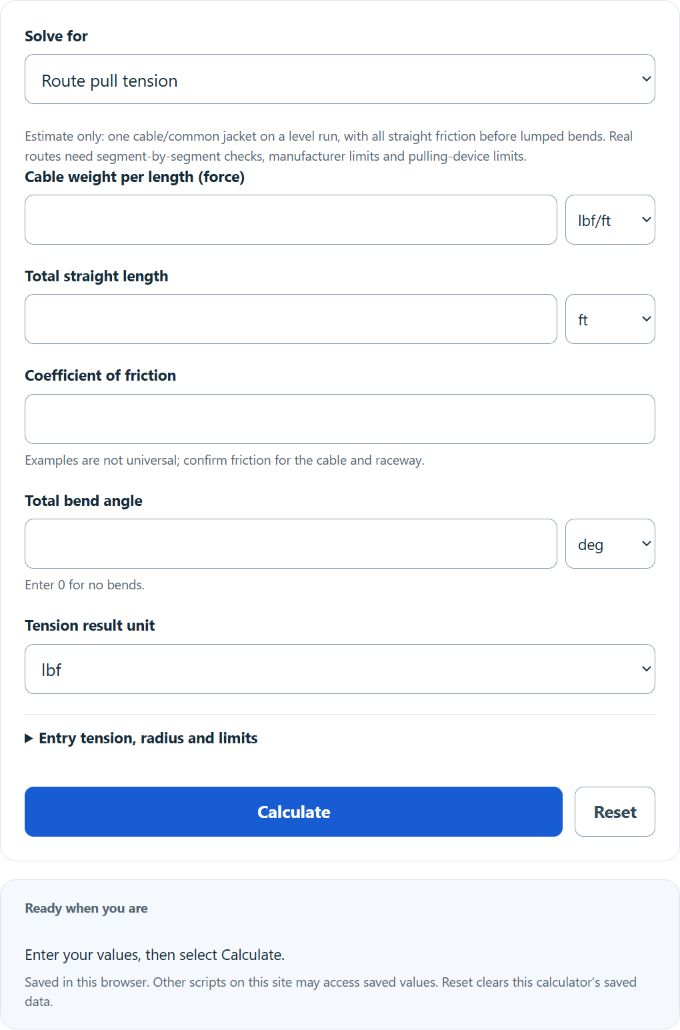
Estimate level-run cable pulling tension, bend multiplier, sidewall load and conductor tension limits. The simplified bend model places all straight friction before the bends; actual routes require segment-by-segment checks.
- All Construction Calculators
- All Force Calculators
- Screw Jack Force Calculator
- Winch Line Pull Force Calculator
- Pull Force Calculator
- Pulley Acceleration Calculator
Wire Pull Force Formula
The following equation can be used to estimate the wire pull force for a straight, level run (no bends).
- Where WPF is the wire pull force (lbf)
- u is the coefficient of friction
- w is the cable weight force per unit length (lbf/ft)
- L is the length of the run (ft)
What is a Wire Pull Force?
Definition:
A wire pull force (pulling tension) is the amount of force it takes to pull a wire or cable through a raceway. In other words, it’s the amount of force needed to pull a wire through a conduit, or through a hole in a wall filled with cable.
How to Calculate Wire Pull Force?
Example Problem:
The following example outlines the steps and information needed to estimate Wire Pull Force for a straight, level run.
First, determine the coefficient of friction. For this example, the coefficient of friction is 0.35.
Next, determine the cable weight per unit length. For this example, the cable weight is 2.0 lb/ft.
Next, determine the length of the run. The run length is 150 ft.
Finally, calculate the wire pull force using the formula above:
WPF = u*w*L
WPF = 0.35*2.0*150
WPF = 105 lbf