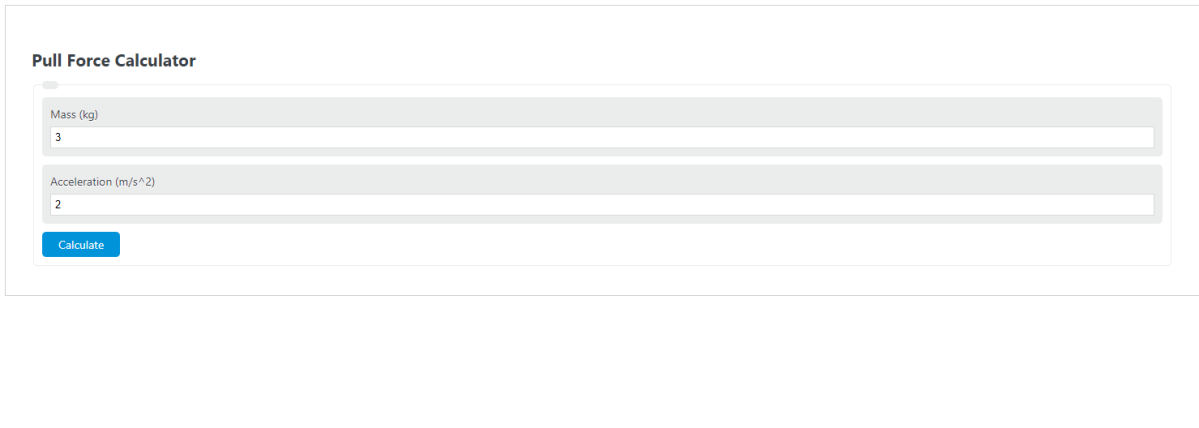
Calculate pull force up an incline or reverse-solve mass or acceleration with friction, pull-line angle, force and mass units, component forces, and a capacity factor.
Pull Force Formula
The following equation is used to calculate the required pull force to move an object up an incline with friction (pulling parallel to the slope).
- Where Fp is the required pull force along the incline (N)
- m is the mass of the object (kg)
- a is the acceleration along the incline (m/s2)
- g is gravitational acceleration (≈ 9.81 m/s2)
- θ is the incline angle measured from horizontal
- μ is the coefficient of friction (unitless; typically kinetic friction for a moving object)
This formula assumes the object is being pulled up the incline and friction acts opposite the motion. If the object moves at constant speed, then a = 0.
What is a Pull Force?
Definition:
A pull force is an applied force that pulls on an object. The object’s acceleration depends on the net force (the sum of all forces), so the applied pull force is not always equal to ma when other forces (such as gravity and friction) are present.
How to Calculate Pull Force?
Example Problem:
The following example outlines the steps and information needed to calculate the pull force up an incline with friction.
First, determine the mass of the object. In this example, the mass of the object is 5 kg.
Next, determine the incline angle and coefficient of friction. For this example, the incline angle is 20° and the coefficient of friction is 0.20.
Then determine the desired acceleration along the incline. In this example, the object accelerates up the slope at 3 m/s2.
Finally, calculate the pull force using the formula above:
Fp = m(a + gsin(θ) + μgcos(θ))
Fp = 5(3 + 9.81sin(20°) + 0.20·9.81cos(20°))
Fp ≈ 5(3 + 3.354 + 1.845)
Fp ≈ 40.995 N ≈ 41.0 N