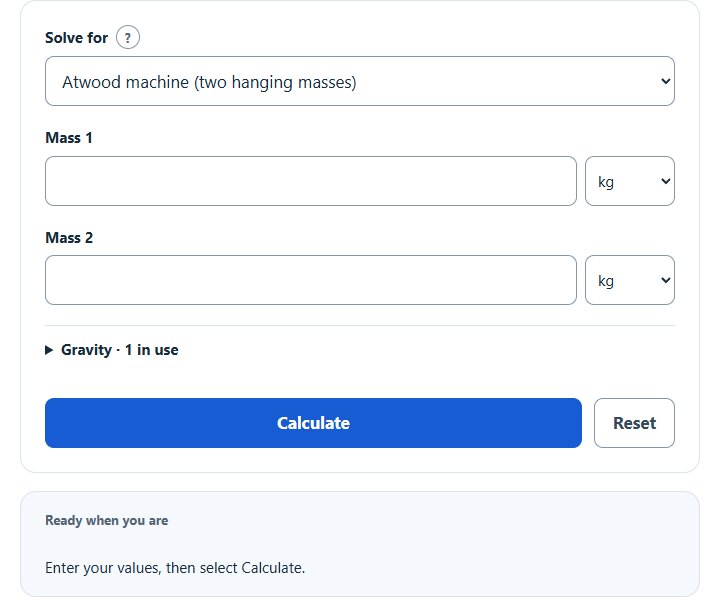
Calculate pulley acceleration and rope tension for two hanging masses (Atwood machine), or for a load lifted by a pull force, in kg, g or lb.
- All Physics Calculators
- All Acceleration Calculators
- Pulley Force Calculator
- Pulley Torque Calculator
- Elevator Acceleration Calculator
- Alternator Pulley Ratio Calculator
Pulley Acceleration Formula
Use this equation to calculate the upward acceleration of a load pulled straight up by a single rope.
- Where PA is the Pulley Acceleration (m/s2)
- T is the tension pull force of the pulley (N)
- m is the mass of the object (kg)
- g is the acceleration due to gravity (9.81 m/s2)
Divide the rope tension by the mass of the load, then subtract the acceleration due to gravity.
What are the units for Pulley Acceleration?
In the International System of Units, also known as SI units, the units for Pulley Acceleration are m/s2.
How to Calculate Pulley Acceleration?
Example Problem:
The following example problem outlines the steps and information needed to calculate the Pulley Acceleration.
First, determine the tension pull force of the pulley. In this example, the tension pull force of the pulley is calculated or measured to be 100 (N).
Next, determine the mass of the object. For this problem, the mass of the object is determined to be 5 (kg).
Finally, calculate the Pulley Acceleration using the formula above:
PA = T/m - g
Inserting the values from above and solving the equation with the imputed values gives:
PA = 100/5 - 9.81 = 10.19 (m/s2)