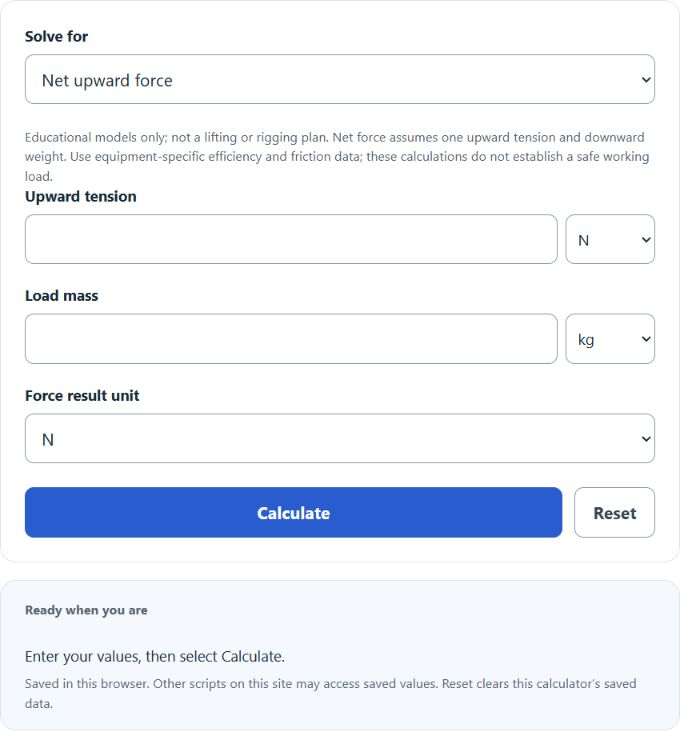
Calculate pulley force, mass, or tension, plus block-and-tackle effort and capstan tension ratio from load, rope parts, friction, and wrap angle.
- All Physics Calculators
- All Force Calculators
- Pulley Torque Calculator
- Pulley Weight Calculator
- Pull Force Calculator
- Pulley Acceleration Calculator
- Pulley Efficiency Calculator
Pulley Force Formula
The basic mode calculates net vertical force on a load supported by one upward tension, with upward positive. It does not calculate axle or anchor reaction forces.
- Where Fp is the net upward force on the load (N)
- TF is the force of tension from the pulley (N)
- GF is the gravitational force (N)
To calculate the pulley force, subtract the gravitation force from the tension force.
What is a Pulley Force?
Definition:
Here, pulley force means net upward force on the load: tension minus weight, using standard gravity 9.80665 m/s². Block-and-tackle effort instead uses the entered overall efficiency. The optional stage-loss model is illustrative and is not a general reeving analysis. Capstan mode calculates the limiting tension ratio at impending slip; it does not determine a safe load rating.
How to Calculate Pulley Force?
Example Problem:
The following example outlines the steps and information needed to calculate the Pulley Force.
First, determine the tension force. In this example, it is 100 N.
Next, determine the gravitational force. This is calculated from the mass, and in this case, is found to be 75 N.
Finally, calculate the pulley force using the formula above:
Fp = TF - GF
Fp = 100-75
Fp = 25 N