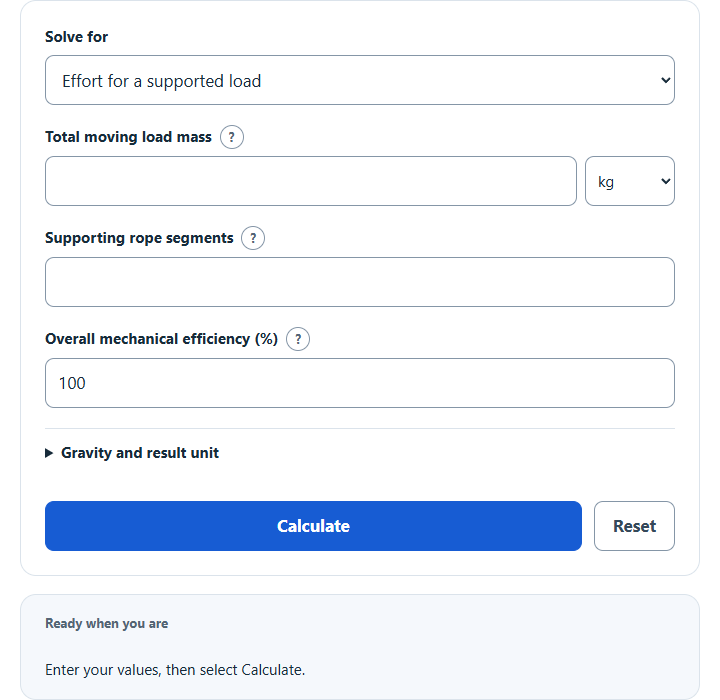
Calculate how much weight a pulley system takes off: enter the load and supporting rope segments to get the pulling effort, liftable load or rope travel.
- All Physics Calculators
- Belt Length Calculator (2 pulley system)
- AMA (Actual Mechanical Advantage) Calculator
- Belt Speed Calculator
- Pulley Torque Calculator
- Pulley Force Calculator
- Pulley Efficiency Calculator
- Alternator Pulley Ratio Calculator
Pulley Weight Formula
The calculator has four separate modes: effort for a supported load, load mass from available effort, rope travel for a lift, and physical pulley mass from dimensions and density. The lifting modes assume a steady lift with parallel supporting rope segments and use overall mechanical efficiency:
- Where eF is the required steady pulling effort force
- m is the total supported moving mass, including moving block/hardware mass when significant
- g is the selected positive gravitational acceleration; leaving the optional field blank uses standard gravity, 9.80665 m/s²
- eta is overall mechanical efficiency as a fraction: efficiency (%) / 100; eta = 1 is ideal. It is not a coefficient of friction
- n is the number of rope segments whose upward tension supports the moving load/block in the assumed parallel-segment arrangement, not the number of pulley wheels
Effort is eF = mg/(n eta), and the inverse load estimate is m = eF × n × eta/g. For a rise h, rope travel is n × h; output work is mgh and input work is mgh/eta. For physical pulley mass, the uniform annular-cylinder model is V = π(D² – d²)w/4 and mass = ρV, with outer diameter D, bore diameter d, width w and density ρ in consistent SI units. It omits grooves, hubs, spokes, keys and other shape details. The steel 7850, aluminium 2700 and cast-iron 7200 kg/m³ presets are approximate representative values, not universal alloy constants; enter material-specific density directly.
Pulley Weight Definition
This page distinguishes the pulling effort or supported load of a lifting system from the physical mass of a pulley wheel. The lifting estimates assume steady motion, a rope whose stretch is negligible and the selected supporting-segment arrangement. Count a rope end attached to the moving block when it actually supports that block; do not automatically exclude all end segments. Angled or different reeving arrangements need a corresponding force and travel analysis. Physical pulley mass is estimated separately and is not automatically included in the lifting load. A theoretical load estimate is not a rated working-load limit or a holding/braking-capacity check.
Pulley Weight Example
How to calculate a pulley weight?
First, determine the total supported moving mass. For this example, use 20 kg, including any moving hardware that must be lifted.
Next, specify overall mechanical efficiency. For this example it is 80%, so eta = 0.8. This is the useful output work divided by input work, not a friction coefficient.
Next, count the rope segments that actually support the moving load/block. Include an attached end when its tension supports the moving block; a fixed pulley used only to redirect the pull does not itself add a supporting segment.
For this example, there are four parallel supporting segments, so n = 4. The pulley-wheel count alone does not establish this value.
Finally, calculate the steady pulling effort using standard gravity, g = 9.80665 m/s², which is the default when the optional gravity field is blank.
eF = (20 × 9.80665)/(0.8 × 4) = 61.2915625 N ≈ 61.2916 N