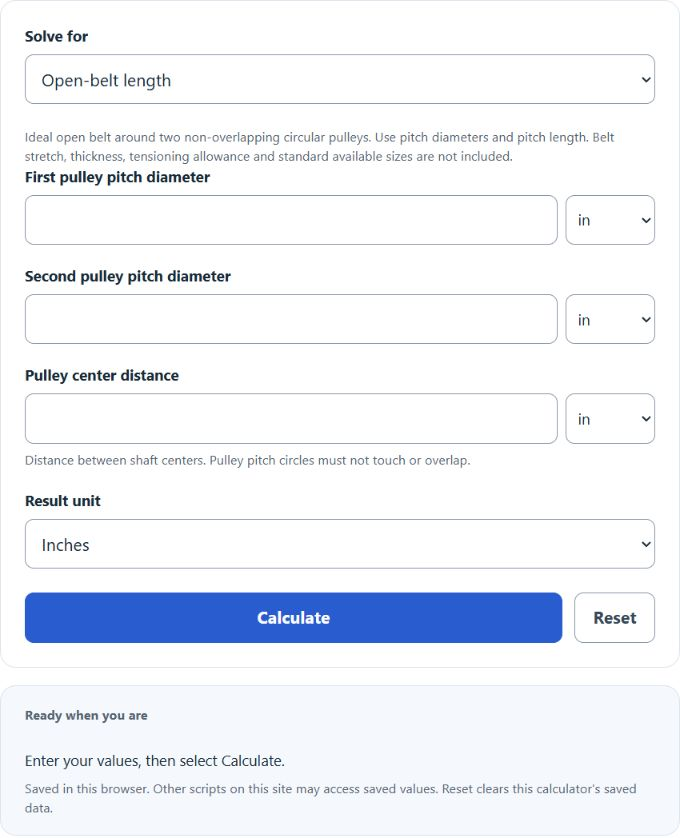
Calculate exact and approximate open-belt length from two pulley pitch diameters and center distance, or solve the required pulley center distance.
- All Automotive Calculators
- Pulley Weight Calculator
- Torque Calculator
- AMA (Actual Mechanical Advantage) Calculator
- Belt Speed Calculator
- Belt Frequency Calculator
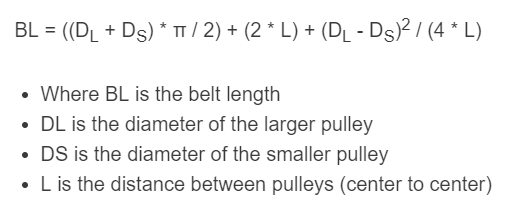
Belt Length Formula
The calculator uses exact ideal open-belt geometry and also reports this common engineering approximation. Both use pulley pitch diameters and assume two non-overlapping pulleys.
For exact geometry, let r = (D − d)/2 and θ = asin(r/C), with angles in radians. Center-distance mode numerically solves the following equation within C > (D + d)/2:
- BL = belt length
- D = diameter of the larger pulley
- d = diameter of the smaller pulley
- C = center-to-center distance between the two pulley shafts
- pi = 3.14159265…
Select Belt length or Pulley center distance, then enter the displayed required values. Each measurement has its own unit selector; changing it converts the entered quantity. The answer uses the selected Result unit.
- Belt length mode: uses both pulley pitch diameters and the center distance to calculate the exact ideal open-belt length and its approximation.
- Center distance mode: uses belt pitch length and both pulley pitch diameters to solve the exact ideal center distance.
Common Belt Length Units and Conversions
The calculator accepts inches, millimeters, centimeters, feet and meters. Quantities are converted to meters internally and the result is converted to the selected output unit.
| Unit | Equivalent in inches | Common use |
|---|---|---|
| 1 inch | 1 in | Small pulleys, automotive belts, shop measurements |
| 1 foot | 12 in | Long center distances or large belt runs |
| 1 centimeter | 0.393701 in | Metric pulley measurements |
| 1 meter | 39.3701 in | Long metric belt layouts |
What to Measure Before Calculating
| Input | How to measure it | Important note |
|---|---|---|
| Larger pulley diameter | Measure straight across the pulley through its center. | Use the belt pitch diameter when available, not just the outer rim diameter. |
| Smaller pulley diameter | Measure straight across the smaller pulley through its center. | Keep units consistent, or use the unit dropdowns to convert automatically. |
| Length between pulleys | Measure from the center of one pulley shaft to the center of the other shaft. | This is center distance, not the open gap between pulley edges. |
| Belt length | Use the belt pitch length or measured loop length. | Real belts may require adjustment for tensioning range and manufacturer sizing. |
Example Belt Length Calculations
Example 1: Calculate belt length
Suppose the larger pulley diameter is 8 in, the smaller pulley diameter is 4 in, and the center distance is 24 in.
The exact ideal belt length is 67.016319 inches, while the engineering approximation is about 67.016223 inches.
Example 2: Calculate length between pulleys
Suppose the belt length is 80 in, the larger pulley diameter is 10 in, and the smaller pulley diameter is 6 in.
The exact-model center-to-center distance is approximately 27.360499 inches.
Belt Length Calculator FAQ
What does length between pulleys mean?
Length between pulleys means the center-to-center distance between the pulley shafts. It is not the distance between the outer edges of the pulleys. To measure it, measure from the center of the first shaft to the center of the second shaft.
Should I use outside diameter or pitch diameter?
Use pitch diameter if you have it. Belt length formulas are most accurate when the pulley diameter represents the effective path of the belt. Outside diameter can give a close estimate in some cases, but it may be less accurate for V-belts, timing belts, and grooved pulleys.
Why is the calculated belt length not exactly the belt size I can buy?
Manufactured belts are sold in standard sizes, and real installations need allowance for tensioning and adjustment. If the calculated value falls between available belt sizes, choose a size that fits the adjustment range of your tensioner or movable pulley mount.