Calculate pulley mechanical advantage, effort force, or load lifted from any 2 values with Newton, kN, lbf, or kgf unit conversions.
- All Physics Calculators
- All Efficiency Calculators
- Pulley Weight Calculator
- Pulley Force Calculator
- Alternator Pulley Ratio Calculator
Pulley Efficiency Formula
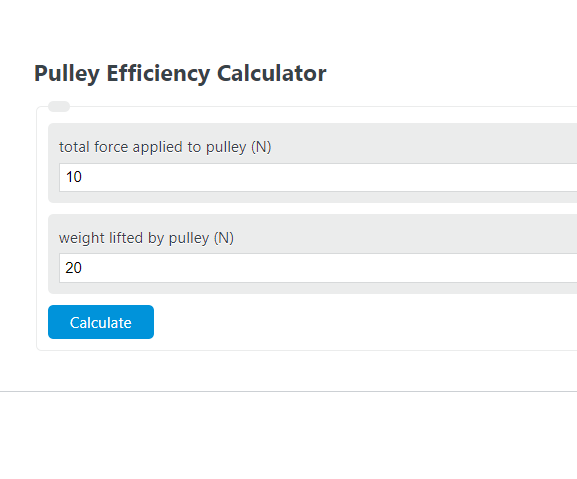
The pulley efficiency calculator estimates how the lifted load compares with the total force applied to the pulley system. For a valid result, enter both force values in compatible units such as N, kN, lbf, or kgf.
- Epull = pulley efficiency percentage shown by the calculator
- WL = weight lifted by the pulley
- AF = total force applied to the pulley system
If you want to solve for one of the inputs instead of the percentage, use the rearranged forms below.
How to Calculate Pulley Efficiency
- Determine the total applied force acting on the pulley system.
- Measure the weight being lifted.
- Confirm both values use the same force unit.
- Divide the lifted weight by the applied force.
- Multiply the result by 100 to convert it to a percentage.
This is a quick way to compare output load to input force, especially when checking pulley performance, estimating system losses, or comparing one setup to another.
How to Interpret the Result
This calculator uses a force-ratio method. That makes it useful for simple comparisons, but it is important to interpret the percentage correctly. In machine design, true pulley efficiency is usually based on input work versus output work, not force alone. Since pulleys trade force for distance, some multi-pulley systems can show a ratio above 100% when only force values are compared.
For a more complete engineering analysis, pulley efficiency is commonly related to actual mechanical advantage and ideal mechanical advantage.
In many block-and-tackle arrangements, the ideal mechanical advantage is approximately equal to the number of supporting rope segments. Under that definition, real mechanical efficiency stays at or below 100%.
| Calculator Result | General Meaning |
|---|---|
| Below 100% | Typical when total input force exceeds the lifted load after friction and other losses are considered. |
| Near 100% | Represents a very efficient or highly idealized pulley system with minimal losses. |
| Above 100% | Usually indicates the value is functioning as a force ratio rather than true mechanical efficiency, or that ideal mechanical advantage was not included in the interpretation. |
Example 1
If a pulley system lifts a 400 N load and the total applied force is 500 N, the result is:
The calculator returns 80%, meaning the lifted load is 80% of the total applied force under this input method.
Example 2
If the lifted load is 900 N and the target result is 75%, the required total applied force is:
In this case, the pulley system would require 1200 N of total applied force based on the calculator formula.
What Reduces Pulley Performance?
- Bearing friction: Resistance at the sheave axle increases the force needed to move the load.
- Rope bending losses: Repeated bending over small pulleys wastes energy.
- Misalignment: Poor rope tracking creates extra drag and uneven loading.
- Rope stretch: Elastic deformation absorbs part of the input effort.
- Worn grooves or rough sheaves: Surface wear increases sliding resistance.
- Too many pulley stages: Additional sheaves improve mechanical advantage but can add cumulative friction.
- Poor lubrication or contamination: Dirt, corrosion, and lack of lubrication increase losses.
Common Input Mistakes
- Mixing units, such as entering one value in newtons and the other in pound-force.
- Entering mass instead of weight without converting to force.
- Using only the hand pull force when the field is intended for total applied force.
- Assuming a result above 100% means the pulley creates energy.
- Ignoring the number of supporting rope segments when evaluating true mechanical efficiency.
Practical Tips
- Use measured force values when possible instead of estimated values.
- Keep the rope condition, pulley diameter, and bearing condition consistent when comparing systems.
- For design work, pair this calculator with mechanical advantage or velocity ratio calculations.
- If the result seems unrealistic, verify whether you are comparing total system input force or only a single effort force.
Frequently Asked Questions
Can pulley efficiency be greater than 100%?
Not as true mechanical efficiency. If the calculator shows more than 100%, the number is usually acting as a force ratio or the system’s ideal mechanical advantage has not been accounted for.
Should I enter weight or mass?
Enter force, not raw mass. If you start with mass, convert it to weight before using the calculator.
Do both values need the same unit?
Yes. Because the formula is a ratio, both inputs must use compatible force units for the percentage to be meaningful.