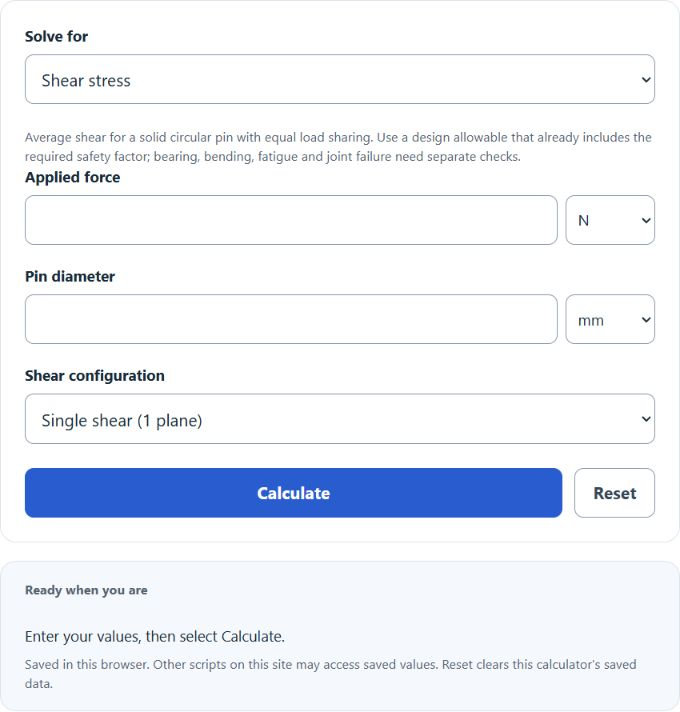
Calculate pin shear stress from force and pin diameter in single or double shear, or find the allowable shear load or minimum pin diameter.
- Von Mises Stress Calculator
- All Construction Calculators
- Flange Bolt Torque Calculator
- Shear Area Calculator
Calculator Functions
| Function | What it does | What it requires |
|---|---|---|
| Shear stress | Finds the average shear stress in a solid round pin | Requires the applied force, the pin diameter and the shear configuration |
| Allowable shear load | Finds the largest force a pin can carry in shear at a chosen stress limit | Requires the pin diameter, the allowable shear stress and the shear configuration |
| Minimum theoretical diameter | Finds the smallest pin diameter that keeps the shear stress at or below a chosen limit | Requires the applied force, the allowable shear stress and the shear configuration |
The Shear configuration is Single shear (1 plane) or Double shear (2 planes). Force is entered in N, kN or lbf, diameter in mm or in, and allowable stress in MPa, psi or ksi. Results are shown in MPa and psi, kN, N and lbf, or mm and in. Inch-pound entries are converted with 1 lbf = 4.448222 N, 1 in = 25.4 mm and 1 psi = 0.006894757 MPa [2].
Pin Shear Formulas
| τ | Average shear stress in the pin (MPa, which equals N/mm²) |
| F | Applied force on the joint (N) |
| n | Number of shear planes: 1 for single shear, 2 for double shear |
| d | Pin diameter (mm) |
Average shear stress is the shear force on a cut through the pin divided by the area of that cut, which is π × d² ÷ 4 for a round pin [1]. In single shear the pin is cut at one plane, which carries the whole force. In double shear the pin passes through a fork or clevis and is cut at two planes that each carry half the force, so the stress is half of the single-shear value [1].
Shear stress
The main formula applies directly. A 35 mm pin that carries 5,000 N in single shear has an area of 962.1 mm² and a stress of 5,000 ÷ 962.1 = 5.197 MPa. The same pin in double shear sees 2.598 MPa. With inch units, a 0.5 in pin that carries 1,000 lbf in double shear sees 2,546 psi.
Allowable shear load
A 10 mm pin in double shear with an allowable shear stress of 100 MPa can carry 100 × 2 × 78.54 = 15,708 N, or 15.708 kN. This is how the shear strength of a dowel pin is worked out: the answer depends on the pin’s diameter, its material and whether it is loaded in single or double shear. The allowable stress has to come from the pin maker’s rating or the governing design standard and should already include the safety factor. A tensile strength is not a shear strength and should not be entered in its place.
Minimum theoretical diameter
(n × π × τallow))
A force of 20 kN in single shear with an allowable shear stress of 80 MPa needs a pin of at least √(4 × 20,000 ÷ (π × 80)) = 17.84 mm. The next standard size up is the starting point, subject to the other checks on the joint.
Limits of This Estimate
- The result is an average over the cross-section of a solid round pin. The actual shear stress is not uniform across the pin, and a hollow or grooved pin has less area.
- Double shear assumes both planes share the load equally. A loose fit or uneven plates can load one plane more than the other.
- Only shear in the pin is checked. Bearing stress between the pin and the plates, bending of the pin, tear-out of the plate and fatigue are separate checks, and any of them can govern the joint.
Sources
- Purdue University, ME 323 Mechanics of Materials, Topic 3: Shear stress and shear strain: average shear stress, and the single-shear and double-shear pin results
- NIST Guide to the SI, Appendix B.8: Factors for Units Listed Alphabetically: pound-force, inch, psi and ksi conversion factors