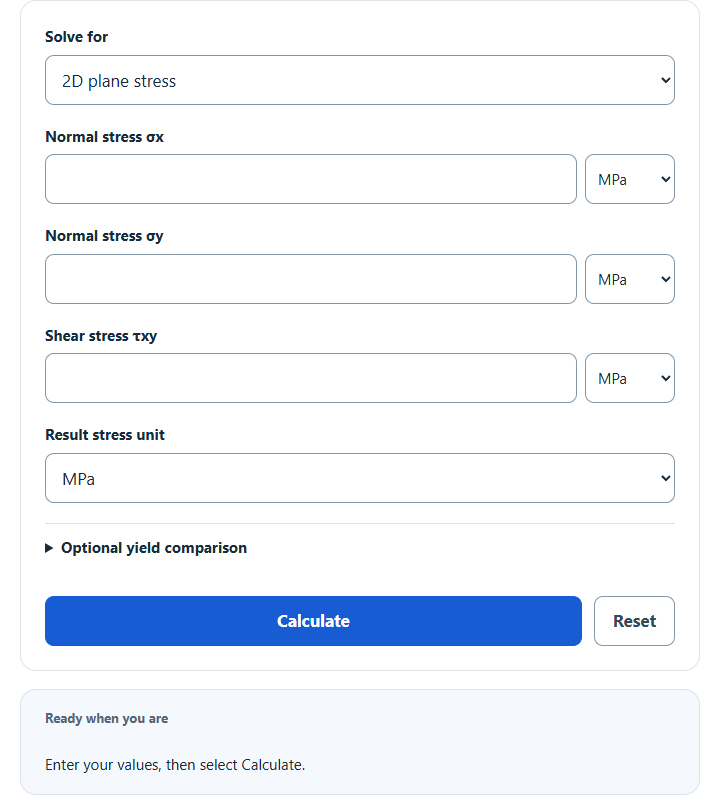
Calculate Von Mises stress from 2D plane stress, 3D principal stresses, or full stress components, with optional yield-strength check.
Von Mises Stress Formula
The following equation gives von Mises equivalent stress for plane stress (σz = τyz = τzx = 0). The calculator also accepts three principal stresses or six components of a symmetric 3D stress tensor.
- Where V is the Von Mises Stress
- σx is the normal stress x component
- σy is the normal stress y component
- τxy is the shear stress
Von Mises Stress Definition
Von Mises equivalent stress is a nonnegative scalar measure derived from the deviatoric stress tensor. It is commonly compared with verified yield strength for applicable isotropic ductile materials; it is not the sum of all stresses or a universal safety criterion.
Von Mises Stress Example
How to calculate 2D plane-stress equivalent stress?
- First, calculate the normal stresses.
Calculate the normal stress in the x and y planes.
- Next, determine the shear stress.
Determine the in-plane shear component τxy.
- Finally, calculate Von Mises stress.
Calculate the Von Mises stress using the formula above.
FAQ
Von Mises stress is used to determine if a ductile metal will yield when subjected to complex loading conditions. The plane-stress case includes two normal stresses and an in-plane shear component; the full 3D model includes three normal and three shear components.
For plane stress, use σx, σy and τxy in the displayed formula. For 3D, choose principal stresses or all six symmetric tensor components in the calculator.
Von Mises stress was first proposed in 1904 by Huber and later popularized by von Mises.
Using the deviatoric strain convention, εeq = √[(2/3)(ε′:ε′)], where ε′ is the strain tensor with its mean normal strain removed and the colon means summing the products of corresponding tensor components. In principal strains, εeq = (√2/3)√[(ε1 − ε2)² + (ε2 − ε3)² + (ε3 − ε1)²]. Here ε1, ε2 and ε3 are principal strains using the same strain measure; strain and εeq are dimensionless. For small-strain components, engineering shear γij corresponds to tensor shear εij = γij/2. This is a strain formula, whereas the calculator above accepts stresses. Do not treat a value from one final strain tensor as accumulated equivalent plastic strain for a general loading history; that requires integrating the plastic strain increments. Some elastic equivalent-strain definitions also include Poisson’s ratio, so match the convention to the material model and analysis software.