Calculate thin-wall hoop stress for cylinders or spheres, reverse-solve pressure or thickness, and check diameter ratio, von Mises stress, and safety factor.
- All Physics Calculators
- Pipe Volume Calculator
- Pipe Flow Calculator
- Pipe Pressure Rating Calculator
- Pressure Test Safe Distance Calculator
- Compressive Stress Calculator
Hoop Stress Formula
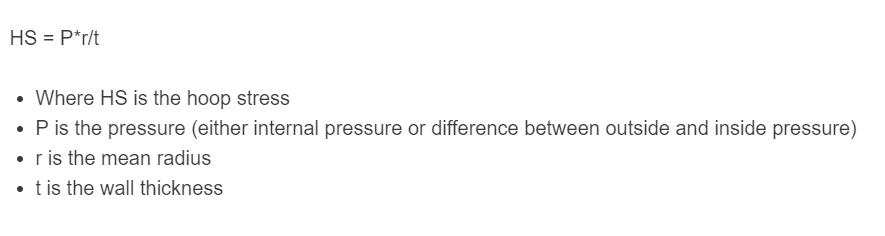
For a thin-walled cylindrical pressure vessel or pipe, hoop stress is the circumferential stress caused by the pressure difference across the wall. The standard thin-wall relation is:
If you prefer to work with mean diameter instead of mean radius, the equivalent form is:
Where:
| Symbol | Meaning | Typical Units |
|---|---|---|
| σh | Hoop stress (circumferential stress) | Pa, kPa, MPa, psi |
| P | Pressure difference across the wall, usually internal minus external pressure | Pa, kPa, MPa, psi |
| rm | Mean radius of the vessel wall | m, cm, in, ft |
| Dm | Mean diameter of the vessel wall | m, cm, in, ft |
| t | Wall thickness | m, cm, in, ft |
What the Calculator Does
This calculator uses the thin-wall hoop stress equation to solve for any missing variable when the other three are known. That means you can use it to calculate hoop stress directly, or rearrange the same relationship to find pressure, mean radius, or wall thickness.
Rearranged Forms
If you are solving for a different variable, these equivalent forms are useful:
How to Calculate Hoop Stress
- Determine the net pressure. Use the pressure difference across the wall, not just internal pressure when significant external pressure exists.
- Use the mean radius. For thin walls, the mean radius is the radius measured at the midpoint of the wall thickness.
- Measure the wall thickness. Thickness must use the same length unit basis as the radius or diameter.
- Apply the formula. Multiply pressure by mean radius, then divide by thickness.
Mean Radius and Mean Diameter
The thin-wall equation is most accurate when radius or diameter is taken at the middle of the wall. Common relationships are:
If outside diameter and thickness are known, the mean radius can also be written as:
When This Equation Is Valid
The formula on this page is the thin-walled cylinder approximation. It is most appropriate when the wall is small compared with the vessel radius. A common rule of thumb is:
Under this assumption, stress is treated as approximately uniform through the wall thickness. If the vessel is thick-walled, stress varies across the wall and a more advanced analysis is required.
Units and Consistency
- If pressure is entered in Pa and dimensions are in m, hoop stress is returned in Pa.
- If pressure is entered in psi and dimensions are both in in, hoop stress is returned in psi.
- Radius and thickness must use compatible length units before applying the equation.
- Stress and pressure share the same dimensional unit, but they are not the same physical quantity.
Example
A cylindrical vessel has a pressure difference of 1.5 MPa, a mean radius of 0.25 m, and a wall thickness of 0.01 m.
The wall therefore experiences a hoop stress of 37.5 MPa.
Hoop Stress vs. Longitudinal Stress
In a closed-end thin cylindrical vessel, the circumferential stress is larger than the axial stress. The longitudinal stress is:
This means the hoop stress is typically twice the longitudinal stress for the same vessel geometry and pressure loading.
Common Mistakes
- Using diameter in the radius equation without dividing by 2.
- Mixing mm, m, in, or ft in the same calculation.
- Using internal pressure instead of pressure difference when external pressure is not negligible.
- Applying the thin-wall equation to a thick-walled vessel.
- Using outside radius instead of mean radius when better accuracy is needed.
FAQ
What is hoop stress?
Hoop stress is the tangential tensile stress that acts around the circumference of a pressurized cylinder. It is the primary stress that tends to split a pipe or vessel along its length.
Why is mean radius used?
The thin-wall model assumes the stress acts at the mid-surface of the wall, so mean radius or mean diameter provides the best representation.
Can hoop stress be negative?
Yes. If the external pressure exceeds the internal pressure, the calculated circumferential stress may be compressive rather than tensile.
Is this formula valid for spheres?
No. Spherical vessels use a different thin-wall relation because the membrane stress distribution is different.
What if the wall is not thin?
For thick-walled cylinders, the hoop stress is not uniform through the wall, so the thin-wall equation should not be used for detailed design or high-accuracy analysis.