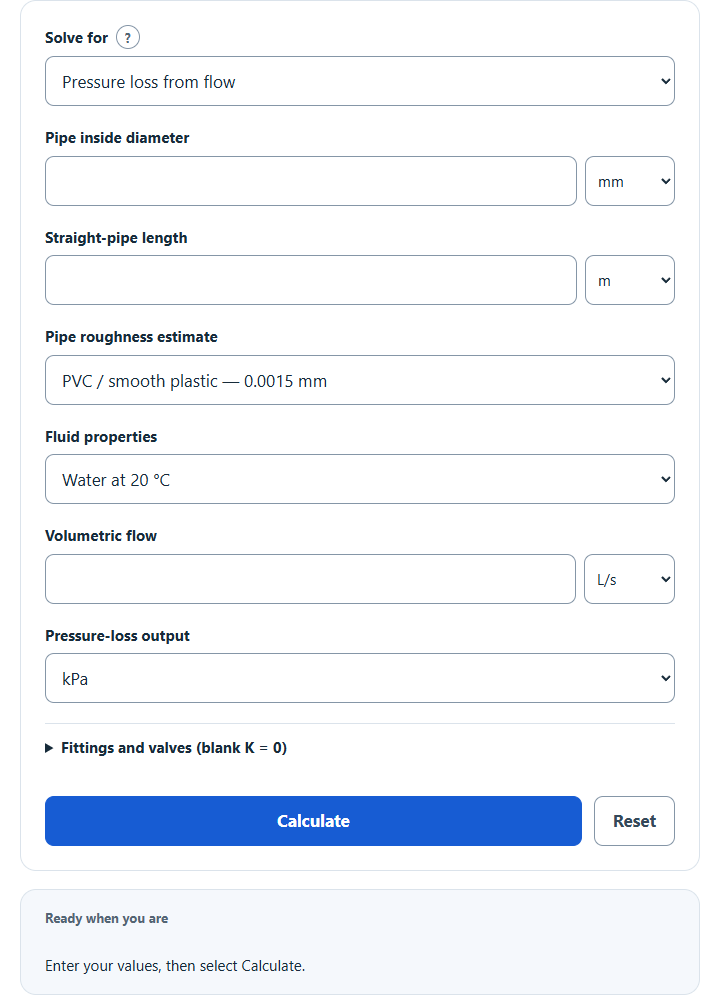
Calculate water flow through a pipe: pressure loss from flow rate, or flow rate and velocity from available pressure or gravity head, using Darcy-Weisbach.
- All Construction Calculators
- Flow to Velocity Calculator
- Water Flow Rate Calculator
- Head Loss Calculator
- Depth of Flow in Pipe Calculator
- Partial Pipe Flow Calculator
- Weir Flow Calculator
- Tile Calculator – How Many Tiles & Boxes You Need
Pipe Flow Formula
This calculator uses Darcy–Weisbach for straight-pipe and fitting pressure losses, with Q = vπD²/4 relating volumetric flow to mean velocity. The Hazen–Williams water-flow relation previously shown here is a different empirical model. Churchill’s continuous correlation supplies the Darcy friction factor across laminar, transitional and turbulent regimes; transitional predictions remain uncertain.
Δp = (fD L/D + K) ρv2/2; h = Δp/(ρg)
- Where fD is the dimensionless Darcy friction factor and K is the supplied total fitting-loss coefficient
- L is the straight-pipe length (m); roughness ε (m) enters the friction-factor correlation
- D is the pipe inside diameter (m)
- ρ is fluid density (kg/m³); g = 9.80665 m/s²; h is fluid head loss (m)
- v is the mean fluid velocity (m/s); Δp is pressure loss (Pa)
From this, the mass flow rate can be determined by multiplying the volume flow rate times the density.
ṁ = ρQ; Q = vπD2/4
- Where ṁ is mass flow rate (kg/s) and ρ is fluid density (kg/m³)
- Q is volumetric flow rate (m³/s); v is mean velocity (m/s)
Pipe Flow Definition
Pipe flow rate is the mass or volume crossing a pipe section per unit time. This calculator models steady, fully developed flow of an incompressible Newtonian liquid in a full circular pipe, with constant supplied properties.
How to calculate pipe flow velocity?
How to calculate pipe flow velocity.
- First, measure the pipe.
Enter the actual inside diameter and straight-pipe length in the selected units.
- Next, select pipe and fluid properties.
Choose approximate roughness and fluid-property presets, or supply custom absolute roughness, density and kinematic viscosity.
- Next, choose the known quantity.
Enter volumetric flow to find pressure loss, or enter available friction-loss pressure or fluid head to find flow. Add the total fitting-loss K when known; blank means zero.
- Finally, calculate and check the assumptions.
Review velocity, Reynolds number, friction, major and minor losses, and head. Available pressure or head must already account for elevation, endpoint velocity changes and other equipment. Transitional-flow estimates are uncertain.
FAQ
What factors affect the flow velocity in a pipe?For a specified flow, velocity is Q divided by pipe area. When solving from available pressure or head, diameter, length, roughness, fluid properties and fitting losses influence the predicted flow and velocity.
How does the slope of the pipe impact the flow rate?Elevation changes contribute to the system energy balance. This calculator has no slope or elevation input: supply only the pressure or fluid head available for friction and fitting losses after accounting for elevation, endpoint velocity changes and other equipment.
Can the pipe flow formula be used for any fluid type?The Darcy–Weisbach model here supports steady, incompressible Newtonian liquids using appropriate density and viscosity. Water presets are approximate. Non-Newtonian fluids, compressible gases, two-phase flow and developing-flow effects need other analysis; changing a Hazen–Williams coefficient does not provide a general conversion to those cases.