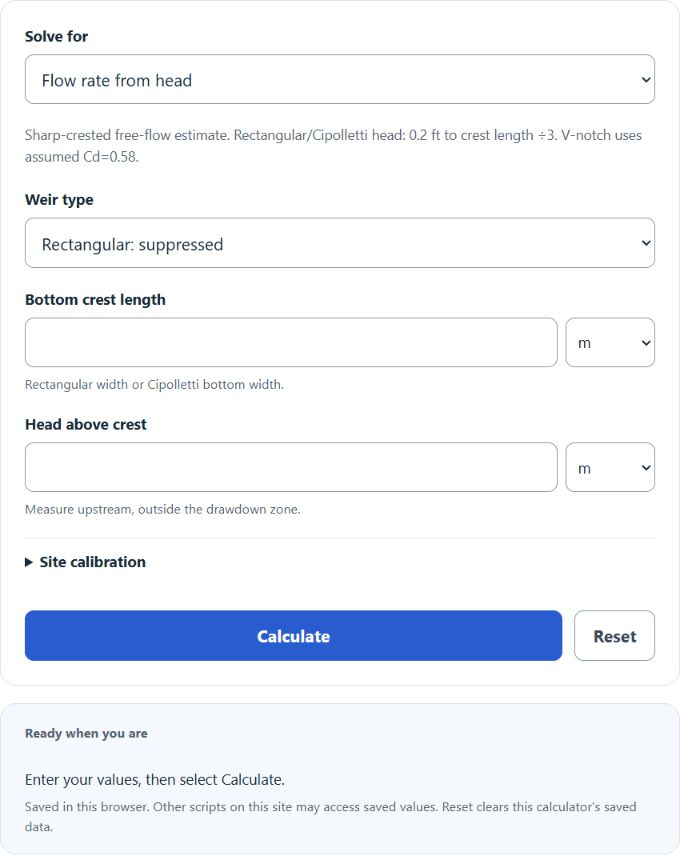
Calculate weir flow rate from head over a rectangular, contracted, V-notch or Cipolletti weir, or find the head for a target flow, in metric or US units.
- All Construction Calculators
- Hose Flow Rate Calculator
- Water Flow Rate Calculator
- Pressure to Head Calculator
- Water Drip/Leak Calculator
- Flow Rate Pressure Calculator
Weir Flow Formula
For a suppressed rectangular sharp-crested weir, this calculator uses the following approximate SI equation with negligible approach velocity.
Q = k ×1.84×L×H(3/2)
- Where Q is discharge in m³/s; k is a site calibration multiplier (default1)
- L is bottom crest length in metres
- H is upstream head above the crest in metres; use0.06096m≤H≤L/3. Contracted: Q=k×1.84×(L−0.1nH)×H(3/2), n=1or2. Cipolletti: Q=k×1.86×L×H(3/2). V-notch: Q=k×(8/15)×0.58×√(2g)×tan(θ/2)×H(5/2), g=9.80665m/s².
Weir Flow Definition
Weir flow is volumetric discharge over a crest. These equations require a sharp crest, a freely ventilated nappe and negligible approach velocity. Measure head at least4maximum heads upstream; verify channel clearance and unsubmerged flow. Rounded SI coefficients remain the same in both unit systems. The fixed0.58 V-notch approximation is not a calibrated Kindsvater–Shen rating.
How to calculate weir flow?
Example Problem #1:
The first step in calculating the volumetric flow of water through a weir is to determine the bottom width of the weir. For this example, the width is measured to be 5 ft.
Next, determine the height of the upstream water above the weir crest. In this case, the head is measured to be1ft, within the supported interval.
Finally, using the formula above, the weir flow rate is found to be:
Using k=1, convert the5ft crest and1ft head to1.524m and0.3048m.
=1.84×1.524×0.3048(3/2) m³/s; divide by0.028316846592 to obtain ft³/s.
≈16.66404 ft³/s.
Example Problem #2:
In this next example, we will use the same method as Example 1 to calculate the flow rate.
First, we determine the width of the weir. This is measured to be 30 ft.
Next, we determine the height. This is measured to be2ft, within the supported interval.
Finally, we calculate the flow rate using the same formula:
Q=1.84×9.144×0.6096(3/2) m³/s, with k=1.
≈282.79817 ft³/s (cfs).