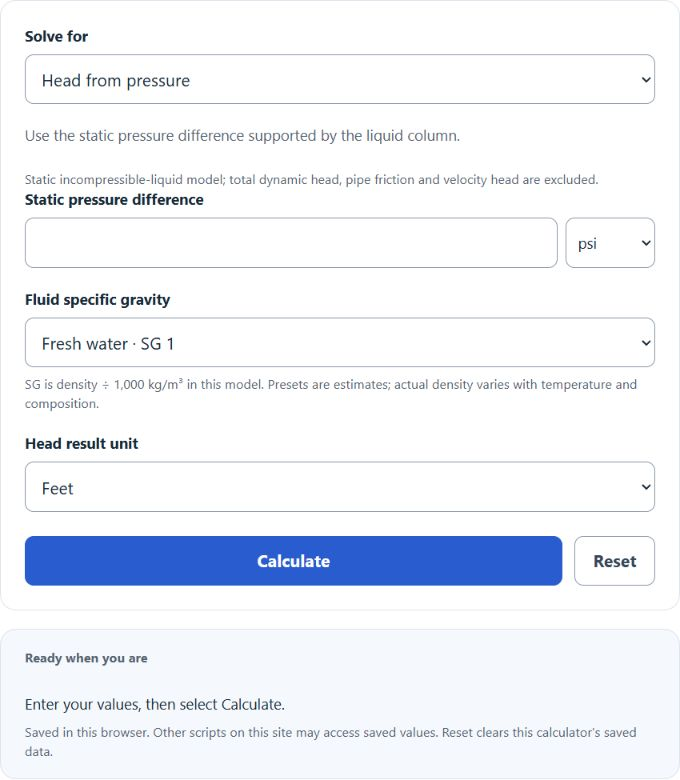
Convert pressure to liquid head or head back to pressure using specific gravity, with psi, bar, kPa, MPa, feet, meters, inches, and centimeters.
- All Unit Converters
- Thermodynamics and Fluid Unit Converters
- All Pressure Calculators
- Volumetric Flow Rate Calculator
- Water Pressure Calculator
- TDH (Total Dynamic Head) Calculator
- Static Head Calculator
- Head to Pressure Calculator
- Wellhead Pressure Calculator
Calculator Functions
| Function | What it does | What it requires |
|---|---|---|
| Head from pressure | Converts a static pressure difference into the height of liquid it supports, in ft, m, in or cm | Requires the pressure in psi, kPa, bar, MPa or Pa, and the fluid specific gravity |
| Pressure from head | Converts a liquid head into the static pressure it exerts, in psi, kPa, bar, MPa or Pa | Requires the head in ft, m, in or cm, and the fluid specific gravity |
| Specific gravity | Finds the specific gravity of the liquid that gives a pressure over a head | Requires the pressure and the head |
The fluid choices are fresh water (SG 1), seawater (SG 1.025), diesel (SG 0.85), gasoline (SG 0.74) or a custom specific gravity. Every result also shows the specific gravity used and the pressure gradient in psi per foot.
Pressure to Head Formulas
| h | Head, the height of the liquid column (m) |
| Δp | Static pressure difference (Pa) |
| ρ | Liquid density, taken as SG × 1,000 kg/m³ |
| g | Standard gravity, 9.80665 m/s² [2] |
Head is pressure divided by the unit weight of the liquid, and ρ × g is that unit weight [1]. In US units the same formula becomes h (ft) = p (psi) × 2.3067 ÷ SG, usually rounded to 2.31 feet of water per psi [1].
Head from pressure
The formula above applies directly. For fresh water, 10 psi is 68,947.57 Pa, and 68,947.57 ÷ (1,000 × 9.80665) = 7.0307 m, or 23.0666 ft. A lighter liquid stands taller under the same pressure: 10 psi supports 27.1372 ft of diesel at SG 0.85.
Pressure from head
A 100 ft column of fresh water is 30.48 m, so Δp = 1,000 × 9.80665 × 30.48 = 298,906.7 Pa, or 43.3528 psi. That is 0.4335 psi per foot of water. Ten meters of seawater at SG 1.025 exerts 100.5182 kPa.
Specific gravity
A liquid that shows 50 psi at the bottom of a 100 ft column has SG = 344,737.9 ÷ (1,000 × 9.80665 × 30.48) = 1.1533, a density of 1,153.3 kg/m³. Both the pressure and the head must be greater than zero.
PSI to Feet of Head Conversion Table
These values are for fresh water at SG 1. For another liquid, divide the head by its specific gravity.
| Pressure (psi) | Head (ft) | Head (m) |
|---|---|---|
| 1 | 2.31 | 0.70 |
| 2 | 4.61 | 1.41 |
| 5 | 11.53 | 3.52 |
| 10 | 23.07 | 7.03 |
| 15 | 34.60 | 10.55 |
| 20 | 46.13 | 14.06 |
| 25 | 57.67 | 17.58 |
| 30 | 69.20 | 21.09 |
| 40 | 92.27 | 28.12 |
| 50 | 115.33 | 35.15 |
| 60 | 138.40 | 42.18 |
| 75 | 173.00 | 52.73 |
| 100 | 230.67 | 70.31 |
| 150 | 346.00 | 105.46 |
Feet of Head to PSI
For fresh water, multiply feet of head by 0.4335 to get psi. One meter of water head is 1.4223 psi, or 9.80665 kPa.
| Head (ft) | Pressure (psi) | Pressure (kPa) |
|---|---|---|
| 1 | 0.43 | 3.0 |
| 5 | 2.17 | 14.9 |
| 10 | 4.34 | 29.9 |
| 20 | 8.67 | 59.8 |
| 50 | 21.68 | 149.5 |
| 100 | 43.35 | 298.9 |
| 200 | 86.71 | 597.8 |
| 500 | 216.76 | 1,494.5 |
Limits of This Estimate
- This is static pressure head for an incompressible liquid. Pipe friction and velocity head are not included, so the result is not a total dynamic head and not a complete pump or piping design.
- Fresh water is taken as exactly 1,000 kg/m³, which gives 2.3067 ft per psi. The common 2.31 figure comes from a unit weight of 62.4 lb/ft³ [1], and the two agree to about 0.05%.
- The seawater, diesel and gasoline specific gravities are typical values, and real density changes with temperature and composition. Use a measured density when accuracy matters. These estimates are based on the best available data and estimations.
- The formula does not apply to gases, whose density changes with pressure.
Sources
- U.S. Bureau of Reclamation, Water Measurement Manual, Chapter 2, Section 3: head as pressure divided by unit weight, 62.4 lb/ft³ for water, and 2.31 feet of water per psi
- NIST, CODATA value: standard acceleration of gravity: g = 9.80665 m/s², exact