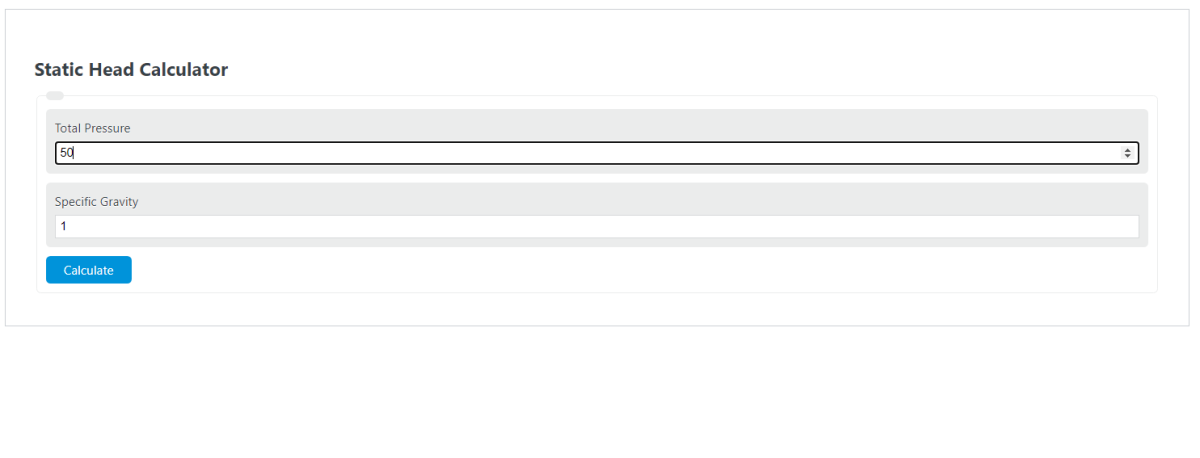
Calculate static pressure from fluid head, solve for vertical head or specific gravity, and convert between feet, meters, psi, kPa, bar, and density units.
- All Construction Calculators
- TDH (Total Dynamic Head) Calculator
- Pressure to Head Calculator
- Pipe Pressure Rating Calculator
- Volumetric Flow Rate Calculator
- Tip Speed Calculator
- Wellhead Pressure Calculator
Static Head Formula
The following formula is used to calculate the static head of a pump.
- Where SH is the static head (ft)
- PSI is the pounds per square inch of pressure
To calculate the static head, multiply the pressure in pounds per square inch by 2.31.
In this case, the formula is assuming that the fluid being pumped is water. If this fluid is not water then the result would have to be divided by the specific gravity of that fluid.
Since water’s SG is 1, it is removed from the formula.
What is static head?
Static head is a measure of the total vertical distance a pump can raise water, typically expressed in units of feet.
The static head is dependent on the amount of pressure that the pump can supply/generate in the fluid line.
How to calculate static head?
The following example problem outlines the information and steps needed to calculate a static head.
First, determine the specific gravity of the fluid. In this case, the fluid is water so the specific gravity is 1 and can be dropped from the calculation.
Next, determine the total pressure generated by the pump in pounds per square inch.
In the case of this example, the pounds per square inch is found to be 50 psi.
Finally, calculate the static head using the formula above:
SH = PSI * 2.31
SH = 50 * 2.31
SH = 115.5 ft