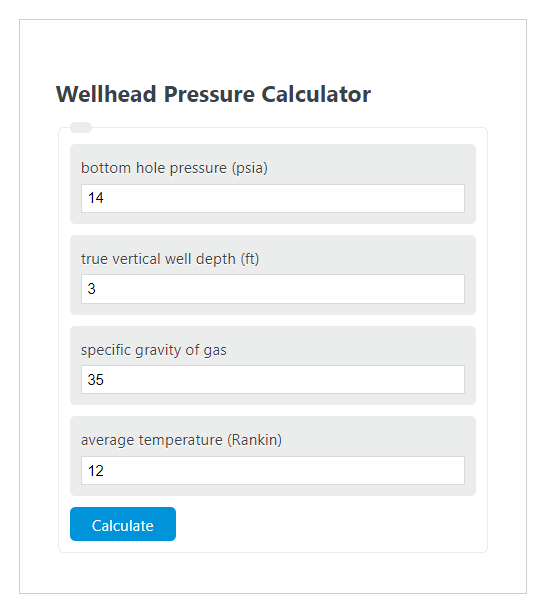
Calculate wellhead or bottom-hole pressure, true vertical depth, gas gravity, or average temperature with an adjustable compressibility factor and full unit conversion.
Related Calculators
- Formation Pressure Calculator
- Capillary Back Pressure Calculator
- Cylinder Pressure Calculator
- Joule Thomson Effect Calculator
- All Physics Calculators
Understanding Wellhead Pressure
The wellhead pressure is the pressure observed at the surface of the well. In a static gas column, it will normally be lower than the bottom-hole pressure because some of the pressure is used to support the gas column between the reservoir and the wellhead. This calculator is designed for quick engineering estimates using bottom-hole pressure, true vertical depth, gas specific gravity, and average temperature.
It is most useful for static or near-static gas conditions, fast field checks, and validating whether an entered pressure profile is directionally reasonable.
Wellhead Pressure Formula
The calculation is based on the exponential gas-column relationship below:
In this equation, Pwh is the wellhead pressure, Pbh is the bottom-hole pressure, H is true vertical depth, Sg is gas specific gravity, Tav is the average absolute temperature, and Z is the gas compressibility factor. This calculator assumes Z = 1, so the result should be treated as an approximation for a static gas column rather than a full real-gas wellbore model.
The constant 0.01875 is the field-unit factor used when depth is in feet, temperature is in Rankine, and pressure is in psia.
Input Definitions
| Input | Meaning | Practical Note |
|---|---|---|
| Bottom Hole Pressure | Absolute pressure at the bottom of the wellbore. | Use absolute pressure for hand checks. Gauge pressure must be converted first. |
| True Vertical Well Depth | Vertical distance from surface reference to the bottom-hole location. | Use TVD, not measured depth, especially in deviated or horizontal wells. |
| Specific Gravity of Gas | Gas density relative to air at standard conditions. | Higher gas specific gravity means a heavier gas column and a lower surface pressure. |
| Average Temperature | Average gas temperature over the vertical column. | The equation uses absolute temperature internally. The calculator handles unit conversion for you. |
| Wellhead Pressure | Surface pressure at the top of the well. | This is the unknown most users are solving for, but the calculator can also back-calculate another variable. |
How Each Variable Changes the Result
| Change | Effect on Wellhead Pressure | Why |
|---|---|---|
| Higher bottom-hole pressure | Increases wellhead pressure | A larger starting pressure at depth raises the entire pressure profile. |
| Greater true vertical depth | Decreases wellhead pressure | A taller gas column creates a larger pressure drop from bottom to surface. |
| Higher gas specific gravity | Decreases wellhead pressure | Heavier gas produces a larger static gradient. |
| Higher average temperature | Increases wellhead pressure | Hotter gas is less dense, so the column weighs less. |
Useful Rearrangements
If you know four values and want to solve manually for the fifth, the same relationship can be rearranged as follows:
How to Use the Calculator
- Enter the bottom-hole pressure.
- Enter the true vertical well depth.
- Enter the gas specific gravity.
- Enter the average temperature for the gas column.
- Leave the unknown field blank and calculate.
- Check that the result makes physical sense before using it in design or operations decisions.
Example
For a bottom-hole pressure of 1500 psia, true vertical depth of 8000 ft, gas specific gravity of 0.65, and average temperature of 520 °R, the estimated wellhead pressure is:
So the wellhead pressure is approximately 1244 psia. Under these assumptions, the gas column accounts for about 256 psi of pressure difference between the bottom hole and the surface.
Important Assumptions
- The well contains a static gas column.
- The average temperature is reasonably representative of the full column.
- The gas compressibility factor is taken as 1.
- The depth used is true vertical depth, not measured depth.
- Pressures are interpreted on an absolute basis in the underlying equation.
Common Input Mistakes
- Using psig instead of psia. If you are hand-checking a field reading, convert gauge pressure to absolute pressure first.
- Using measured depth instead of TVD. This can overstate the gas-column effect in deviated wells.
- Entering bottom-hole temperature instead of average column temperature. The equation uses the average temperature over the gas column.
- Applying the equation to flowing or multiphase wells. Friction, liquid loading, and changing fluid composition can make the estimate unreliable.
- Ignoring non-ideal gas behavior. At higher pressures, assuming Z = 1 may introduce noticeable error.
Pressure Conversion Reminder
If your pressure reading is in gauge pressure and you want to verify the calculation by hand, convert to absolute pressure first:
This is the standard sea-level approximation. The calculator itself handles unit conversions, but understanding the distinction helps prevent unrealistic results.
When This Calculator Is Most Useful
- Estimating surface pressure from a known bottom-hole pressure in a gas well
- Checking whether a reported wellhead pressure is directionally reasonable
- Comparing the effect of depth, gas gravity, or temperature on surface pressure
- Performing quick hand-checks before using more detailed wellbore or nodal analysis software
When a More Advanced Model Is Better
- Flowing wells with meaningful friction losses
- Multiphase wells containing gas, oil, water, or condensate
- High-pressure systems where real-gas compressibility is important
- Wells with strong temperature variation along the wellbore
- Situations requiring operational accuracy rather than a first-pass estimate
Quick Interpretation Guide
If your calculated wellhead pressure comes out higher than the bottom-hole pressure for a normal positive depth, that is usually a sign that one of the inputs is inconsistent, the pressure basis is wrong, or the static-gas assumption does not apply. In most static gas-column cases, deeper wells and heavier gases reduce surface pressure, while hotter gas columns preserve more pressure at the wellhead.