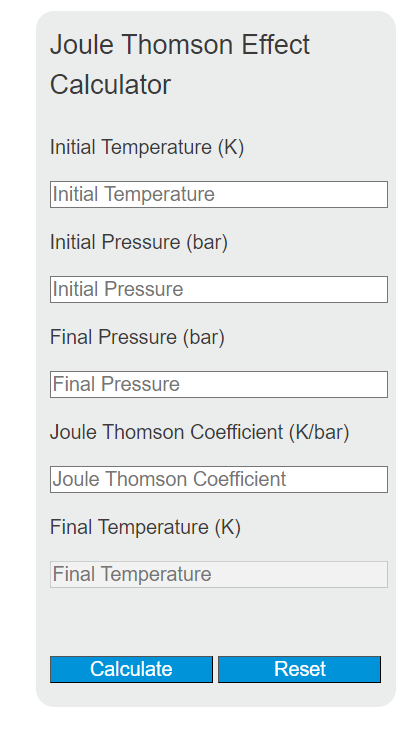
Calculate gas outlet temperature and heating or cooling from a Joule-Thomson coefficient and pressure change, or solve the coefficient from inlet and outlet conditions.
Joule Thomson Effect Formula
The following formula is used to calculate the final temperature of a gas after expansion through the Joule Thomson effect.
Variables:
- Tf is the final temperature of the gas (K)
- Ti is the initial temperature of the gas (K)
- μ is the Joule Thomson coefficient (K/bar)
- Pi is the initial pressure of the gas (bar)
- Pf is the final pressure of the gas (bar)
To calculate the final temperature of a gas after expansion, subtract the final pressure from the initial pressure, multiply the result by the Joule Thomson coefficient, and add the initial temperature.
What is the Joule Thomson Effect?
The Joule Thomson effect describes the temperature change of a real gas or liquid when it is forced through a valve or porous plug while keeping it insulated so that no heat is exchanged with the environment. This process, called a throttling process or Joule Thomson expansion, is an isenthalpic process (occurs at constant enthalpy). The effect is used in refrigeration and liquefaction of gases.
How to Calculate Final Temperature using Joule Thomson Effect?
The following steps outline how to calculate the final temperature of a gas after expansion using the Joule Thomson effect.
- First, determine the initial temperature of the gas (Ti) in Kelvin.
- Next, determine the initial pressure of the gas (Pi) in bar.
- Next, determine the final pressure of the gas (Pf) in bar.
- Next, determine the Joule Thomson coefficient (μ) in Kelvin per bar.
- Next, gather the formula from above = Tf = Ti + μ * (Pi – Pf).
- Finally, calculate the final temperature (Tf) in Kelvin.
- After inserting the variables and calculating the result, check your answer with the calculator above.
Example Problem :
Use the following variables as an example problem to test your knowledge.
Initial temperature of the gas (Ti) = 300 K
Initial pressure of the gas (Pi) = 10 bar
Final pressure of the gas (Pf) = 1 bar
Joule Thomson coefficient (μ) = 0.25 K/bar