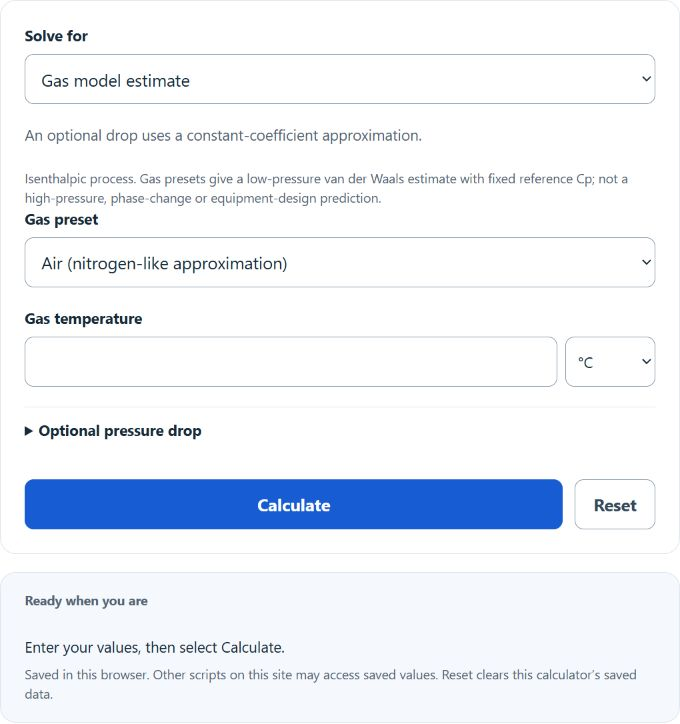
Estimate the Joule–Thomson coefficient with a low-pressure gas model, calculate signed temperature change from a supplied coefficient, or estimate the coefficient from measured isenthalpic changes. The gas model uses fixed reference heat capacities and is not a high-pressure or phase-change prediction.
Joule–Thomson Coefficient Formula
The following example problem outlines the steps and information needed to estimate the Joule–Thomson coefficient from measured changes during an isenthalpic (throttling) process.
Variables:
- μJT is the Joule–Thomson coefficient (K/Pa, often reported as K/bar). For temperature differences, K and °C are numerically identical.
- ΔT is the signed temperature change, ΔT = T₂ − T₁ (K or °C)
- ΔP is the signed pressure change, ΔP = P₂ − P₁ (Pa)
To estimate μJT from data, divide the measured temperature change by the measured pressure change from the same isenthalpic throttling event (use the signed changes, not just magnitudes).
How to Calculate Joule–Thomson Coefficient?
The following steps outline how to estimate the Joule–Thomson coefficient from a throttling (isenthalpic) process.
- Measure the initial and final temperatures and compute the signed change ΔT = T₂ − T₁ (K or °C).
- Measure the initial and final pressures and compute the signed change ΔP = P₂ − P₁ (Pa).
- Use the estimate μJT ≈ ΔT/ΔP (a finite-difference form of (∂T/∂P)H).
- Compute μJT and report units (K/Pa or K/bar).
- After inserting the variables and calculating the result, check your answer with the calculator above.
Example Problem :
Use the following variables as an example problem to test your knowledge (signed changes for a pressure drop through a valve):
change in temperature ΔT = T₂ − T₁ (°C) = −5
change in pressure ΔP = P₂ − P₁ (Pa) = −1,000,000
μJT ≈ ΔT / ΔP = (−5) / (−1,000,000) = 0.000005 K/Pa = 0.5 K/bar