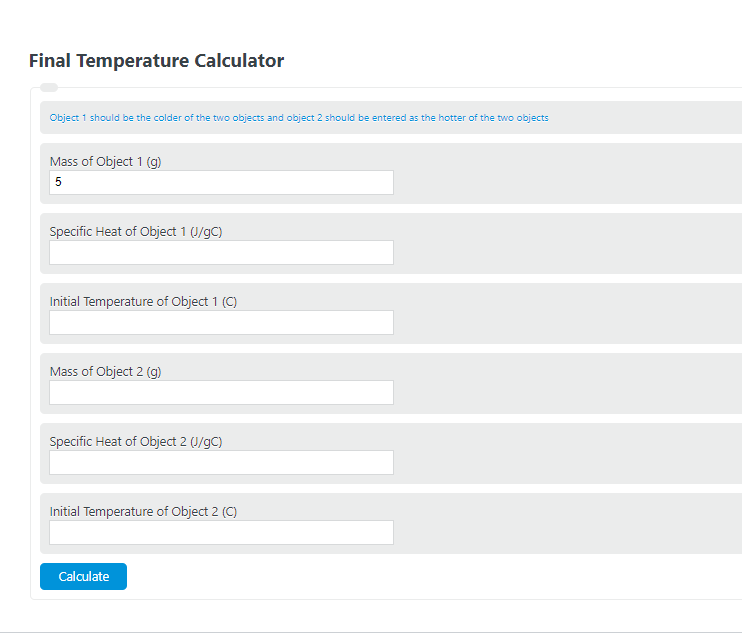
Calculate an ideal final temperature for two bodies, temperature after added heat, or the second mass needed to reach a target.
- All Physics Calculators
- Specific Heat Calculator
- Joule Calculator
- Mixed Air Temperature Calculator
- Water Temperature Calculator
- Compressed Air Temperature Calculator
Final Temperature Formula (Richmann’s Law)
The final temperature when two substances reach thermal equilibrium is derived from the conservation of energy: the heat lost by the hotter substance equals the heat gained by the cooler substance. This relationship was first formalized by the Baltic German physicist Georg Wilhelm Richmann in 1750 and is known as Richmann’s law of mixtures.
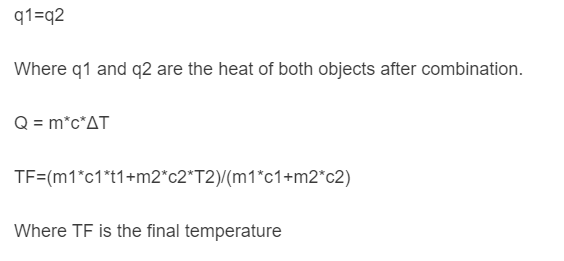
The general formula for two different substances is:
Where Tf is the final equilibrium temperature, m1 and m2 are the masses of substances 1 and 2, c1 and c2 are their specific heat capacities, and T1 and T2 are their initial temperatures.
This formula is derived from setting the heat equations equal:
The left side represents heat released by the warmer object, and the right side represents heat absorbed by the cooler object. Solving for Tf yields the weighted average formula above.
When mixing two amounts of the same substance (for example, hot and cold water), the specific heats cancel and the formula simplifies to:
This simplified version is just a mass-weighted average of the two temperatures.
What Is Thermal Equilibrium?
Thermal equilibrium is the state reached when two objects in thermal contact stop exchanging net heat energy because they have reached the same temperature. This concept is so fundamental to thermodynamics that it forms the basis of the Zeroth Law of Thermodynamics: if object A is in thermal equilibrium with object B, and object B is in thermal equilibrium with object C, then A and C are also in thermal equilibrium with each other. This transitive property is what makes temperature measurement with thermometers possible.
The final temperature always lies between the initial temperatures of the two substances. It will be closer to the initial temperature of whichever substance has the larger thermal mass (the product of mass times specific heat, m*c). A substance with high thermal mass resists temperature change. This is why dropping a small piece of hot metal into a large body of water barely changes the water’s temperature: water’s thermal mass dominates the system.
The time required to reach equilibrium depends on the thermal conductivity of the materials and the surface area of contact, but the final temperature itself depends only on mass, specific heat, and initial temperature.
Specific Heat Capacity Reference Table
The table below lists specific heat capacities for common substances at approximately 25°C and 1 atm. Use these values with the calculator above.
| Substance | Specific Heat (J/g°C) | Category |
|---|---|---|
| Water (liquid) | 4.184 | Liquid |
| Ethanol | 2.440 | Liquid |
| Vegetable Oil | 2.000 | Liquid |
| Glycerin | 2.430 | Liquid |
| Mercury | 0.139 | Liquid Metal |
| Ice (at 0°C) | 2.090 | Solid |
| Steam (at 100°C) | 2.010 | Gas |
| Aluminum | 0.897 | Metal |
| Steel (carbon) | 0.466 | Metal |
| Copper | 0.385 | Metal |
| Iron | 0.449 | Metal |
| Silver | 0.235 | Metal |
| Gold | 0.129 | Metal |
| Lead | 0.128 | Metal |
| Titanium | 0.523 | Metal |
| Brass | 0.380 | Metal |
| Glass | 0.840 | Solid |
| Concrete | 0.880 | Solid |
| Granite | 0.790 | Solid |
| Wood (oak) | 2.000 | Solid |
| Air (dry, 25°C) | 1.006 | Gas |
Notice the enormous range: water stores over 32 times more heat per gram per degree than lead. This is why water is used as a coolant in engines, nuclear reactors, and industrial processes. Gold and lead, with their very low specific heats, change temperature rapidly with small energy inputs.
Assumptions and Limitations
The final temperature formula above is valid only under specific conditions. Violating any of these assumptions will produce incorrect results:
No phase changes. The formula assumes both substances remain in the same phase throughout the process. If mixing hot water into ice causes the ice to melt, the latent heat of fusion (334 J/g for water) absorbs a large amount of energy without changing temperature. In that case, you must account for the phase change energy separately before applying the equilibrium formula to the resulting liquid. If your calculated final temperature falls below 0°C or above 100°C for a water system, that is a signal that a phase change occurs and the simple formula does not apply directly.
Closed system with no heat loss. The formula assumes all heat transfer occurs between the two substances only. In practice, the container (calorimeter), surrounding air, and any stirring rod also absorb or release heat. Laboratory calorimeters account for this with a calorimeter constant (Ccal), typically measured in J/°C, which is added to the denominator of the formula.
Uniform initial temperatures. Each substance must be at a uniform temperature throughout. If a metal bar is glowing red on one end and cool on the other, using a single “initial temperature” value will not produce accurate results.
Constant specific heat. Specific heat capacity actually varies with temperature, though for most common substances the variation is small enough over moderate temperature ranges (within a few hundred degrees) to be negligible. For extreme temperature differences, such as heating metals from cryogenic to near-melting temperatures, temperature-dependent specific heat data should be used.
No chemical reactions. If the two substances react when mixed (for example, an acid and a base), the heat of reaction adds to or subtracts from the thermal energy budget, and the simple formula no longer applies.
Real-World Applications
Metallurgy and quenching. When a blacksmith quenches a heated steel workpiece in a water or oil bath, the final temperature formula predicts the equilibrium temperature of the quench bath after the piece is submerged. In industrial heat treatment, engineers calculate the required quench bath volume to ensure the bath temperature stays below a critical threshold. A 2 kg steel part at 850°C dropped into 20 liters of 25°C water will raise the bath to only about 34°C, because water’s thermal mass is so dominant.
HVAC and mixed air streams. Air handling units in commercial buildings frequently mix outdoor air with recirculated indoor air. The mixed air temperature is calculated using the same weighted-average principle, with mass flow rates replacing static masses. An HVAC engineer designing a system for a building in a northern climate must ensure the mixed air temperature stays above freezing to prevent coil icing.
Cooking and food safety. When adding cold ingredients to hot liquids (stock, sauces, frying oil), the temperature drop follows the same physics. Restaurant food safety protocols rely on understanding that adding 1 kg of cold (5°C) chicken to 3 kg of boiling (100°C) stock will drop the temperature to roughly 76°C. Knowing this allows chefs to maintain temperatures above the 74°C threshold required to kill harmful bacteria like Salmonella.
Calorimetry in chemistry. In lab settings, calorimetry experiments use the final temperature formula in reverse: by measuring the final temperature of a known mass of water after a substance is added, the specific heat of the unknown substance can be determined. This is one of the oldest quantitative techniques in chemistry, dating back to Joseph Black’s experiments on latent heat in 1761.
Thermal energy storage. Solar thermal systems and industrial waste heat recovery systems store energy in large water tanks or molten salt reservoirs. Engineers use the equilibrium temperature calculation to size these storage tanks. Water’s high specific heat (4.184 J/g°C) makes it one of the most cost-effective thermal storage media available.