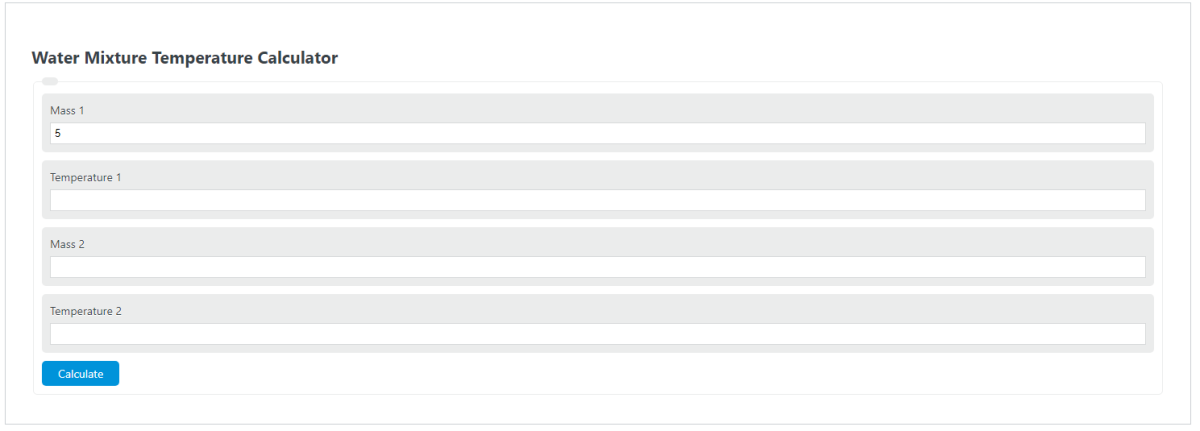
Calculate the final temperature when mixing hot and cold water, or find each volume needed for a target temperature, in °C, °F, and common volume units.
- All Physics Calculators
- Final Temperature Calculator
- Mixed Air Temperature Calculator
- Delta T Calculator (Change in T)
- Total Energy To Heat Water Calculator
- Water Temperature at Depth Calculator
Water Mixture Temperature Formula and Guide
The water temperature calculator finds the final temperature after mixing two amounts of water at different starting temperatures. Because both substances are water, the specific heat is the same on both sides of the energy balance, so the result becomes a mass-weighted average of the two temperatures.
| Variable | Meaning | Common Units |
|---|---|---|
| WT | Final mixed water temperature | °C, °F, K |
| m1 | Mass of the first water portion | kg, g, lb |
| T1 | Starting temperature of the first water portion | °C, °F, K |
| m2 | Mass of the second water portion | kg, g, lb |
| T2 | Starting temperature of the second water portion | °C, °F, K |
How the Calculation Works
Each water portion contributes thermal energy in proportion to its mass and temperature. A larger mass pulls the final temperature closer to its own starting temperature, which is why this is called a weighted average rather than a simple average.
- Enter the mass of the first and second water portions.
- Enter the starting temperature for each portion.
- Keep both masses in the same mass unit.
- Keep both temperatures in the same temperature scale.
- The calculator returns the equilibrium temperature of the mixture.
Rearranged Forms
If you know any four values, you can solve for the fifth. These rearrangements are useful for estimating how much hot or cold water is needed to reach a target temperature.
Solve for the first temperature:
Solve for the second temperature:
Solve for the first mass:
Solve for the second mass:
Quick Interpretation Rules
- The final temperature must fall between the two starting temperatures.
- If one mass is much larger than the other, the final temperature will be much closer to the larger mass temperature.
- If both masses are equal, the final temperature becomes the simple average of the two temperatures.
- If both starting temperatures are the same, mixing does not change the temperature.
Equal-mass shortcut:
Example
If 200 g of water at 50°C is mixed with 100 g of water at 40°C, the final temperature is found by substituting those values into the mixture equation.
This result is closer to 50°C than to 40°C because the hotter water has the greater mass.
When This Calculator Is Accurate
- Both materials are liquid water.
- No meaningful heat is lost to the air, pipes, or container.
- No ice melting or boiling occurs during mixing.
- The container itself does not absorb a significant amount of heat.
- The two temperature entries use the same scale throughout the calculation.
Common Mistakes
- Mixing temperature scales: Do not combine one input in °C and another in °F unless you convert first.
- Mixing mass units: Convert all masses to the same unit before calculating.
- Using the formula for different liquids: This simplified form is for water-to-water mixing. Other substances require specific heat to be included.
- Ignoring container heat loss: Real-world results may be slightly lower or higher if the container is hot or cold.
- Using phase-change conditions: If ice or steam is involved, latent heat must be considered, so this simple model will not be sufficient.
Helpful Notes
For everyday estimating, many people think in terms of hot water and cold water amounts rather than energy. This calculator converts that situation into a fast, reliable temperature estimate for bathing, cleaning, laboratory preparation, cooking, and general fluid mixing where the material is plain water.
If you only know water volume, convert to mass first for the best accuracy. For ordinary practical use with liquid water, volume-based estimates can be close, but mass is the correct basis for the calculation.