Calculate joules of kinetic energy from mass and speed in m/s, find speed from joules, or get energy from power and time, force and distance, or volts.
Calculator Functions
| Function | What it does | What it requires |
|---|---|---|
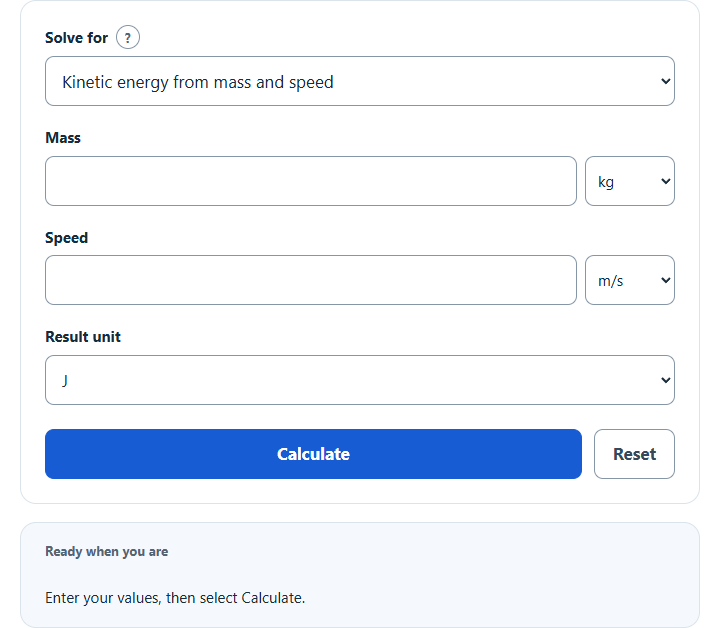
| Kinetic energy from mass and speed | Finds the kinetic energy of a moving object in joules | Requires mass and speed |
| Speed from kinetic energy and mass | Finds the speed of an object from its kinetic energy | Requires kinetic energy and mass |
| Mass from kinetic energy and speed | Finds the mass of an object from its kinetic energy | Requires kinetic energy and speed |
| Energy from power and time | Finds the energy delivered by a steady power over a period | Requires power and elapsed time |
| Power from energy and time | Finds the average power that delivers an amount of energy in a period | Requires energy and elapsed time |
| Time from energy and power | Finds how long a power takes to deliver an amount of energy | Requires energy and power |
| Work from force and distance | Finds the work done by a constant force along a straight path | Requires force, distance and the angle between them |
| Force from work and distance | Finds the force that does an amount of work over a distance | Requires work, distance and the angle between force and path |
| Distance from work and force | Finds the distance over which a force does an amount of work | Requires work, force and the angle between force and path |
| DC energy from voltage, current and time | Finds the electrical energy delivered by a steady DC voltage and current | Requires voltage, current and elapsed time |
| DC voltage from energy, current and time | Finds the DC voltage that delivers an amount of energy | Requires energy, current and elapsed time |
| DC current from energy, voltage and time | Finds the DC current that delivers an amount of energy | Requires energy, voltage and elapsed time |
| DC time from energy, voltage and current | Finds how long a DC voltage and current take to deliver an amount of energy | Requires energy, voltage and current |
| Convert energy units | Converts an energy value from one unit to another | Requires an energy value and a result unit |
Every function has a result unit. Energy can be entered or shown in J, kJ, MJ, Wh, kWh, thermochemical calories and kilocalories, Btu (IT), ft·lbf, eV, keV, MeV or GeV. Mass accepts kg, g or lb, speed accepts m/s, km/h, mph or ft/s, and the angle in the work functions is 0° unless changed.
Joule Formulas
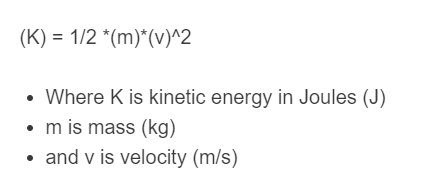
| K | Kinetic energy (J) |
| m | Mass (kg) |
| v | Speed (m/s) |
A joule is the SI unit of energy and work. One joule is one newton acting through one meter, and one watt is one joule per second [3]. In base units a joule is 1 kg·m²/s², which is why mass in kilograms and speed in meters per second give kinetic energy directly in joules.
Kinetic energy from mass and speed
The main formula applies directly. A 2 kg object moving at 3 m/s has K = ½ × 2 × 3² = 9 J. A mass entered in grams or pounds is converted to kilograms first, so no manual conversion is needed.
m/s to Joules
A speed in m/s has no joule value on its own, because the energy also depends on the mass that is moving. Mass times speed is momentum, not energy. With the mass known, the formula above gives the joules: 1 kg at 1 m/s is 0.5 J, and the same 1 kg at 10 m/s is 50 J, since energy rises with the square of the speed.
Speed from kinetic energy and mass
A kinetic energy of 9 J in a 2 kg object means v = √(2 × 9 ÷ 2) = 3 m/s.
Mass from kinetic energy and speed
A kinetic energy of 9 J at 3 m/s means m = 2 × 9 ÷ 3² = 2 kg.
Energy from power and time
Power is energy per unit of time, so a steady 100 W for 60 s delivers 100 × 60 = 6,000 J.
Power from energy and time
Delivering 6,000 J in 60 s is an average power of 100 W.
Time from energy and power
At 100 W, 6,000 J takes 6,000 ÷ 100 = 60 s.
Work from force and distance
Work is force times distance, and only the part of the force that points along the path does work [2]. θ is the angle between the force and the direction of movement. A 10 N force moving an object 5 m at 60° to the path does 10 × 5 × cos 60° = 25 J. At 90° the work is zero, and beyond 90° it is negative.
Force from work and distance
Work of 25 J over 5 m at 60° needs a force of 25 ÷ (5 × 0.5) = 10 N.
Distance from work and force
Work of 25 J from a 10 N force at 60° takes a distance of 25 ÷ (10 × 0.5) = 5 m.
DC energy from voltage, current and time
A volt is a watt per ampere [3], so voltage times current is power in watts, and multiplying by time gives joules. A 12 V supply delivering 2 A for 60 s provides 12 × 2 × 60 = 1,440 J.
DC voltage from energy, current and time
Energy of 1,440 J from 2 A over 60 s means a voltage of 1,440 ÷ 120 = 12 V.
DC current from energy, voltage and time
Energy of 1,440 J at 12 V over 60 s means a current of 1,440 ÷ 720 = 2 A.
DC time from energy, voltage and current
At 12 V and 2 A, 1,440 J takes 1,440 ÷ 24 = 60 s.
Convert energy units
The value is converted to joules and then to the result unit. One kilowatt hour is 3,600,000 J, one thermochemical calorie is 4.184 J, one Btu (IT) is 1,055.056 J, one foot pound-force is 1.355818 J and one electronvolt is 1.602177 × 10⁻¹⁹ J [4].
Limits of This Estimate
- The kinetic energy functions use the classical formula, which holds for speeds far below the speed of light. The calculator rejects speeds at or above it.
- The power, work and DC functions assume constant values. A power, force, voltage or current that varies needs its average over the same interval.
- The DC functions do not cover AC circuits, where power also depends on the power factor, and they do not include battery or charger losses.
- The calorie is the thermochemical calorie and the Btu is the International Table Btu. Other definitions of both units differ slightly [4].
Sources
- Feynman, Leighton and Sands, The Feynman Lectures on Physics, Volume I, Chapter 13: kinetic energy as ½mv²
- NASA Glenn Research Center, Work Equals Force Times Distance: work as force times distance along the path, and the joule as a newton times a meter
- NIST Special Publication 811, Chapter 4: the joule, watt and volt in terms of other SI units
- NIST Special Publication 811, Appendix B.8: conversion factors for energy units