Calculate volumetric or gravimetric energy density, solve energy or storage size, or evaluate a battery from voltage, capacity, mass, and volume with unit conversions.
- All Physics Calculators
- All Density Calculators
- Change in Internal Energy Calculator
- Joule Calculator
- Flux Density Calculator
- Battery Energy Density Calculator
Energy Density Formula
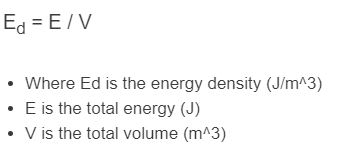
The calculator solves energy density, stored energy, or required storage size using either volume or mass. Battery mode estimates nominal energy as voltage × amp-hour capacity and reports both Wh/kg and Wh/L. Energy density = energy / size; energy = density × size; size = energy / density.
Per volume:
Per mass:
- E — total energy released, in MJ
- V — volume of fuel, in L
- ρ_E — volumetric energy density, in MJ/L
- m — mass of fuel, in kg
- e — specific energy (gravimetric energy density), in MJ/kg
No material values are built into this calculator. Enter values measured or specified for your material and conditions. LHV excludes the heat recovered by condensing product water; HHV includes it. Keep the same heating-value basis when comparing fuels. Battery nominal energy is an estimate from rated voltage and charge capacity, not measured usable energy.
Reference Values
Volumetric energy density measures energy per volume; specific energy measures energy per mass. The approximate reference figures below are illustrative and mix heating-value conventions and system boundaries; they are not calculator presets or a consistent fuel-performance ranking. In particular, the listed hydrogen 142 MJ/kg is HHV, while 8.5 MJ/L represents an approximate liquid LHV figure. Do not combine those two columns to infer a material density. Obtain matching LHV or HHV values and conditions from a suitable supplier or data source for an actual comparison.
| Fuel | MJ/L | MJ/kg | kWh/kg |
|---|---|---|---|
| Diesel | 38.6 | 45.5 | 12.6 |
| Gasoline | 34.2 | 46.4 | 12.9 |
| Jet fuel / kerosene | 35.0 | 43.0 | 11.9 |
| Propane (liquid) | 25.3 | 46.4 | 12.9 |
| Ethanol | 21.1 | 26.8 | 7.4 |
| LNG | 22.2 | 55.5 | 15.4 |
| Liquid hydrogen | 8.5 | 142.0 | 39.4 |
| Coal (bituminous) | — | 24.0 | 6.7 |
| Wood (dry) | — | 16.0 | 4.4 |
| Li-ion battery pack | 2.6 | 0.875 | 0.24 |
Unit conversions you will run into:
| From | To | Multiply by |
|---|---|---|
| MJ | kWh | 0.2778 |
| MJ | BTU | 947.8 |
| kWh | MJ | 3.6 |
| BTU/lb | MJ/kg | 0.002326 |
| kcal/kg | MJ/kg | 0.004184 |
Worked Example
How much energy is in a 50 L tank of gasoline?
Gasoline has a volumetric energy density of 34.2 MJ/L.
E = 50 L × 34.2 MJ/L = 1,710 MJ ≈ 475 kWh.
As a separate illustrative mass calculation, 37 kg × 46.4 MJ/kg = 1,716.8 MJ. Agreement between mass and volume calculations requires both energy-density inputs to use the same fuel, conditions and heating-value basis; the mixed reference table alone does not establish this.
FAQ
Why is liquid hydrogen so weak per liter but so strong per kilogram? Hydrogen has the highest specific energy of any common fuel, but its liquid density is only about 71 kg/m³. You need a large, insulated tank to store a useful amount.
Does this account for engine efficiency? No. The result is chemical, stored or nominal energy on the basis entered. A separate, applicable efficiency is needed to estimate useful shaft or electrical output.
LHV or HHV? There are no built-in fuel values. Enter an LHV or HHV consistent with your application and keep that convention in all comparisons.
Can I use this for natural gas at pipeline pressure? Enter a mass-specific value matching your gas composition and heating-value basis, or a volumetric value matching its pressure and temperature. A cryogenic LNG volume is not interchangeable with pipeline gas volume.