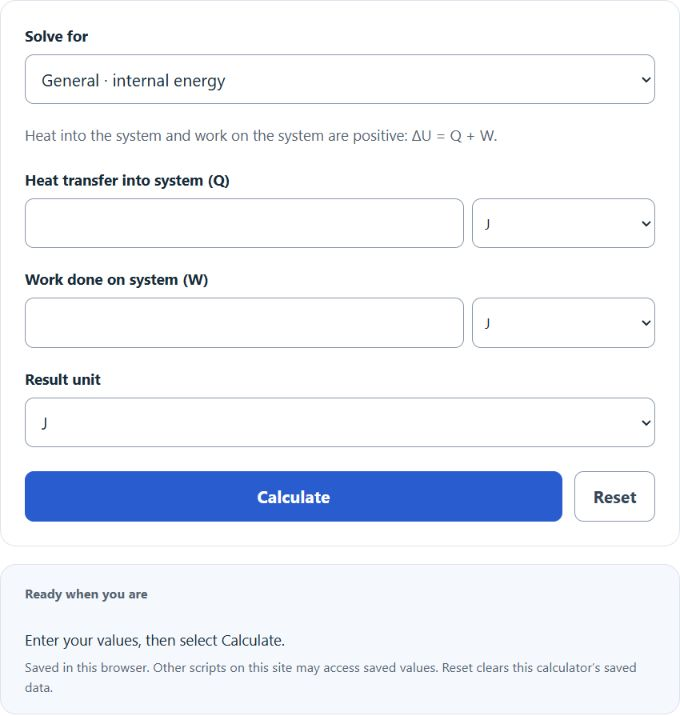
Calculate change in internal energy, heat transfer, work, pressure, or volume using the first law and constant-pressure PΔV relationships.
- All Physics Calculators
- Conservation of Energy Calculator
- Thermal Efficiency Calculator
- Linear Energy Transfer Calculator
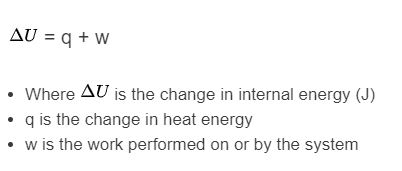
Change in Internal Energy Formula
The calculator uses the first law of thermodynamics. In the General mode, work is treated as work done on the system, so positive work increases internal energy.
- ΔU = change in internal energy
- Q = heat transferred to the system
- W = work done on the system
For the General mode, select the quantity to calculate, then enter the other two values:
In the Constant Pressure mode, the calculator assumes a closed system, constant external absolute pressure, and only pressure-volume work. The formula used is:
- ΔU = change in internal energy
- Qp = heat transfer at constant pressure
- P = constant external absolute pressure
- ΔV = change in volume
- PΔV = pressure-volume work term
For the Constant Pressure mode, the calculator can also rearrange the equation to solve for heat transfer, pressure, or change in volume:
The calculator converts energy values to joules, pressure values to pascals, and volume values to cubic meters before applying the formulas. The result is then converted back to the unit you selected.
Energy, Pressure, and Volume Conversions
These are the base conversions used in the calculations.
| Quantity | Unit | Equivalent in base unit |
|---|---|---|
| Energy | 1 kJ | 1000 J |
| Energy | 1 cal | 4.184 J |
| Energy | 1 kcal | 4184 J |
| Pressure | 1 kPa | 1000 Pa |
| Pressure | 1 bar | 100,000 Pa |
| Pressure | 1 atm | 101,325 Pa |
| Volume | 1 L | 0.001 m³ |
| Volume | 1 cm³ | 0.000001 m³ |
Sign Meaning for Internal Energy Results
| Value | Meaning |
|---|---|
| Positive ΔU | The system’s internal energy increased. |
| Negative ΔU | The system’s internal energy decreased. |
| Positive Q | Heat is added to the system. |
| Negative Q | Heat leaves the system. |
| Positive W in General mode | Work is done on the system. |
| Negative W in General mode | Work is done by the system. |
Examples
Example 1: General first law calculation
Suppose heat transfer is 500 J and work done on the system is -120 J. Find the change in internal energy.
The change in internal energy is 380 J.
Example 2: Constant pressure calculation
Suppose heat transfer at constant pressure is 2.50 kJ, pressure is 100 kPa, and change in volume is 3.0 L. Find the change in internal energy.
Convert the values used in the pressure-volume term:
Since 2.50 kJ equals 2500 J:
The change in internal energy is 2200 J, or 2.20 kJ.
FAQ
What sign convention does this calculator use for work?
In General mode, work is entered as work done on the system. That means positive work increases internal energy and negative work decreases internal energy. The formula is ΔU = Q + W.
Why is PΔV subtracted in the constant pressure formula?
At constant pressure, expansion uses energy to do pressure-volume work. With the calculator’s convention, the internal energy change is calculated as ΔU = Qp – PΔV. If volume increases, ΔV is positive and the PΔV term reduces ΔU. If volume decreases, ΔV is negative and subtracting PΔV increases ΔU.
Why do pressure and volume multiply to give energy?
Pressure has units of pascals, and volume has units of cubic meters. Since 1 Pa equals 1 N/m², Pa·m³ becomes N·m, which is the same as a joule. That is why PΔV is an energy term.