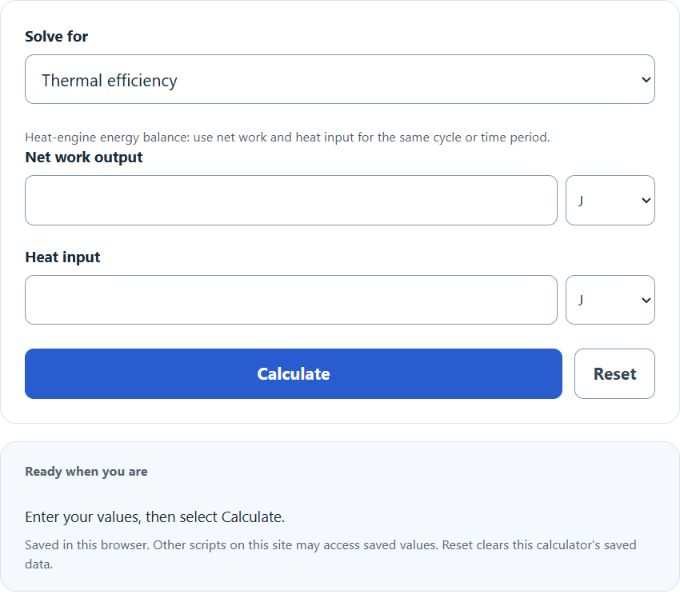
Choose thermal efficiency, net work output, or heat input and enter the two known values. Use the same cycle or time period; joules, kilojoules, thermochemical calories and international-table Btu are supported.
- All Physics Calculators
- All Efficiency Calculators
- Efficiency Ratio Calculator
- LMTD (Logarithmic Mean Temperature Difference) Calculator
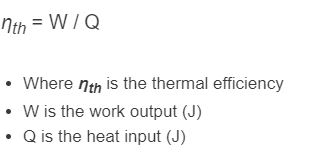
Thermal Efficiency Formula
Thermal efficiency measures how much of the supplied heat is converted into useful work. It is a dimensionless performance ratio for heat engines, power cycles, and other thermodynamic systems, but it is usually reported as a percentage.
When you want the answer in percent, multiply the ratio by 100.
| Quantity | Meaning | Typical units |
|---|---|---|
| Thermal efficiency | The fraction of heat input converted into useful work | Decimal or percent |
| Work output | Net work produced by the engine or cycle | J, kJ, cal, BTU |
| Heat input | Total thermal energy supplied to the system | J, kJ, cal, BTU |
Rearranged Equations
If you know any two values, the missing value can be found directly. This is useful when sizing a system, checking test data, or back-calculating required heat input.
Use efficiency as a decimal when applying the rearranged equations. If your efficiency is shown as a percentage, convert it before solving.
How to Use the Thermal Efficiency Calculator
- Enter the useful work output produced by the system.
- Enter the total heat input supplied to the system.
- Make sure the energy units are compatible.
- Calculate the efficiency and interpret the result as the share of heat converted into useful work.
This calculator is most useful when all values refer to the same engine cycle, operating period, or test condition.
Example Calculation
If a heat engine receives 2500 J of heat and produces 800 J of useful work, the thermal efficiency is:
That means 32% of the input heat became useful work, while the remaining energy left the system as waste heat, exhaust losses, cooling losses, friction, or other irreversibilities.
Related Energy Balance
In many applications, it is also helpful to estimate the heat rejected by the system.
This relationship helps explain why even a reasonably efficient engine still rejects a large amount of energy.
How to Interpret the Result
- Low efficiency: Only a small portion of the supplied heat becomes useful work.
- Higher efficiency: A larger share of the heat input is converted into useful output.
- Zero percent: No useful work is produced.
- One hundred percent: Perfect conversion of heat into work, which real heat engines do not achieve.
- Above one hundred percent: Usually indicates mixed units, incorrect measurements, or an input mistake.
Common Reasons Thermal Efficiency Is Limited
- Heat loss to the surroundings
- Mechanical friction
- Incomplete combustion or imperfect heat release
- Pumping and auxiliary power losses
- Irreversibilities during compression and expansion
- Exhaust energy that leaves before being converted into work
Theoretical Maximum Efficiency
For an ideal heat engine operating between a hot reservoir and a cold reservoir, the maximum possible efficiency is bounded by the Carnot limit.
Absolute temperature must be used for this relationship, typically in kelvins. Real systems always operate below this theoretical maximum because real processes include losses and non-ideal behavior.
Applications of Thermal Efficiency
- Internal combustion engines
- Steam turbines and Rankine cycles
- Gas turbines and Brayton cycles
- Heat engines and power-plant cycles (boiler heat-delivery efficiency uses a different useful-output definition)
- Laboratory heat-engine experiments
- Energy audits and performance testing
Common Mistakes to Avoid
- Using heat input and work output from different time periods
- Mixing units without converting them properly
- Confusing gross heat input with net usable heat input
- Using percentage form in place of decimal form when rearranging equations
- Treating thermal efficiency as the same metric as overall plant efficiency or electrical efficiency
FAQ
What does thermal efficiency tell you?
It tells you how effectively a system converts thermal energy into useful work. A higher value means less of the input heat is being wasted.
Can thermal efficiency be negative?
Not for a correctly defined heat engine operating normally. A negative result usually points to sign convention issues or incorrect data entry.
Can I use kilojoules, calories, or BTU?
Yes. Any energy unit can be used as long as the heat input and work output are expressed consistently.
Is thermal efficiency the same as coefficient of performance?
No. Thermal efficiency is used for heat engines that convert heat into work, while coefficient of performance is used for refrigerators and heat pumps.