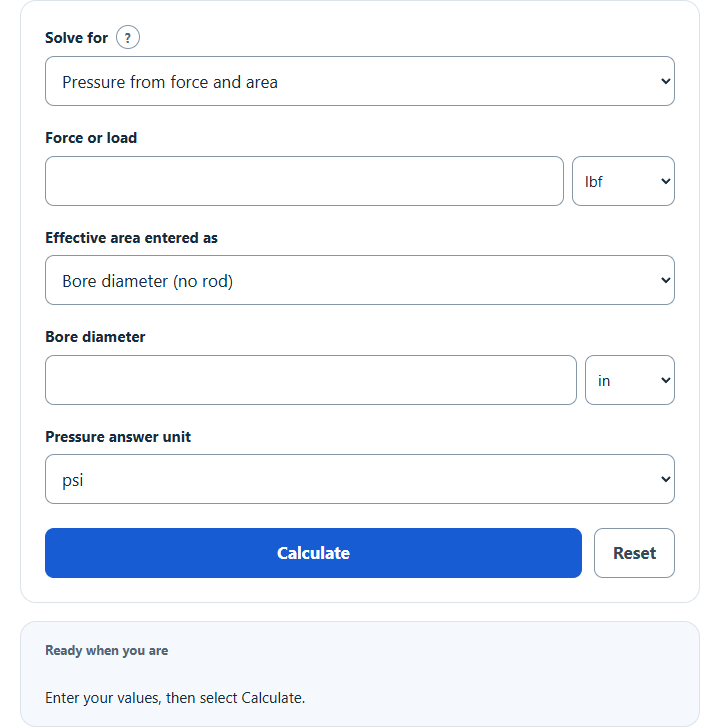
Calculate cylinder pressure from force and bore diameter, or cylinder force from pressure, in psi, bar, lbf or kN, including hydraulic rod-side area.
- All Physics Calculators
- All Pressure Calculators
- Cylinder Force Calculator
- Ground Pressure Calculator
- Pump Pressure Calculator
- Cylinder Density Calculator
Cylinder Pressure Formula
The following formula is used to calculate the Cylinder Pressure.
- Where Pc is the Cylinder Pressure (N/m2)
- Fc is the cylinder force (N)
- Ac is the cylinder area (m2)
To calculate ideal cylinder pressure, divide force by the effective area: full bore area for extension or annular area for retraction. Opposite-side gauge pressure is assumed zero; friction and other losses are excluded. This estimate does not establish rated working pressure or a safe load.
How to Calculate Cylinder Pressure?
The following two example problems outline how to calculate the Cylinder Pressure.
Example Problem #1:
- First, determine the cylinder force (N). In this example, the cylinder force (N) is given as 400.
- Next, determine the cylinder area (m2). For this problem, the cylinder area (m2) is given as 15.
- Finally, calculate the Cylinder Pressure using the equation above:
Pc = Fc / Ac
Inserting the values from above and solving the equation:
Pc = 400 / 15 ≈ 26.666667 (N/m2)
Example Problem #2:
Using the same process as above, first define the variables required by the formula. In this case, these values are:
cylinder force (N) = 560
cylinder area (m2) = 50
Entering these values yields:
Pc = 560 / 50 = 11.2 (N/m2)