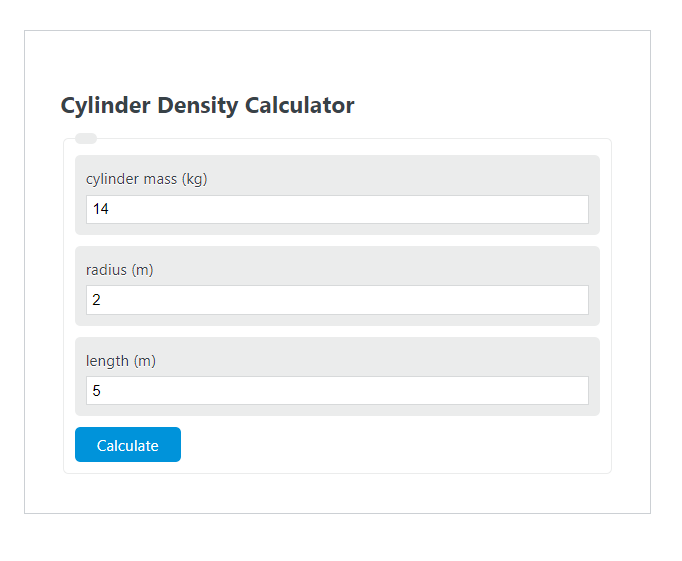
Calculate cylinder density or mass from diameter or radius, length, and volume using g/cm³, kg/m³, or lb/ft³ units for any cylinder.
- All Physics Calculators
- All Density Calculators
- Weight to Density Calculator
- Liquid Density Calculator
- Cylinder Mass calculator
Cylinder Density Formula
Density is mass divided by volume. For a cylinder, the volume comes from the radius and length, so the density formula expands into the form below.
If you already know the volume, the calculator uses the simpler form:
If you know density and want mass, it rearranges to:
- rho = density of the cylinder
- m = mass of the cylinder
- V = volume of the cylinder
- r = radius (half of the diameter)
- h = length or height of the cylinder
The three calculator modes match these three forms:
- Density: size uses mass plus diameter or radius and length. It builds the volume for you, then divides mass by volume.
- Density: volume skips the geometry. Enter mass and a measured volume and you get density directly.
- Find mass reverses the process. Enter a known density with the cylinder dimensions to predict the mass.
Reference Tables
Use these to sanity-check a result or to pick a density when you only know the material.
| Material | g/cm³ | kg/m³ | lb/ft³ |
|---|---|---|---|
| Pine wood | 0.50 | 500 | 31.2 |
| Water (4 °C) | 1.00 | 1000 | 62.4 |
| Concrete | 2.40 | 2400 | 149.8 |
| Aluminum | 2.70 | 2700 | 168.6 |
| Steel | 7.85 | 7850 | 490.1 |
| Copper | 8.96 | 8960 | 559.4 |
| Lead | 11.34 | 11340 | 707.9 |
| Convert from | To | Multiply by |
|---|---|---|
| g/cm³ | kg/m³ | 1000 |
| g/cm³ | lb/ft³ | 62.428 |
| kg/m³ | lb/ft³ | 0.06243 |
| lb/ft³ | kg/m³ | 16.0185 |
Worked Examples
Example 1: Aluminum rod. A solid rod is 2 cm in diameter and 10 cm long, with a mass of 84.8 g.
- Radius = 1 cm, so V = pi * 1² * 10 = 31.416 cm³
- rho = 84.8 / 31.416 = 2.70 g/cm³
That matches aluminum on the table above.
Example 2: Predicting mass of a steel pin. Steel density is 7.85 g/cm³. A pin has a 5 mm diameter and is 40 mm long.
- Radius = 2.5 mm = 0.25 cm, length = 4 cm
- V = pi * 0.25² * 4 = 0.7854 cm³
- m = 7.85 * 0.7854 = 6.16 g
FAQ
Should I enter the diameter or the radius? Either works. Use the dropdown under the base measurement to tell the calculator which one you typed. Most calipers and rulers measure diameter, so that is the default.
Why does my measured density not match the table? Common causes are hollow sections, internal porosity, surface coatings, or measurement error on small dimensions. The radius is squared in the formula, so a small error on diameter has a large effect on density.
Does this work for hollow tubes? No. The size mode assumes a solid cylinder. For a tube, measure the volume by water displacement and use the volume mode instead.
What units can I mix? Any of the supported units in each dropdown. The calculator converts everything to SI internally, then displays the result in the unit you pick.