Calculate volumetric flow rate from pipe size and flow velocity or from volume and time, or convert flow rate to velocity, pipe diameter or mass flow.
- All Physics Calculators
- Water Flow Rate Calculator
- Pipe Flow Calculator
- SCCM Calculator
- RPM to Flow Rate Calculator
Calculator Functions
| Function | What it does | What it requires |
|---|---|---|
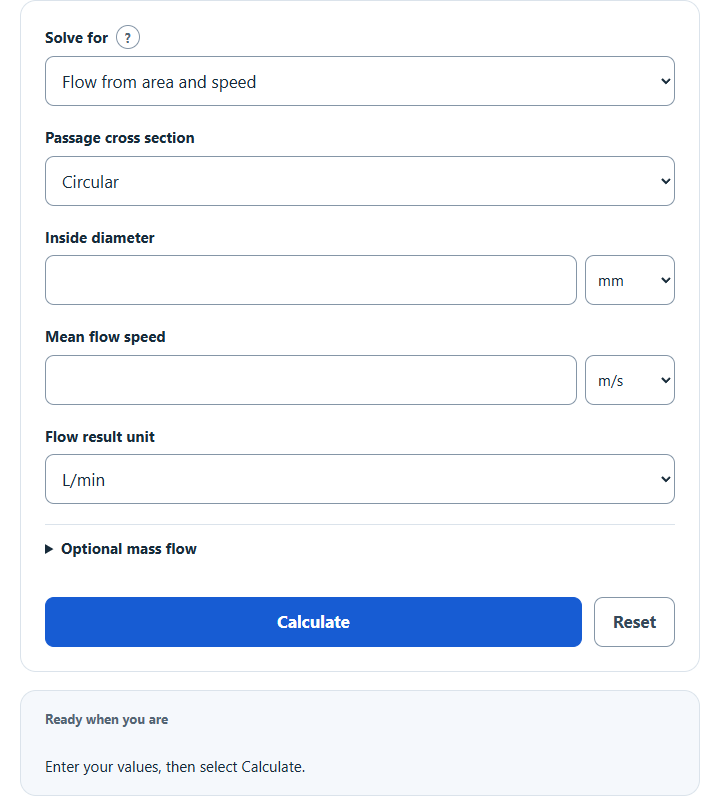
| Flow from area and speed | Finds the volumetric flow rate through a pipe, duct or other passage | Requires the passage size and the mean flow speed |
| Flow from volume and time | Finds the average flow rate from a measured volume and how long it took | Requires the transferred volume and the elapsed time |
| Mean flow speed | Finds how fast the fluid moves through a passage at a given flow rate | Requires the passage size and the volumetric flow rate |
| Circular inside diameter | Finds the round inside diameter that carries a flow at a chosen speed | Requires the volumetric flow rate and the mean flow speed |
| Transferred or spray volume | Finds the volume delivered at a steady flow rate over a period | Requires the volumetric flow rate and the elapsed time |
| Transfer time | Finds how long a steady flow rate takes to move a given volume | Requires the transferred volume and the volumetric flow rate |
The passage can be Circular (inside diameter), Rectangular (internal width and height) or a Known area. Each function has a result unit selector. Every result also lists the flow in m³/s, L/min, US gpm, CFM and m³/h. The optional Fluid density adds mass flow in kg/s and kg/h.
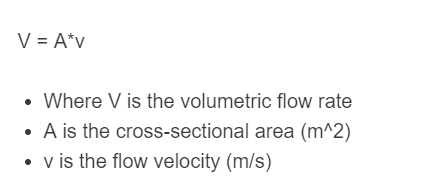
Volumetric Flow Rate Formulas
| Q | Volumetric flow rate (m³/s) |
| A | Open cross-sectional area of the passage (m²) |
| v | Mean flow speed through that area (m/s) |
For a round passage A = π × d² ÷ 4, and for a rectangular one A = width × height.
Flow from area and speed
The formula above applies directly. Water moving at 2 m/s through a 50 mm inside diameter has A = π × 0.05² ÷ 4 = 0.0019635 m², so Q = 0.003927 m³/s, which is 235.6 L/min.
Flow from volume and time
V is the volume moved and t is the time it took. Filling a 200 L drum in 40 s is 5 L/s, or 300 L/min. This is the average over the whole period.
Mean flow speed
A flow of 100 L/min through a 25 mm inside diameter moves at 0.0016667 ÷ 0.00049087 = 3.395 m/s.
Circular inside diameter
Carrying 300 L/min at 2 m/s needs an area of 0.005 ÷ 2 = 0.0025 m², which is a 56.4 mm inside diameter. This is a geometric size, not a pipe selection.
Transferred or spray volume
A sprayer delivering 5 US gpm for 10 minutes puts out 50 US gallons.
Transfer time
Moving 1,000 L at 50 L/min takes 20 minutes, or 1,200 s.
Mass flow
ρ is the fluid density in kg/m³. The density presets are 998 and 1,000 kg/m³ for water and 1.204 kg/m³ for air at 20 °C. At 998 kg/m³, 0.003927 m³/s is 3.919 kg/s.
The unit factors are 0.003785411784 m³ per US gallon, 0.028316846592 m³ per cubic foot, 0.0254 m per inch and 0.00508 m/s per ft/min [2].
Limits of This Estimate
- The speed must be the average across the whole open cross section. Speed measured at one point, such as the center of a pipe, is usually higher than the average.
- Pressure loss, pump behavior and nozzle overlap are not modeled.
- A gas changes volume with pressure and temperature, so its volumetric flow only holds at the conditions where it was measured.
- Mass flow is only as good as the density entered. The presets are for 20 °C.
Sources
- U.S. Bureau of Reclamation, Water Measurement Manual, Chapter 2, Section 4: Discharge-Area-Velocity Relationships: discharge as volume per unit time and as velocity times area
- NIST Special Publication 811, Guide for the Use of the SI, Appendix B.8: US gallon, cubic foot, inch and foot-per-minute conversion factors