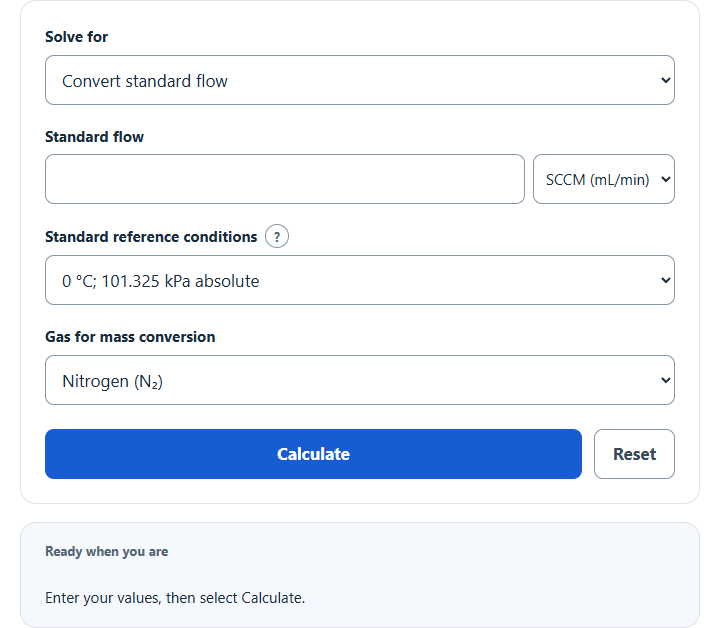
Convert SCCM to SLPM, mL/min, SCFH or SCFM and back, or to molar, mass or actual gas flow, at standard reference conditions such as 0 °C and 1 atm.
- All Unit Converters
- FPM to CFM Calculator
- SLPM to SCFH Calculator
- Volumetric Flow Rate Calculator
- Flow Time Calculator
- CFM to LPM Calculator
- mL per Minute Calculator
Calculator Functions
| Function | What it does | What it requires |
|---|---|---|
| Convert standard flow | Converts a gas flow between SCCM, SLPM, standard mL/min, SCFH and SCFM | Requires the standard flow in SCCM, SLPM, SCFH or SCFM |
| SCCM from mass flow | Converts a gas mass flow to SCCM | Requires the mass flow in mg/min, g/min, g/s or kg/h, the gas and the reference conditions |
| Actual volume flow from SCCM | Finds the real volume flow of the gas at its working temperature and pressure | Requires the standard flow, the reference conditions, and the actual gas temperature and absolute pressure |
| SCCM from standard volume and time | Finds the flow from a gas volume, already stated at standard conditions, delivered over a period | Requires the standard gas volume and the elapsed time |
Every function uses a set of standard reference conditions: 0 °C, 20 °C or 25 °C at 101.325 kPa absolute, or a custom temperature and pressure. Every function also uses a gas: nitrogen, dry air, oxygen, carbon dioxide, hydrogen, helium, argon or a custom molar mass. Each result lists the flow in SCCM, SLPM, mL/min, SCFH and SCFM together with the molar flow in mol/min and the mass flow in g/min.
SCCM Formulas
| q | Flow in SCCM, standard cubic centimeters per minute: the gas flow expressed as the volume it would occupy at the standard reference conditions [1] |
| SLPM | Standard liters per minute, also written SLM |
SCCM is a unit of gas flow. Because the volume is tied to a fixed temperature and pressure, a flow in SCCM describes a fixed amount of gas per minute, whatever the gas temperature and pressure in the line. The reference is not universal. A common definition is 0 °C and 101.325 kPa absolute, while some instruments are referenced to 20 °C, and mixing the two changes a reading by about 7% [1].
Convert standard flow
One SCCM is one standard mL/min, also written cc/min or ccm. A cubic foot is 28,316.846592 cm³ [3], so SCFH = SCCM × 60 ÷ 28,316.846592 and SCFM = SCFH ÷ 60. These conversions keep the same reference conditions on both sides.
| SCCM | SLPM | SCFH |
|---|---|---|
| 1 | 0.001 | 0.002119 |
| 10 | 0.01 | 0.02119 |
| 50 | 0.05 | 0.1059 |
| 100 | 0.1 | 0.2119 |
| 500 | 0.5 | 1.0594 |
| 1,000 | 1 | 2.1189 |
| 5,000 | 5 | 10.5944 |
SCCM from mass flow
ṁ is the mass flow in g/min, M is the molar mass of the gas in g/mol and Vm is the volume of one mole of ideal gas at the reference conditions, in cm³/mol:
R is the molar gas constant, 8.314462618 J/(mol·K) [2], T is the reference temperature in kelvin and P is the reference pressure in kPa. At 101.325 kPa, Vm is 22,413.97 cm³/mol at 0 °C, 24,055.12 at 20 °C and 24,465.40 at 25 °C. One gram per minute of nitrogen (28.0134 g/mol) at the 0 °C reference is 1 ÷ 28.0134 × 22,413.97 = 800.12 SCCM.
Actual volume flow from SCCM
(Ps ÷ P)
Q is the actual flow in cm³/min, T and P are the gas temperature in kelvin and absolute pressure in the line, and Ts and Ps are the reference values. A flow of 1,000 SCCM referenced to 0 °C occupies 1,000 × (298.15 ÷ 273.15) × (101.325 ÷ 200) = 552.99 cm³/min at 25 °C and 200 kPa, which is 0.553 actual L/min. Pressure can be entered in kPa, bar, psia, atm or Torr.
SCCM from standard volume and time
V is the gas volume in cm³ at standard conditions and t is the elapsed time in minutes. Fifty standard cm³ delivered over 500 minutes is 0.1 SCCM. A volume measured at the working temperature and pressure gives actual cm³/min, not SCCM.
Limits of This Estimate
- The reference conditions must match the ones the flow meter or controller was calibrated to. Its manual or calibration sheet states them.
- The mass and actual-volume functions treat the gas as ideal. They apply no real-gas correction and no gas correction factor for an instrument calibrated on a different gas. These estimates are based on the best available data and estimations.
- Pressures are absolute. A gauge reading needs atmospheric pressure added first.
Sources
- Mass Flow ONLINE, What do ln/min, ls/min, slm and sccm stand for?: meaning of sccm and slm, the 0 °C and 20 °C reference conditions, and the 7% difference between them
- NIST, CODATA Value: molar gas constant: value of R
- NIST, Guide for the Use of the International System of Units (SP 811), Appendix B.8: cubic foot, standard atmosphere, psi and torr in SI units