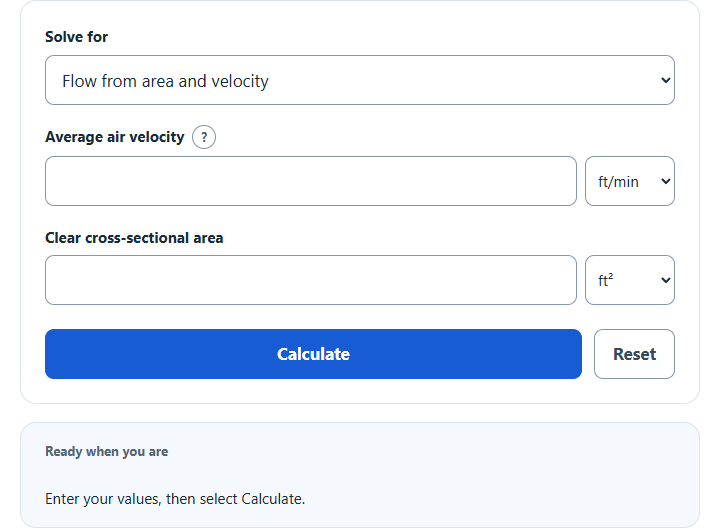
Convert FPM to CFM by multiplying air velocity by duct area, or enter a round or rectangular duct size. Also works backward from CFM to FPM.
- All Unit Converters
- CFM Per Ton Calculator
- CFM to HP Calculator
- lb/hr to SCFM Calculator
- SLPM to SCFH Calculator
- Air Flow Calculator
- CFM to FPS Calculator
- CFM to Square Feet Converter
- Duct Velocity Calculator
Calculator Functions
| Function | What it does | What it requires |
|---|---|---|
| Flow from area and velocity | Converts FPM to CFM for an opening of known area | Requires the average air velocity and the clear cross-sectional area |
| Velocity from flow and area | Converts CFM to FPM for an opening of known area | Requires the volume flow rate and the clear cross-sectional area |
| Area from flow and velocity | Finds the clear area that passes a set flow at a set velocity | Requires the volume flow rate and the average air velocity |
| Flow through a round duct | Converts FPM to CFM in a round duct, working out the area from the diameter | Requires the inside duct diameter and the average air velocity |
| Velocity through a round duct | Converts CFM to FPM in a round duct | Requires the inside duct diameter and the volume flow rate |
| Flow through a rectangular duct | Converts FPM to CFM in a rectangular duct, working out the area from width and height | Requires the inside duct width, the inside duct height and the average air velocity |
| Velocity through a rectangular duct | Converts CFM to FPM in a rectangular duct | Requires the inside duct width, the inside duct height and the volume flow rate |
Velocity can be entered in ft/min, ft/s, m/s or m/min, area in ft², in², m² or yd², flow in CFM or m³/min, and duct dimensions in inches or millimeters. The round duct functions offer 4, 6, 8, 10 and 12 inch diameters as quick picks. Every result also lists the cross-sectional area in ft² and m², the velocity in m/min and m/s, and the flow in m³/min.
FPM to CFM Formula
| CFM | Volume flow rate in cubic feet per minute (ft³/min) |
| FPM | Average air velocity in feet per minute (ft/min) |
| A | Clear cross-sectional area the air moves through (ft²) [1] |
FPM is a speed and CFM is a volume per minute, so FPM cannot be turned into CFM without an area. 100 FPM is 100 CFM through 1 ft², 200 CFM through 2 ft² and about 35 CFM through an 8 inch round duct. CFM and ft³/min are the same unit, so no conversion is needed between them.
Flow from area and velocity
The formula above applies directly: 500 FPM through 2 ft² is 500 × 2 = 1,000 CFM. A velocity in feet per second is multiplied by 60 first, so 10 ft/s is 600 FPM. Metric entries are converted with 1 ft = 0.3048 m exactly [2].
Velocity from flow and area
This is the CFM to FPM conversion. 1,000 CFM through 2 ft² moves at 1,000 ÷ 2 = 500 FPM. The same flow through a smaller opening moves faster.
Area from flow and velocity
1,200 CFM at 800 FPM needs 1,200 ÷ 800 = 1.5 ft² of clear area. A velocity of zero is rejected, because no area can pass a flow at zero speed.
Flow through a round duct
D is the inside diameter in feet, so a diameter in inches is divided by 12 first. An 8 inch duct has an area of π × 0.6667² ÷ 4 = 0.3491 ft², and 1,000 FPM through it is 349.07 CFM.
| FPM | CFM through 1 ft² | CFM in a 6 in round duct | CFM in an 8 in round duct | CFM in a 12 in round duct |
|---|---|---|---|---|
| 100 | 100 | 20 | 35 | 79 |
| 300 | 300 | 59 | 105 | 236 |
| 400 | 400 | 79 | 140 | 314 |
| 500 | 500 | 98 | 175 | 393 |
| 600 | 600 | 118 | 209 | 471 |
| 700 | 700 | 137 | 244 | 550 |
| 800 | 800 | 157 | 279 | 628 |
| 900 | 900 | 177 | 314 | 707 |
| 1,000 | 1,000 | 196 | 349 | 785 |
| 1,200 | 1,200 | 236 | 419 | 942 |
| 1,500 | 1,500 | 295 | 524 | 1,178 |
| 2,000 | 2,000 | 393 | 698 | 1,571 |
| 5,000 | 5,000 | 982 | 1,745 | 3,927 |
Round duct values are rounded to the nearest whole CFM. For another size, multiply the 1 ft² column by the duct area in square feet.
Velocity through a round duct
The area comes from the diameter as above, then FPM = CFM ÷ A. 400 CFM in an 8 inch duct moves at 400 ÷ 0.3491 = 1,145.92 FPM.
Flow through a rectangular duct
W and H are the inside width and height in feet. A 12 by 8 inch duct has an area of 1 × 0.6667 = 0.6667 ft², and 900 FPM through it is 600 CFM.
Velocity through a rectangular duct
The area comes from width times height, then FPM = CFM ÷ A. 600 CFM in a 12 by 8 inch duct moves at 600 ÷ 0.6667 = 900 FPM.
Limits of This Estimate
- The velocity must be the average across the opening. Air moves fastest at the center of a duct, and in a straight round duct the average is about 90% of a centerline reading [1].
- The result is actual CFM at the temperature and pressure of the air being measured. It is not standard CFM (SCFM), which is corrected to dry air at 68 °F and 29.92 in Hg [1], and no density correction is made.
- Area means the clear inside opening. Grilles, louvers, liners and insulation reduce it, and nominal duct sizes can differ from the inside dimension.
Sources
- OSHA Technical Manual, Section III, Chapter 3, Ventilation Investigation: area, velocity and volume flow rate as used for ducts, velocity as flow divided by area, average against centerline velocity, and actual against standard CFM
- NIST, Guide for the Use of the International System of Units (SP 811), Appendix B.8: 1 foot = 0.3048 m, used for the metric units