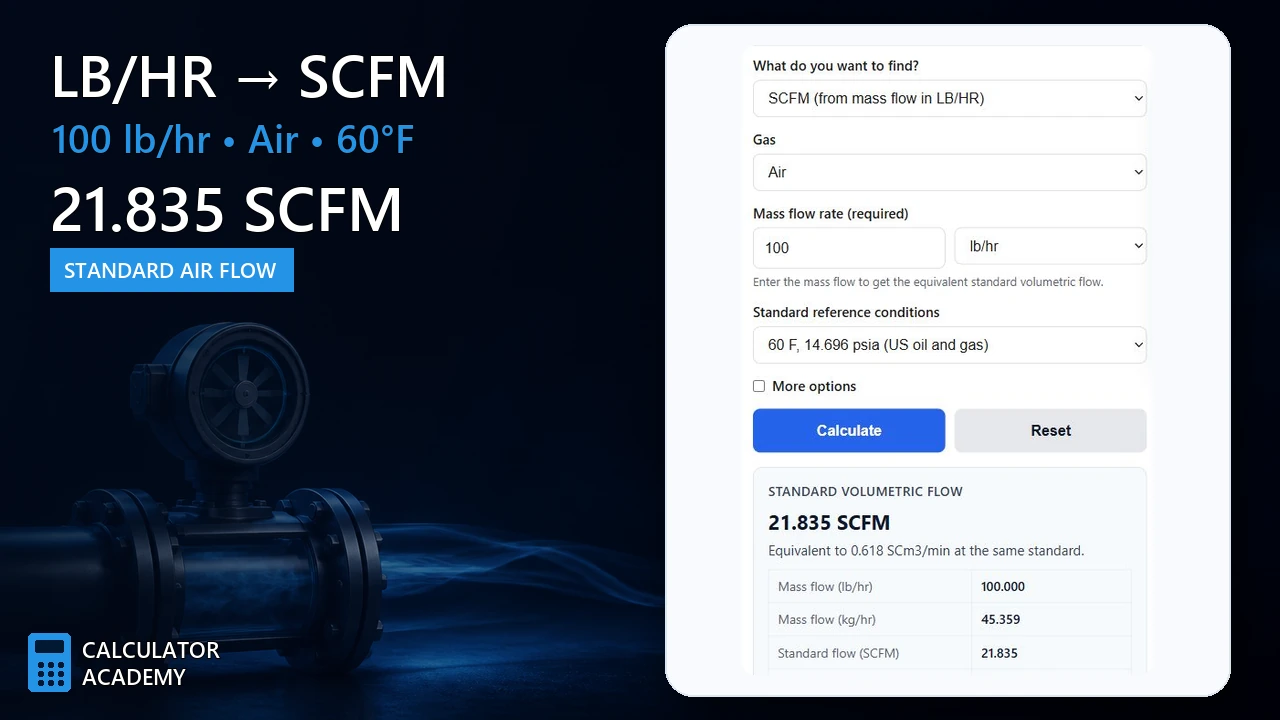
Convert LB/HR to SCFM or SCFM to LB/HR from one entered value, including kg/hr and SCm³/min options for mass and standard volumetric flow rates.
| SCFM to LB/HR | LB/HR to SCFM |
|---|---|
| 0.5 SCFM = 5.22 lb/hr | 10 lb/hr = 0.958 SCFM |
| 1 SCFM = 10.44 lb/hr | 25 lb/hr = 2.395 SCFM |
| 2 SCFM = 20.88 lb/hr | 50 lb/hr = 4.789 SCFM |
| 3 SCFM = 31.32 lb/hr | 100 lb/hr = 9.578 SCFM |
| 5 SCFM = 52.20 lb/hr | 150 lb/hr = 14.367 SCFM |
| 7.5 SCFM = 78.30 lb/hr | 200 lb/hr = 19.156 SCFM |
| 10 SCFM = 104.40 lb/hr | 250 lb/hr = 23.946 SCFM |
| 15 SCFM = 156.60 lb/hr | 500 lb/hr = 47.891 SCFM |
| 20 SCFM = 208.81 lb/hr | 750 lb/hr = 71.837 SCFM |
| 25 SCFM = 261.01 lb/hr | 1000 lb/hr = 95.783 SCFM |
| 30 SCFM = 313.21 lb/hr | 1500 lb/hr = 143.674 SCFM |
| 40 SCFM = 417.61 lb/hr | 2000 lb/hr = 191.565 SCFM |
| 50 SCFM = 522.02 lb/hr | 3000 lb/hr = 287.348 SCFM |
| 75 SCFM = 783.02 lb/hr | 4000 lb/hr = 383.130 SCFM |
| 100 SCFM = 1044.03 lb/hr | 5000 lb/hr = 478.913 SCFM |
| 150 SCFM = 1566.05 lb/hr | 7500 lb/hr = 718.369 SCFM |
| 200 SCFM = 2088.06 lb/hr | 10000 lb/hr = 957.826 SCFM |
| 300 SCFM = 3132.09 lb/hr | 15000 lb/hr = 1436.739 SCFM |
| 500 SCFM = 5220.15 lb/hr | 20000 lb/hr = 1915.652 SCFM |
| 1000 SCFM = 10440.30 lb/hr | 50000 lb/hr = 4789.130 SCFM |
| Formulas: lb/hr = SCFM x 10.4403 and SCFM = lb/hr / 10.4403 (MW = 66; 60 deg F, 14.696 psia). | |
| kg/hr to SCm³/min | SCm³/min to kg/hr |
|---|---|
| 10 kg/hr = 0.0598 SCm³/min | 0.1 SCm³/min = 16.72 kg/hr |
| 25 kg/hr = 0.1495 SCm³/min | 0.25 SCm³/min = 41.81 kg/hr |
| 50 kg/hr = 0.2990 SCm³/min | 0.5 SCm³/min = 83.62 kg/hr |
| 100 kg/hr = 0.5980 SCm³/min | 1 SCm³/min = 167.24 kg/hr |
| 250 kg/hr = 1.4949 SCm³/min | 2 SCm³/min = 334.48 kg/hr |
| Formulas: SCm³/min = kg/hr x 0.0059795 and kg/hr = SCm³/min x 167.238. | |
- All Unit Converters
- CFM Per Ton Calculator
- Gas Piping Size Calculator
- CCF to Therms Calculator
- Cubic Feet to Tons Calculator
- Gas Cylinder Consumption Calculator
- BTU to HP Calculator
- CFM to FPS Calculator
LB/HR to SCFM Formula
Converting mass flow (lb/hr) to standard volumetric flow requires the molecular weight of the gas. The general formula, derived from the ideal gas law at 60 degrees F and 14.696 psia, is:
Where MW is the molecular weight of the gas in lb/lb-mol and 379.49 ft3/lb-mol is the molar volume of an ideal gas at 60 degrees F and 14.696 psia. For gasoline vapor (MW = 66), this gives the factor 10.44 used in this calculator.
Conversion Factors by Gas Type
The factor 10.44 applies only to gasoline vapor (MW = 66). Every gas has its own molecular weight and therefore its own conversion factor. The table below gives exact lb/hr per SCFM values for common industrial gases at 60 degrees F and 14.696 psia:
| Gas | MW (lb/lb-mol) | lb/hr per SCFM | SCFM per lb/hr |
|---|---|---|---|
| Hydrogen (H2) | 2.016 | 0.319 | 3.1348 |
| Methane (CH4) | 16.043 | 2.536 | 0.39432 |
| Natural gas (typical) | 17.0 | 2.687 | 0.37222 |
| Water vapor | 18.015 | 2.847 | 0.35123 |
| Nitrogen (N2) | 28.014 | 4.427 | 0.22590 |
| Air | 28.966 | 4.578 | 0.21843 |
| Ethane (C2H6) | 30.069 | 4.752 | 0.21046 |
| Oxygen (O2) | 31.999 | 5.057 | 0.19775 |
| Propane (C3H8) | 44.096 | 6.970 | 0.14348 |
| Carbon dioxide (CO2) | 44.010 | 6.957 | 0.14375 |
| Butane (C4H10) | 58.123 | 9.186 | 0.10886 |
| Gasoline vapor | 66.0 | 10.435 | 0.09583 |
| Hexane (C6H14) | 86.177 | 13.618 | 0.07343 |
| Formula: factor = MW x 60 / 379.49. Natural gas MW typically ranges from 16 to 19 lb/lb-mol depending on source composition. | |||
What is SCFM?
SCFM (Standard Cubic Feet per Minute) is a mass-equivalent volumetric flow rate normalized to a fixed reference condition. Because a gas expands at higher temperature and contracts at higher pressure, SCFM removes those variables by expressing flow as if the gas were at a defined standard state. The result is proportional to molar and mass flow regardless of actual operating conditions.
The word “standard” is not universal. Three definitions see regular use in engineering:
| Industry / Standard | Temp | Pressure | Air density (lb/ft3) |
|---|---|---|---|
| US oil and gas (AGA, API) | 60 deg F | 14.696 psia | 0.07634 |
| ISA / ICAO | 59 deg F (15 deg C) | 14.696 psia | 0.07641 |
| CAGI compressed air | 68 deg F (20 deg C) | 14.696 psia | 0.07518 |
| ISO 13443 natural gas | 59 deg F (15 deg C) | 14.504 psia | 0.07548 |
A flow stated as 1,000 SCFM of air at the 60 deg F standard carries about 1.5% more mass than 1,000 SCFM at the 68 deg F standard. For combustion or custody transfer work, always confirm which reference standard applies.
SCFM vs ACFM
SCFM is flow corrected to reference conditions. ACFM (Actual Cubic Feet per Minute) is the real volumetric flow at the gas’s operating temperature and pressure. The relationship is:
At elevated operating pressure, ACFM is lower than SCFM. At elevated temperature, ACFM is higher. Blowers and compressors are sized in ACFM because that determines actual equipment size. Pipeline contracts and combustion air calculations use SCFM or lb/hr because those quantities are proportional to the mass of gas transferred.
How to Calculate SCFM from LB/HR
Example: A fuel system delivers 5,000 lb/hr of gasoline vapor (MW = 66) to a combustion unit. What is the equivalent SCFM at 60 degrees F and 14.696 psia?
Step 1: Identify the molecular weight. Gasoline vapor averages MW = 66 lb/lb-mol.
Step 2: Calculate the conversion factor:
Step 3: Divide mass flow by the factor:
For comparison, the same 5,000 lb/hr of propane (MW = 44.1) yields SCFM = 5000 / 6.97 = 717 SCFM. Lighter molecules occupy more volume per unit mass at standard conditions.