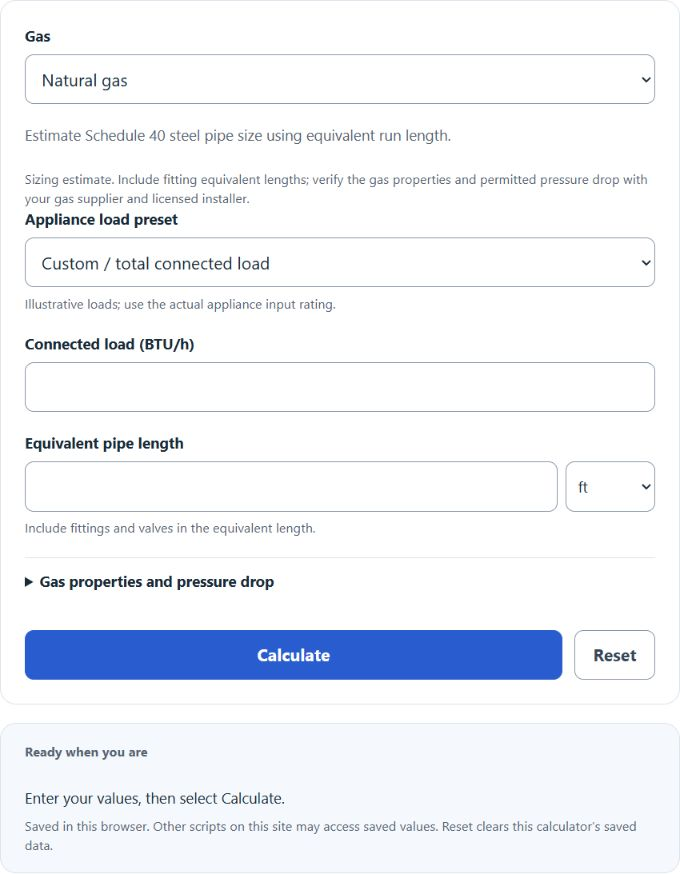
Estimate Schedule 40 steel gas pipe size for natural gas or propane from BTU load and equivalent pipe length in feet or meters. Confirm supply properties and permitted pressure drop with a qualified installer.
- All Construction Calculators
- Surface Area of a Pipe Calculator
- Pipe Pressure Rating Calculator
- GPM to Pipe Size Calculator
- CCF to Therms Calculator
- Gas Cylinder Consumption Calculator
Gas Piping Size Formula
The calculator estimates Schedule 40 steel gas pipe size using the low-pressure Spitzglass relation. It converts the appliance load to standard cubic feet per hour and selects the smallest supported nominal size with estimated capacity at least equal to the load for the entered equivalent length.
- CFH = required gas flow in cubic feet per hour
- BTU/hr = total connected appliance load
- HV = heat value of the gas; nominal defaults are 1,000 BTU/standard ft³ for natural gas and 2,516 for propane. Enter the supplier value when different
- Q = pipe capacity in cubic feet per hour
- D = inside diameter of the pipe in inches
- ΔP = allowed pressure drop in inches water column; blank uses 0.5 as a model assumption, not a universal design allowance
- L = equivalent pipe length in feet, including fitting and valve allowances
- SG = specific gravity of the gas relative to air; nominal defaults are 0.60 for natural gas and 1.52 for propane, and can be changed to supplier values
For natural gas, the calculator uses a lower heat value per cubic foot, so the same BTU/hr load requires more cubic feet per hour. For propane, the higher heat value means the same BTU/hr load needs fewer cubic feet per hour, but the gas also has a higher specific gravity. If you enter the run length in meters, it is converted to feet before sizing. The equation uses the entered positive equivalent length without rounding or a 10-foot floor. It is an engineering estimate, not a direct lookup in current code tables.
Typical Appliance Loads and Gas Sizing Inputs
The listed appliance loads are illustrative assumptions, not manufacturer ratings. The nameplate rating on the actual appliance is the value to use when it is available.
| Appliance | Illustrative Load | Sizing Note |
|---|---|---|
| Gas fireplace | 30,000 BTU/hr | Often a small branch load |
| Clothes dryer | 35,000 BTU/hr | Use the dryer nameplate if different |
| Storage water heater | 40,000 BTU/hr | Common residential input |
| Cooking range | 65,000 BTU/hr | Total input can vary by model |
| Mid-size furnace | 80,000 BTU/hr | Use input rating, not output rating |
| Tankless water heater | 199,000 BTU/hr | Often requires a larger gas line |
| Gas Type | Nominal Heat Value | Nominal Specific Gravity |
|---|---|---|
| Natural gas | 1,000 BTU/ft³ | 0.60 |
| Propane, LP | 2,516 BTU/ft³ | 1.52 |
Example Gas Pipe Size Calculations
Example 1: Natural gas furnace
You have an 80,000 BTU/hr natural gas furnace and a 40 ft equivalent run.
The calculator checks each Schedule 40 pipe size at 40 ft using natural gas specific gravity. The model estimate is the smallest supported pipe with capacity at or above 80 CFH.
Example 2: Propane tankless water heater
You have a 199,000 BTU/hr propane tankless water heater and a 60 ft equivalent run.
The calculator checks the propane capacity for each standard pipe size at 60 ft and selects the first size that meets or exceeds 79.1 CFH.
FAQ
Should I enter the total appliance load or only one appliance?
Enter the load that the pipe section must carry. For a branch serving one appliance, enter that appliance’s BTU/hr input. For a main section feeding several appliances, add the BTU/hr inputs of the appliances downstream of that section.
What pipe run length should I use?
Enter the equivalent length for the piping section and design method being assessed, including horizontal and vertical piping plus fitting and valve allowances. A longest-length code method may require the farthest outlet length for every section; confirm the applicable method with your installer.
Can this replace a code-approved gas piping design?
No. Gas piping must be installed and sized according to the applicable fuel gas code, utility requirements, appliance instructions, pressure system, material, and fittings. Use the result as a sizing estimate, then confirm it with a licensed gas fitter or the authority having jurisdiction.