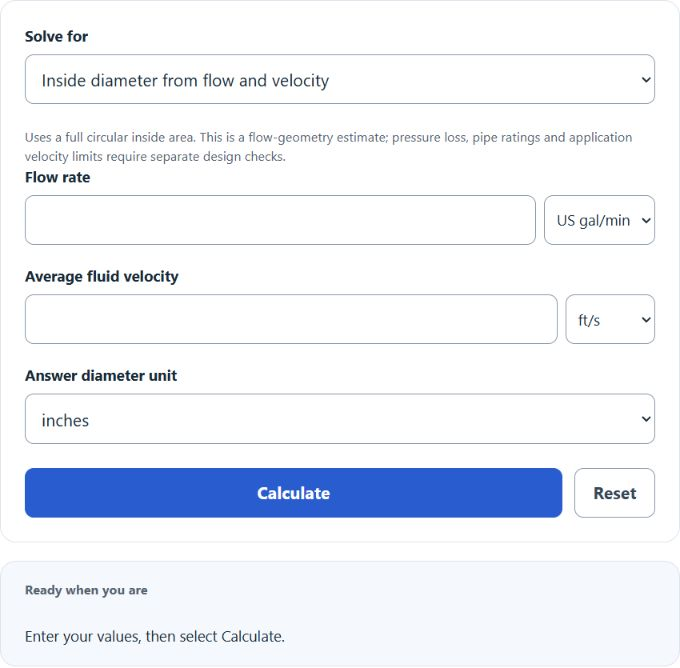
Calculate pipe inside diameter from flow and velocity, reverse-solve capacity or speed, convert units, and screen a Schedule 40 PVC nominal candidate plus flow sensitivity.
- All Unit Converters
- Thermodynamics and Fluid Unit Converters
- Pipe Flow Calculator
- Pipe Volume Calculator
- TFA – Total Flow Area Calculator
- lb/hr to GPM Calculator
- GPM To Precipitation Rate Calculator
GPM to Pipe Size Formula
The following formula is used to convert GPM to pipe size, in this case, a diameter.
- Where D is the diameter of the pipe (ft)
- GPM is the flow rate through the pipe (US liquid gallons per minute)
- V is the velocity of the flow (ft/minute)
To calculate pipe size, divide the US GPM by 1728/231 (about 7.48052), then by the velocity in ft/min and by pi. Multiply this result by 4, then take the square root.
| Flow Rate (GPM) | Velocity (ft/s) | Pipe Diameter (in) | Pipe Diameter (mm) |
|---|---|---|---|
| 0.5 | 5 | 0.202 | 5.134 |
| 1 | 5 | 0.286 | 7.260 |
| 2 | 5 | 0.404 | 10.267 |
| 3 | 5 | 0.495 | 12.575 |
| 4 | 5 | 0.572 | 14.520 |
| 5 | 5 | 0.639 | 16.234 |
| 7.5 | 5 | 0.783 | 19.883 |
| 10 | 5 | 0.904 | 22.959 |
| 15 | 5 | 1.107 | 28.118 |
| 20 | 5 | 1.278 | 32.468 |
| 25 | 5 | 1.429 | 36.301 |
| 30 | 5 | 1.566 | 39.765 |
| 40 | 5 | 1.808 | 45.917 |
| 50 | 5 | 2.021 | 51.337 |
| 60 | 5 | 2.214 | 56.237 |
| 75 | 5 | 2.475 | 62.874 |
| 80 | 5 | 2.557 | 64.936 |
| 100 | 5 | 2.858 | 72.601 |
| 150 | 5 | 3.501 | 88.918 |
| 200 | 5 | 4.042 | 102.674 |
| * Rounded to 3 decimals. D(in) = √((77/(60π)) × Q/V) ≈ 0.639138 × √(Q/V), with Q in US GPM and V in ft/s. 1 inch = 25.4 mm. | |||
GPM to Pipe Size Definition
Converting a GPM to pipe size is done using the formula Q=V*A, where Q is the volumetric flow rate (GPM), V is the velocity, and A is the cross-sectional area.
In this case, we know Q and V, but not the area (aka pipe size). Solving for the area we get a formula of A= Q/V. Substituting area with the formula for the area of a circle and solving for D we get the formula above.
Example Problem
How to calculate Pipe Size from GPM?
First, determine the volumetric flow rate of the fluid through the pipe. In this case, we want the flow rate to be in gallons per minute. After measuring we determine the flow rate to be 40 gallons per minute.
Next, convert 40 US gallons/minute to cubic feet/minute using 231/1728 ft³ per US gallon.
= 40 × 231/1728 ≈ 5.34722 ft³/min
Next, determine the linear velocity of the fluid. Measuring the flow yields a velocity of 4 ft/min.
Finally, calculate the pipe diameter using the formula above:
D = √(4 × 5.34722 / (4 × π)) ≈ 1.30463 ft
= 15.6556 in (about 397.65 mm)
Similarly, the cross-sectional area can be calculated as:
A = Q/V
= 5.34722/4
= 1.33681 ft²