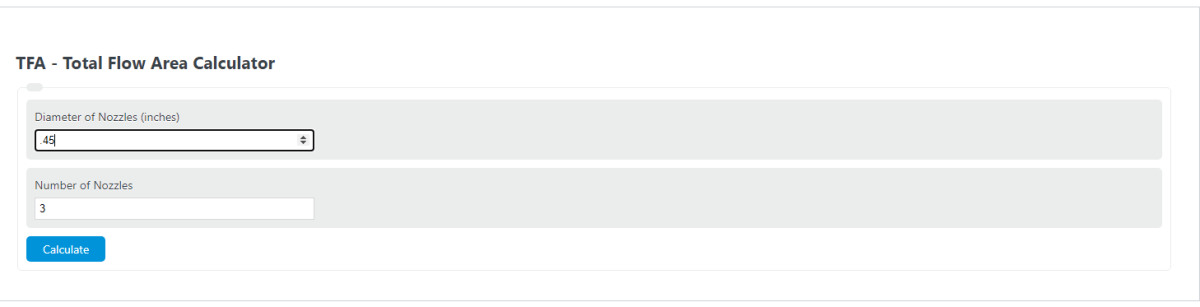
Calculate drilling bit total flow area from multiple nozzle sizes, or determine equal nozzle diameter from target TFA, in 32nds, inches, millimeters, square inches, and square millimeters.
- All Physics Calculators
- Hose Flow Rate Calculator
- Flow Rate Pressure Calculator
- Water Flow Rate Calculator
- Volumetric Flow Rate Calculator
- Manning’s Flow Calculator
- EMW (Equivalent Mud Weight) Calculator
- Nozzle Pressure Calculator
TFA Formula
The following formula is used to calculate the total flow area (TFA) of a downhole drilling tool when all nozzles have the same diameter.
- Where TFA is the total flow area (area units, e.g., in² or m²)
- D is the diameter of each nozzle (length units, e.g., inches or meters)
- n is the number of nozzles
To calculate total flow area (for identical nozzles), square the diameter, multiply by π/4, then multiply by the number of nozzles. If the tool has different nozzle diameters, compute each nozzle’s area and sum them.
Often for downhole drilling tools, nozzle diameters are expressed in 32nds of an inch (e.g., 10/32). In this scenario (with identical nozzles), the formula can be written as:
- Where S is the nozzle size number in 32nds of an inch (so S = 10 for 10/32 in)
- n is the number of nozzles (all the same size)
TFA Definition
What is TFA?
TFA stands for total flow area. It's a term used to describe the total area of one or more openings on a device that fluid is designed to flow through. This is a common term in downhole drilling tools but can also be applied to any nozzle.
Example Problem
How to calculate TFA?
First, determine the diameter of the nozzle. For this example, the diameter of the nozzle is found to be .45 inches.
Next, determine the number of nozzles per tool. In this case, there are a standard 3 nozzles per tool.
Finally, calculate the TFA using the formula above:
TFA = (π * D^2) / 4 * n
TFA = (3.14159 * .45^2) / 4 * 3
TFA = .4771 in^2