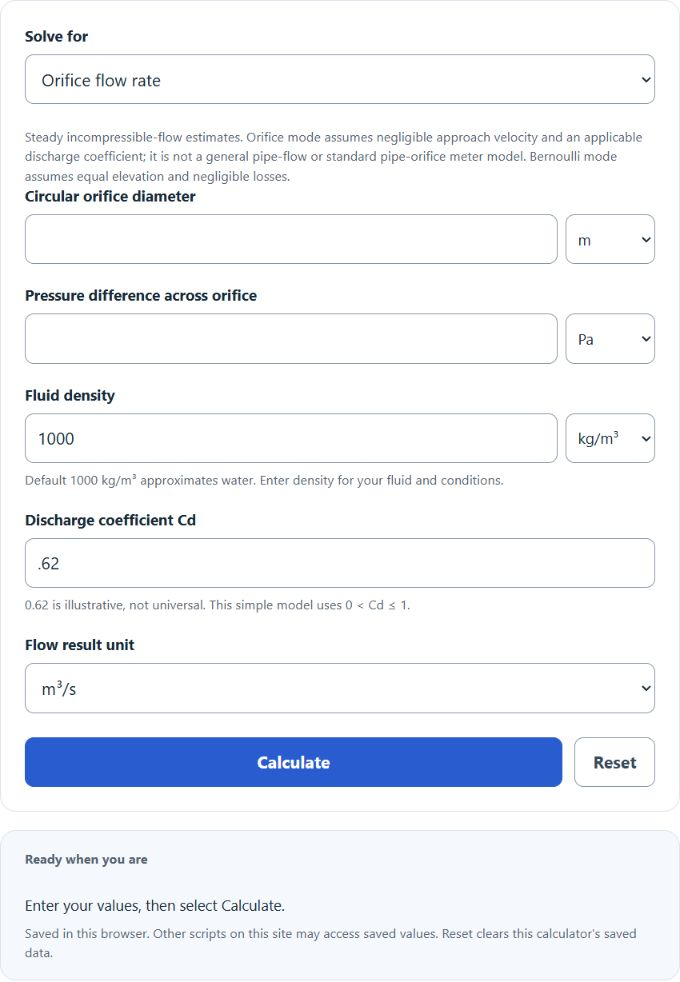
Choose simplified orifice flow, orifice pressure difference, or Bernoulli final static pressure. The orifice modes use circular opening area, density and an entered discharge coefficient with negligible approach velocity. Bernoulli mode uses initial pressure and two speeds for steady, incompressible, same-elevation flow with negligible losses. These are separate models, not a complete pipe-system calculation.
- All Physics Calculators
- Water Flow Rate Calculator
- Pipe Flow Calculator
- Volumetric Flow Rate Calculator
- Weir Flow Calculator
- TFA – Total Flow Area Calculator
- Pitot Tube Calculator
Flow Rate Pressure Formula
For the simple orifice model, A = pi*d^2/4, Q = Cd*A*sqrt(2*DeltaP/rho), and DeltaP = rho/2*[Q/(Cd*A)]^2. Use SI units internally. Cd is dimensionless and must match the geometry and conditions; 0.62 is only an illustrative default. Approach velocity, pipe diameter-ratio correction, friction, gas choking and cavitation are not modeled. See the US Bureau of Reclamation orifice calibration discussion.
Separate Bernoulli pressure model
The following formula is used only in Bernoulli final pressure mode, with initial and final pressures on the same reference. It assumes steady, constant-density flow along a streamline with equal elevation, negligible losses and no pump/turbine work. See NASA’s Bernoulli explanation. Negative gauge pressure can be valid; negative absolute pressure indicates invalid conditions for this model.
- Where P2 is the final (static) pressure
- P1 is the initial (static) pressure
- v2 is the final velocity
- v1 is the initial velocity
- ρ is the fluid density
Flow Rate Pressure Definition
“Flow rate pressure” is not a standard standalone term in fluid mechanics. In this context, it refers to the pressure change associated with a change in flow speed (the dynamic-pressure term in Bernoulli’s equation) for steady, incompressible flow. Real systems may also have additional pressure losses due to friction, fittings, and elevation change.
Flow Rate Pressure Example
How to calculate flow rate pressure?
- First, determine the initial pressure.
Calculate or measure the initial/inlet pressure.
- Next, measure the initial and final velocities.
Calculate or measure the velocities at the start and end of the fluid flow.
- Next, calculate the density.
Determine the density of the fluid.
- Finally, calculate the final pressure.
Calculate the final pressure using the equation above (assuming negligible elevation change and losses).
FAQ
In many practical uses, this refers to a pressure difference associated with fluid motion (often the dynamic-pressure term in Bernoulli’s equation). It is not a formal single defined quantity by itself and may also include friction and elevation effects in real piping systems.