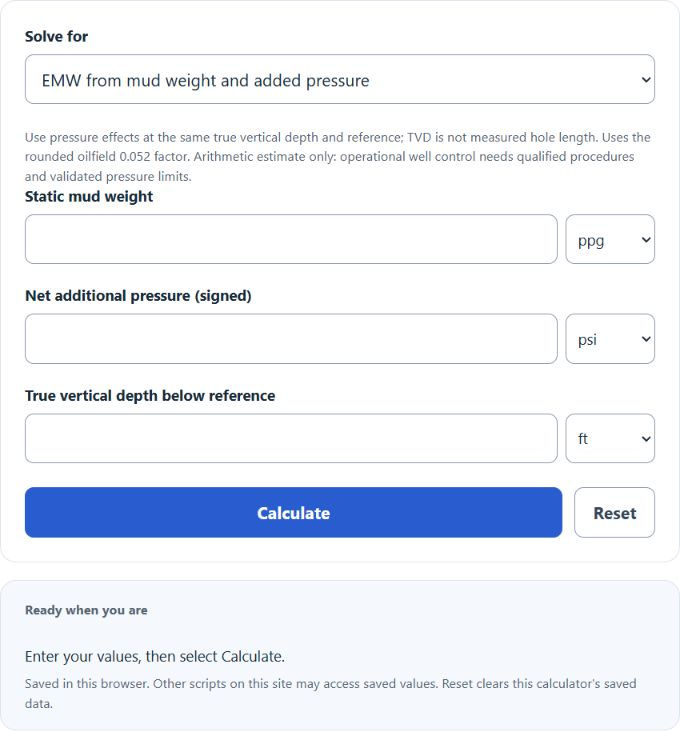
Calculate equivalent mud weight from mud weight, circulating effect, and other pressure effects, or solve pressure and TVD from EMW for drilling wells.
- All Construction Calculators
- TFA (Total Flow Area) Calculator
- Well Volume Calculator
- Annular Pressure Loss Calculator
- Casing Capacity & Annular Volume Calculator
- Bit Pressure Loss Calculator
- Nozzle Pressure Calculator
EMW Formula
The following component form can be used when each effect is expressed as an equivalent mud-weight contribution (at the same depth).
- Where EMW is the equivalent mud weight (the mud weight that would create the same pressure at a given true vertical depth)
- MW is the static mud weight
- ΔECD is the increase due to circulating pressure losses expressed as an equivalent mud-weight increase (ΔECD = ECD − MW)
- ΔAOPE is the sum of any other pressure effects expressed as an equivalent mud-weight increase (for example surge/swab or applied backpressure)
To calculate EMW from components, add the static mud weight (MW) plus the circulating contribution (ΔECD) plus any other contributions (ΔAOPE), with all terms expressed in the same mud-weight units (ppg, kg/m³, or g/cm³). If you instead know the total pressure P above the chosen reference at depth TVD, use EMW (ppg) = P (psi) / (0.052 × TVD (ft)); do not add MW again. For a net additional pressure ΔP, use EMW = MW + ΔP / (0.052 × TVD). The inverse modes use ΔP = (EMW − MW) × 0.052 × TVD or TVD = ΔP / [0.052 × (EMW − MW)], requiring a positive, finite depth. The factor 0.052 is the conventional rounded field factor. Use consistent reference pressures and true vertical depth, not measured hole length. This is arithmetic support, not an operational well-control determination.
What is EMW?
Definition:
EMW, short for equivalent mud weight, is the equivalent fluid density (mud weight) that would produce a specified pressure at a specified true vertical depth. It is commonly used to express bottomhole pressure effects (such as circulating friction losses, surge/swab, or applied surface backpressure) in mud-weight units.
How to calculate EMW?
Example Problem:
The following example outlines how to calculate EMW using the component form above.
First, determine the static mud weight. For this example, the static mud weight is 9.2 ppg.
Next, determine the circulating contribution expressed as an equivalent mud-weight increase (ΔECD = ECD − MW). In this case, ΔECD is 0.8 ppg.
Next, determine any other pressure effects expressed as an equivalent mud-weight increase (ΔAOPE). For this example, ΔAOPE is 0.3 ppg.
Finally, calculate the EMW using the formula above:
EMW = MW + ΔECD + ΔAOPE
EMW = 9.2 + 0.8 + 0.3
EMW = 10.3 ppg