Calculate water volume in a cylindrical well from casing diameter, total depth, and static water level, or solve for water height or diameter.
- All Construction Calculators
- Active Wet Well Volume Calculator
- Liquid Volume Calculator
- Water Displacement Calculator
- Wellhead Pressure Calculator
- Pipe Volume Calculator
- Water Volume Calculator
Well Volume Formula
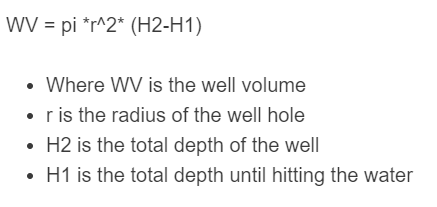
The water stored in a cylindrical well is found by multiplying the well’s cross-sectional area by the height of the water column. This calculator uses the portion of the well that actually contains water, not the entire drilled depth.
If you know the diameter instead of the radius, use the equivalent form below.
| Symbol | Meaning |
|---|---|
| WV | Water-filled volume of the well |
| r | Inside radius of the well |
| d | Inside diameter of the well |
| D_t | Total depth from the top of the well to the bottom |
| D_w | Depth from the top of the well down to the water level |
What This Calculator Measures
For most practical purposes, well volume means the volume of standing water inside the well casing or bore. That water column height is the distance from the water surface to the bottom of the well.
If you want the entire cylindrical interior volume of the well, regardless of where the water level sits, use the full-depth form below.
In water storage, drawdown, and recovery discussions, the more useful value is usually the water-filled volume WV.
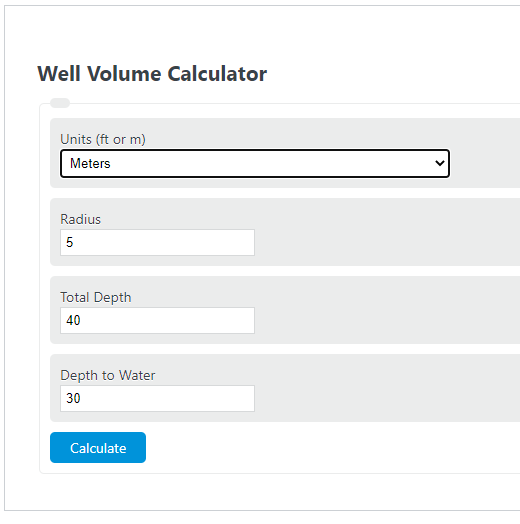
How to Use the Well Volume Calculator
- Measure the inside radius of the well. If only the diameter is known, convert it first.
- Enter the total well depth from the top opening to the bottom.
- Enter the depth to water from the same top reference point down to the static water level.
- Keep all length measurements in the same unit system.
- Read the result as well volume in cubic units and liters.
The most common input error is mixing units, such as entering radius in feet and depth in meters. The calculator is only accurate when every length uses the same base unit.
Unit Conversion Notes
The calculator can also express volume in liters, which is often easier to interpret for water storage and pumping estimates.
If your measurements are in feet, inches, or centimeters, the raw volume will first be produced in the matching cubic unit. Converting that result to liters makes it easier to compare with tank capacities, daily water use, or pump output.
Example Calculation
Suppose a well has a diameter of 10 ft, a total depth of 40 ft, and the water level begins 30 ft below the top.
This means the well contains about 785.4 cubic feet of standing water, or roughly 22,238.5 liters, before accounting for pumping drawdown or recharge.
Common Mistakes to Avoid
- Using diameter as radius: if the opening is 10 ft across, the radius is 5 ft, not 10 ft.
- Using inconsistent units: radius, total depth, and depth to water must all use the same unit.
- Measuring from different reference points: both depth values should start from the same top point.
- Ignoring casing dimensions: for better accuracy, use the inside radius where the water actually sits.
- Confusing stored volume with well yield: volume is how much water is standing in the well, while yield is how fast the well can supply water over time.
Assumptions and Limitations
- The formula assumes the well is cylindrical with a nearly constant radius.
- It estimates static stored water volume, not sustainable pumping rate.
- If the water level changes during pumping, the actual available volume changes too.
- If D_w is greater than or equal to D_t, there is no standing water volume to calculate.
When Well Volume Is Useful
- Estimating how much water is standing in a drilled well
- Planning pump tests and recovery observations
- Sizing treatment chemicals based on water volume
- Comparing stored water with household, irrigation, or livestock demand
- Checking whether a casing size change materially affects stored capacity