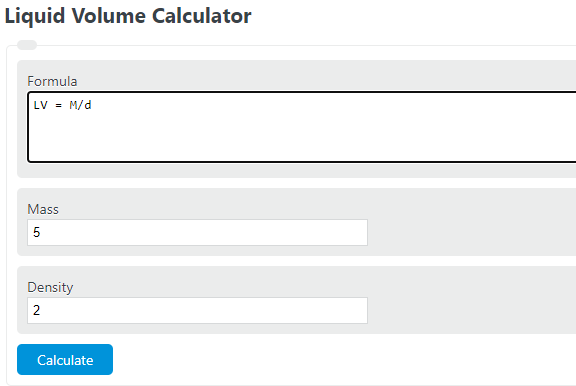
Calculate liquid volume for rectangular tanks, cylinders, and spheres from dimensions, with results in liters, US gal, UK gal, m³, and ft³.
- All Unit Converters
- All Volume Calculators
- Volume Ratio Calculator
- Volumetric Flow Rate Calculator
- Molar Volume Calculator
- Detention Time Calculator
- Column Volume Calculator
- Inlet Capacity Calculator
Liquid Volume Formula
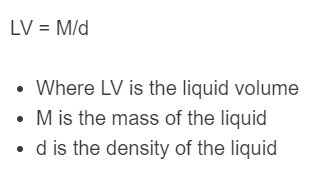
The following is the liquid volume formula:
- Where LV is the liquid volume
- M is the mass of the liquid
- d is the density of the liquid
To calculate a liquid volume, divide the mass of the liquid by the density of the liquid.
Liquid Volume Definition
A liquid volume is simply defined as the total volume of any liquid or combination of liquids.
Can you measure liquid volume?
One way to measure liquid volume is to pour the liquid into a graduated container and read the volume marking at eye level. If you are using a straight-sided container with a constant cross-sectional area (for example, a cylinder or rectangular prism), you can also calculate volume from the measured fill height (volume = cross-sectional area × height). For containers with changing cross-section (tapered or curved shapes), volume is not proportional to height, so you typically need the container’s calibration marks or a volume-vs-height chart.
Do liquids change volume?
Liquids like water are often treated as nearly incompressible, meaning their volume changes only slightly with pressure under everyday conditions. However, liquids do change volume with temperature (thermal expansion), and they compress slightly as pressure increases.
Does liquid have volume?
Yes, liquids have volume. In practice, accurately measuring the volume of a liquid is easiest when it is collected in (or flows through) a container with known dimensions or volume markings. Another way to determine volume is by using the mass–density relationship shown in the formula above.
Is liquid volume the same as capacity?
Liquid volume can be the same as capacity only if the capacity is defined such that the liquid volume at 100% of the container is specified as the capacity.
Why should liquid volumes be read at eye level?
Liquids form a meniscus due to surface tension (adhesion and cohesion). Reading at eye level helps avoid parallax error and ensures you read the correct part of the meniscus (typically the bottom of the meniscus for water and many liquids, and the top of the meniscus for mercury).
What tool measures liquid volume?
The most common lab tool used to measure liquid volumes is a graduated cylinder. These are containers marked with volume graduations so you can read the volume after a liquid is poured in.
How to calculate liquid volume?
- First, determine the total mass of the liquid using a scale (tare/zero the container, then weigh the liquid).
- Next, determine the density of the liquid (from a reference table or measurement). For example, the density of water at about 20 °C is approximately 998 kg/m3 (0.998 kg/L).
- Finally, calculate the liquid volume using the formula LV = M/d.