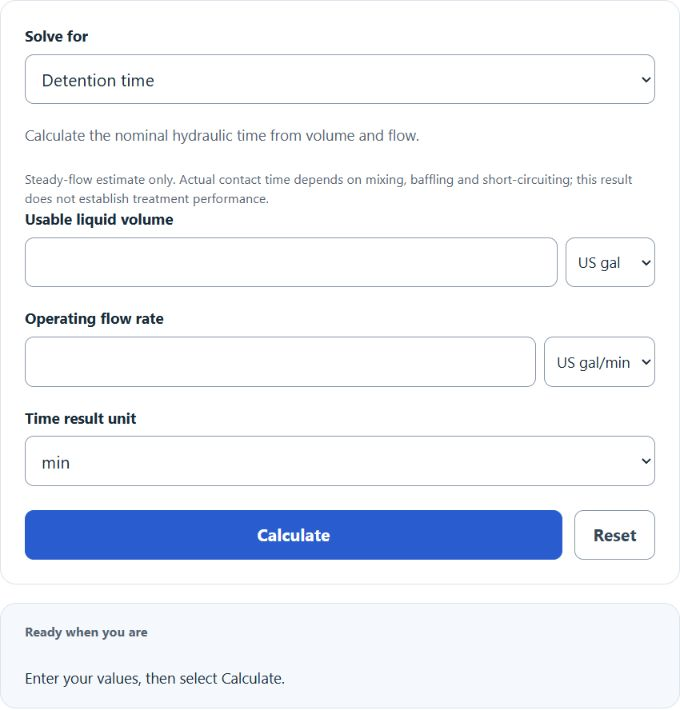
Select detention time, flow rate or liquid volume, then enter the other two quantities. Units include US gallons, liters, cubic meters and cubic feet, with time results in minutes, hours or seconds.
Detention Time Formula
The detention time calculator uses the relationship between volume, flow rate, and time. It estimates nominal detention time for steady flow using usable liquid volume. Internally, volume is in liters, flow is in liters per minute and time is in minutes.
- DT = detention time
- V = tank, basin, or vessel volume
- Q = flow rate through the tank, basin, or vessel
If you are solving for volume, the formula is rearranged as:
If you are solving for flow rate, the formula is rearranged as:
Select the quantity to solve for and enter the two displayed inputs:
- To calculate detention time: enter volume and flow rate. The calculator divides volume by flow rate.
- To calculate volume: enter flow rate and detention time. The calculator multiplies flow rate by detention time.
- To calculate flow rate: enter volume and detention time. The calculator divides volume by detention time.
The calculator converts inputs to liters, liters per minute and minutes, performs the calculation, then converts the result to your selected output unit. All gallon units are US liquid gallons.
Common Unit Conversions for Detention Time Calculations
| Measurement | Unit | Approximate US-Gallon Equivalent |
|---|---|---|
| Volume | 1 liter | 0.264172 gallons |
| Volume | 1 cubic meter | 264.172 gallons |
| Volume | 1 cubic foot | 7.48052 gallons |
| Flow rate | 1 liter per minute | 0.264172 gallons per minute |
| Flow rate | 1 cubic meter per hour | 4.40288 gallons per minute |
| Time | 1 hour | 60 minutes |
Typical Detention Time Interpretations
| Result | What It Means |
|---|---|
| Short detention time | Fluid passes through the tank quickly. This may reduce contact, settling, or reaction time. |
| Long detention time | Fluid remains in the tank longer. This may improve contact time, settling, or treatment, depending on the process. |
| Zero or near-zero flow | The formula becomes invalid or produces an extremely large detention time. Use the actual operating flow rate. |
Example Detention Time Calculations
Example 1: Calculate detention time
You have a 5,000 gallon tank and a flow rate of 250 gallons per minute.
The detention time is 20 minutes.
Example 2: Calculate required volume
You need a detention time of 45 minutes at a flow rate of 80 gallons per minute.
The required volume is 3,600 gallons.
FAQ
What is detention time?
Detention time is the estimated amount of time water or another fluid remains inside a tank, basin, or vessel. It is calculated by dividing the volume by the flow rate. For example, if a tank holds 1,000 gallons and the flow rate is 100 gallons per minute, the detention time is 10 minutes.
Is detention time the same as contact time?
They are related, but not always identical. Detention time is a simple hydraulic estimate based on volume and flow. Contact time may account for actual mixing, short-circuiting, baffling, or process-specific efficiency. In practical treatment systems, the effective contact time can be less than the theoretical detention time.
Why does each mode require two values?
The formula has three variables: volume, flow rate and detention time. Select the quantity you want to calculate, then enter the other two positive values. The calculated quantity is displayed in the results area.