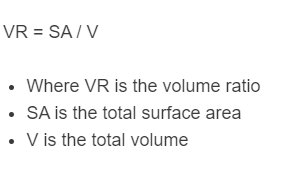
Calculate a surface-area-to-volume ratio from values or shape dimensions, or find the ratio of two volumes entered in cm³, mL, L or gallons.
- All Math and Numbers Calculators
- All Volume Calculators
- Percent Volume Calculator
- Mass to Volume Calculator
- Specific Volume Calculator
Calculator Functions
| Function | What it does | What it requires |
|---|---|---|
| Surface-area-to-volume ratio | Finds the surface-area-to-volume ratio (SA/V) from a known area and volume | Requires the total surface area, the volume and the result length unit |
| Ratio from shape dimensions | Finds the SA/V of a sphere, cube, closed cylinder or rectangular prism | Requires the shape and its dimensions: a radius, an edge, a radius and height, or a length, width and height |
| Shape size for target ratio | Finds the size of a shape that has a chosen SA/V | Requires the shape and the target SA/V. A cylinder also requires its height ÷ radius, and a rectangular prism its width ÷ length and height ÷ length |
| Ratio of two volumes | Finds how many times larger one volume is than another | Requires volume A and volume B, each in cm³, m³, in³, ft³, mL, L or US gallons |
The three surface-area functions show results in the chosen length unit: cm, m, in or ft. They also list the surface area, the volume, volume ÷ surface area, and how the solid compares with a sphere of the same volume.
Volume Ratio Formulas
| SA/V | Surface-area-to-volume ratio, in inverse length such as 1/cm |
| A | Total surface area of the closed solid |
| V | Enclosed volume |
Volume ratio has two meanings, and the calculator covers both. The first three functions give surface area divided by volume. Ratio of two volumes compares one volume with another and has no unit.
Surface-area-to-volume ratio
A solid with 24 cm² of surface and 8 cm³ of volume has SA/V = 24 ÷ 8 = 3 per cm. The area and volume must use matching units, which the calculator handles. It rejects an area smaller than that of a sphere with the same volume, because no closed solid can have less.
Ratio from shape dimensions
| Shape | Surface area | Volume | SA/V |
|---|---|---|---|
| Sphere [1] | 4πr² | 4πr³/3 | 3/r |
| Cube [2] | 6e² | e³ | 6/e |
| Closed cylinder [3] | 2πr(r + h) | πr²h | 2/r + 2/h |
| Rectangular prism [4] | 2(LW + LH + WH) | LWH | 2/L + 2/W + 2/H |
Here r is the radius, e the edge, h the height, and L, W and H the length, width and height. A cube with a 2 cm edge has 6 × 2² = 24 cm² of surface and 2³ = 8 cm³ of volume, so SA/V = 3 per cm. Doubling the edge to 4 cm halves the ratio to 1.5 per cm: a larger solid of the same shape always has a smaller SA/V. The cylinder includes both end caps.
Shape size for target ratio
The SA/V column is solved for the size. With R as the target ratio, a sphere has r = 3/R and a cube has e = 6/R. A sphere with SA/V = 1.5 per cm has a radius of 3 ÷ 1.5 = 2 cm.
A cylinder needs its proportion a = height ÷ radius, and its height is then a × r. With a = 2 and R = 3 per cm, r = (2 + 1) ÷ 3 = 1 cm and h = 2 cm.
A rectangular prism needs b = width ÷ length and c = height ÷ length. Its width is b × L and its height is c × L.
Ratio of two volumes
Both volumes are converted to the same unit first. A 64 cm³ solid and an 8 cm³ solid are in the ratio 64 ÷ 8 = 8 : 1. For two solids of the same shape, the ratio of their lengths is the cube root of the volume ratio, here 2 : 1. A cube with twice the edge of another has 2³ = 8 times the volume.
Limits of This Estimate
- The shapes are closed solids. Open tubes, hollow shells and wall thickness are not modeled.
- SA/V has a unit. A ratio of 3 per cm is 300 per m, so two ratios can only be compared in the same length unit.
- A target ratio fixes the size of a cylinder or prism only once its proportions are given. Different proportions give different sizes for the same ratio.
Sources
- Wolfram MathWorld, Sphere: surface area and volume of a sphere
- Wolfram MathWorld, Cube: surface area and volume of a cube
- Wolfram MathWorld, Cylinder: total surface area and volume of a closed cylinder
- Wolfram MathWorld, Cuboid: surface area and volume of a rectangular prism